
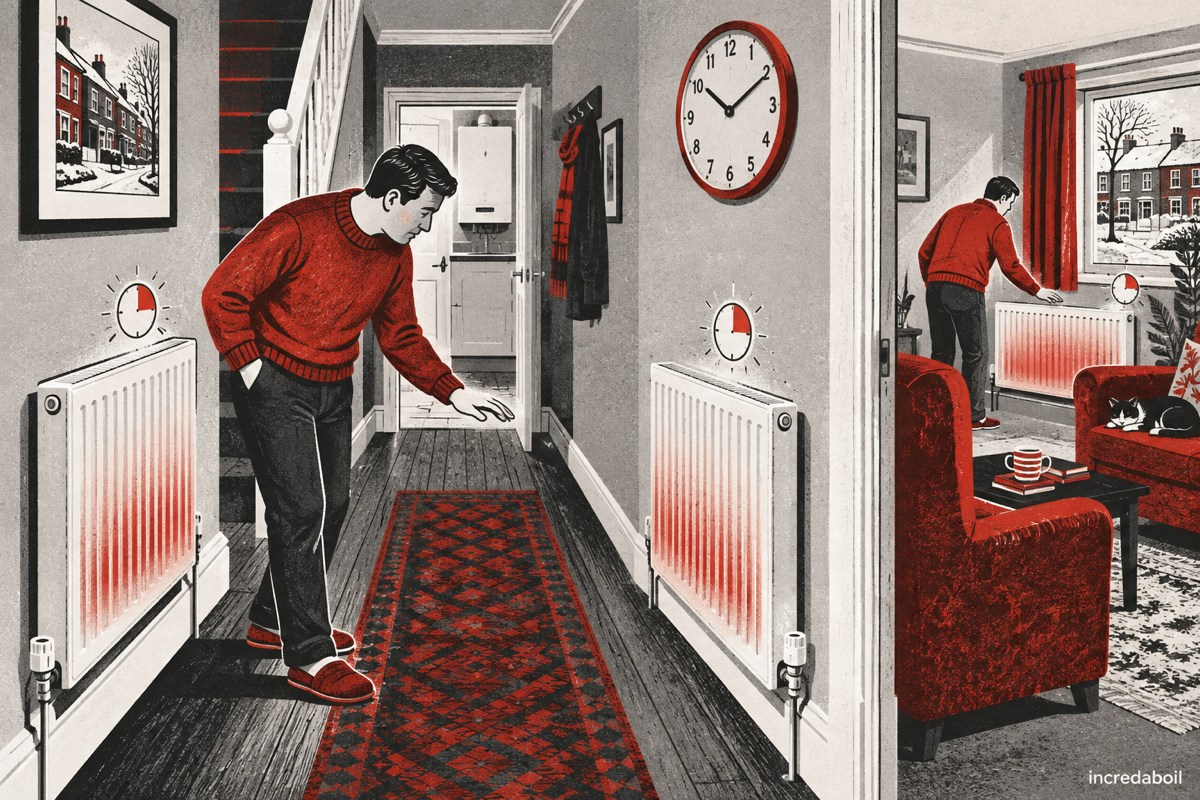
Why are all my radiators heating slowly?
Radiators do not become fully hot the instant the boiler starts, but a clear change in how long every room takes to warm deserves investigation. When all radiators are slow, start with the system-wide clues: controls, boiler flow temperature, pressure, air, circulation and water condition. A single slow radiator points more strongly towards that radiator’s valves or local flow.
A slow warm-up does not automatically mean the system needs a powerflush or a new boiler. The temperature pattern across the radiators and the order in which they warm can narrow the possibilities without dismantling anything.
How long should radiators take to heat?
There is no universal time. It depends on the boiler, starting temperature, radiator size, pipe layout, controls, insulation and weather. A low-temperature heating setup will generally warm radiators more gradually than a high-flow-temperature system, yet it may still heat the home properly over a longer planned period.
Use your own system as the baseline. If it has always taken time but eventually reaches the thermostat setting, that may be normal for its design. If every radiator previously warmed much faster, or the boiler runs for hours without reaching the target, look for what changed.
Start by checking the controls
Make sure the programmer is in a normal heating period and the room thermostat is set above the current room temperature. Open ordinary thermostatic radiator valves to their usual occupied-room settings. A thermostat near a fast-warming radiator, sunny window or other heat source can end demand before the rest of the house catches up.
Energy Saving Trust explains that the boiler flow temperature controls how hot the water is before it travels to the radiators. If it is set too low, radiators may not become warm enough to heat the home during cold weather. Do not confuse this with the hot-water tap temperature, and be careful on systems with a hot-water cylinder because one control may serve both.
Check the boiler display and pressure
Confirm that the boiler is actually in heating mode and has no fault code. Photograph the full display and use the exact manual to interpret it. A burner that starts and stops repeatedly may not be delivering sustained heat to the circuit, but the sound alone cannot reveal why.
Check pressure when the system is cool and compare it with the model’s operating instructions. Low pressure can reduce heating performance or stop operation. Do not rely on one universal number, although many sealed systems commonly sit around 1 to 1.5 bar when cold. If pressure falls again after a correct top-up, arrange an inspection rather than repeatedly refilling.
Read the temperature pattern
Cold at the top, warmer below
This commonly indicates trapped air. Air prevents water filling the top of the radiator and may cause bubbling. Bleed only the affected radiators with the heating off and cool, then check pressure again before restarting. Follow your boiler’s user instructions.
Warm at the top, cold at the bottom
Worcester Bosch and Baxi associate this pattern with sludge or debris restricting circulation. It is evidence of poor water condition, not proof that a particular cleaning method is needed. An engineer should assess the system before recommending a chemical clean or powerflush.
Warm near one valve but cool elsewhere
This can point to restricted flow through the radiator, a valve issue or system imbalance. Keep the visible thermostat valve at its normal setting, but do not force a seized valve or dismantle it.
Every radiator warms evenly but only gradually
Check flow-temperature settings, schedules and whether the home ultimately reaches its target. If all radiators follow a similar pattern, the system may simply be operating at a lower water temperature. A sudden change still warrants checking pressure, boiler operation and controls.
Could the radiators need balancing?
Balancing adjusts water flow so nearby radiators do not take more than their share while distant ones lag behind. Vaillant lists excessively long heat-up times and large temperature differences between rooms as signs that balancing may be needed. This is most likely when some radiators heat quickly and others remain cooler.
If every radiator is equally slow, imbalance is less conclusive. The boiler may be sending cooler water, system pressure may be low or overall circulation may be restricted. Record which radiator warms first from a completely cold start and how the pattern progresses.
Balancing involves adjustments across the whole system. Although manufacturer guides describe homeowner methods, an engineer is a sensible choice if valves are stiff, unlabelled, leaking or unfamiliar. Do not adjust the pump or internal boiler controls.
Could trapped air affect every radiator?
Yes, particularly after the system has been drained or altered. Vaillant notes that air hinders water circulation and can make radiators slow, partly warm or cold. Gurgling and cold tops support this explanation.
Bleed radiators only when there is evidence of air. Turn the heating off and let them cool, open the bleed screw slowly, and close it when water flows steadily. Never remove the screw. Check boiler pressure afterwards. If air returns repeatedly, an engineer should find why it is entering.
Could sludge be slowing the whole system?
Corrosion products can settle in radiators and pipework. Baxi lists radiators failing to reach temperature, hot flow pipework with a much cooler return and noisy operation among signs associated with sludge. Energy Saving Trust says corrosion, scale and sludge reduce boiler and radiator effectiveness.
These signs can overlap with poor balance, valve problems and low flow temperature. Do not book a flush on one symptom alone. A competent engineer can inspect system water, compare radiator patterns and assess circulation before specifying treatment.
What if the boiler cycles on and off?
Short bursts of burner operation can make the whole system slow to warm. The cause may be normal control behaviour, a temperature setting or a fault that needs diagnosis. Note the length of each run, display symbols and whether pressure changes. Do not repeatedly reset the boiler or alter service settings.
If the burner stays on but the flow pipe becomes hot while radiators remain slow, restricted circulation is more likely than a missing heat demand. Pipework can be hot, so observe carefully without gripping or opening anything.
Simple external checks
- Confirm the heating schedule, thermostat and visible radiator-valve settings.
- Move furniture and long curtains away from radiators so heat can circulate into the room.
- Check the complete boiler display and the cold pressure against the exact manual.
- From a cold start, note which radiators warm first and where each one stays cool.
- Listen for gurgling and check for visible leaks, staining or corrosion around accessible valves.
- Note recent changes such as radiator work, a drained system or a lowered flow-temperature setting.
These checks create a useful pattern. They are not an instruction to open the appliance, drain the system or change internal circulation settings.
What not to do
- Do not remove the boiler casing.
- Do not adjust the circulation pump or installer parameters.
- Do not keep bleeding radiators after water flows without air.
- Do not repeatedly top up pressure that keeps falling.
- Do not force radiator valves or undo pipe connections.
- Do not assume a powerflush is required without a diagnosis.
When to call an engineer
Arrange help if the system no longer reaches the thermostat target, pressure repeatedly drops, the boiler shows a fault, severe noises develop, several radiators have cold bottoms, air keeps returning or visible leaks appear. Also call if all radiators remain slow after settings, pressure and obvious air have been checked.
Give the engineer the boiler model, cold pressure, flow-temperature setting, heating schedule, warm-up order and the temperature pattern on several radiators. Mention recent plumbing work and whether hot water is also affected. This helps separate a control issue from water quality, circulation or boiler performance.
Gas and carbon monoxide safety
If you smell gas or suspect unsafe operation, HSE advises opening doors and windows, turning off the gas at the meter if you know how, and calling the National Gas Emergency Service on 0800 111 999. Avoid switches, flames and sparks.
If a carbon monoxide alarm sounds or anyone develops headache, dizziness, nausea, weakness, confusion, chest pain or shortness of breath, go outside and seek medical advice. The NHS says severe breathing difficulty, sudden confusion, collapse, marked weakness or chest pain requires 999 or A&E.
Frequently asked questions
Should every radiator heat at exactly the same speed?
Not exactly. Pipe length, radiator size and valve settings affect the order. A large difference between rooms can indicate imbalance or restricted flow.
Will bleeding make slow radiators heat faster?
Only when trapped air is part of the problem, usually shown by a cold top or gurgling. A cold bottom points more towards deposits or restricted circulation.
Does slow heating always mean sludge?
No. Settings, low pressure, air, imbalance and boiler cycling can produce similar symptoms. Water condition should be assessed before choosing a cleaning method.
Could a lower flow temperature be the reason?
Yes. Lower-temperature operation can be slower, particularly in cold weather. The home should still reach a comfortable target; adjust only in line with official guidance for your system.
Should I turn the room thermostat much higher?
A room thermostat sets the target temperature; it does not make the boiler heat faster. Set a sensible target and investigate why the system is not reaching it.
Related boiler help
- How to tell if radiators need balancing
- Why are radiators cold at the bottom?
- Why is boiler pressure low after bleeding?
Are all the radiators still taking too long to warm?
Review the repair service details and arrange a professional system check.