
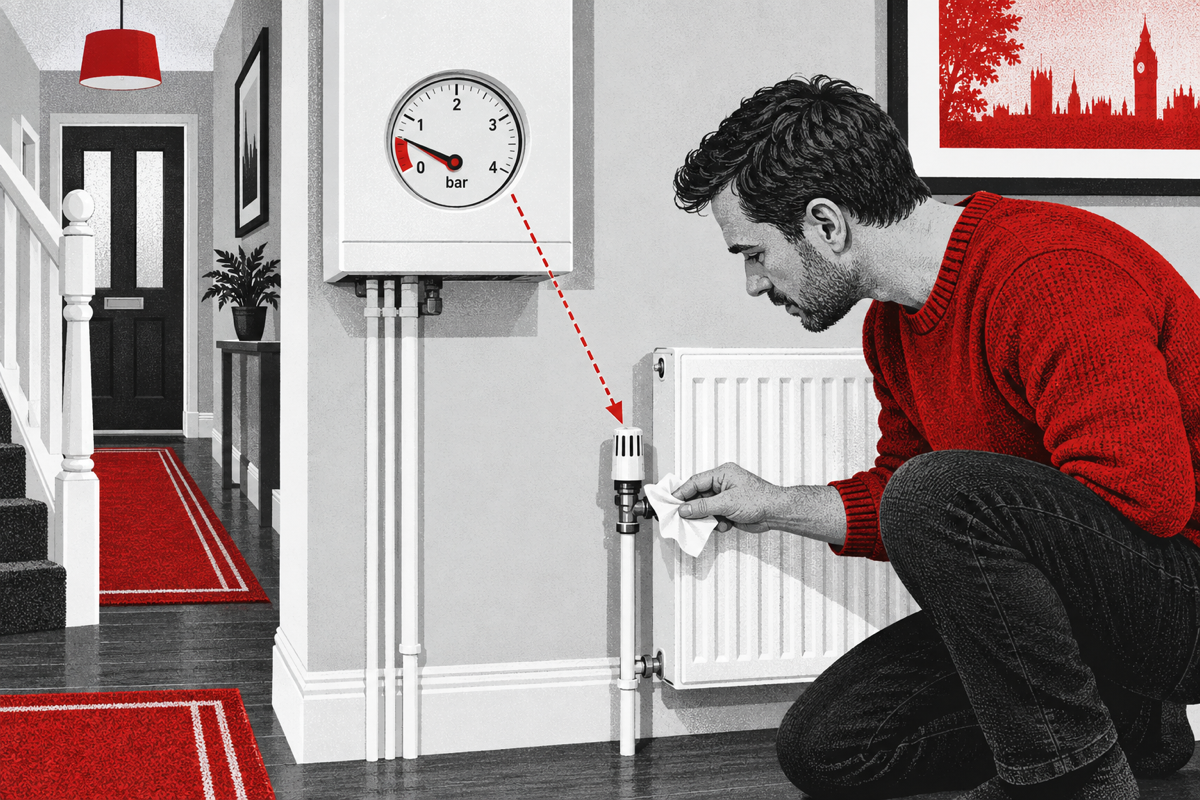
Boiler losing pressure with no visible leak
A sealed heating system should not need frequent topping up. If the gauge keeps falling but there is no puddle, water may still be escaping through a tiny warm leak, concealed pipework, the outside pressure-relief discharge or somewhere inside the boiler. A pressure rise while heating followed by a very low cold reading can also give an engineer an important clue about the expansion vessel and relief valve.
Do not keep refilling the system indefinitely. Record the pressure when fully cool, watch what happens during one normal heating cycle and inspect only accessible, external areas. The pattern is much more useful than a single gauge reading.
What boiler pressure are you measuring?
The gauge on a modern combi or system boiler normally shows the pressure in the sealed central-heating circuit. It does not show the pressure at your kitchen tap. Water circulates between the boiler, radiators and heating pipework; if the cold reading repeatedly falls, either the reading is wrong or conditions within that circuit have changed.
Worcester Bosch says its applicable systems are commonly around 1 to 1.5 bar when cool, while Baxi describes a normal operating range of 1 to 2 bar. These figures are useful context, not a substitute for the manual for your exact boiler. Use its stated cold range.
First establish whether the loss is recurring
Take a photograph of the gauge when the system has been off long enough to cool. Note the date and time. Repeat under similar cold conditions over several days without deliberately altering the pressure. Read an analogue dial straight on rather than at an angle.
A one-off fall after radiators have been bled or plumbing work has been completed is different from a system that loses pressure every day or week. Worcester Bosch says its systems would usually need topping up only once or twice a year; much more frequent repressurising should be investigated.
If the reading never changes at all, even when the heating warms and cools, the gauge itself may need checking. Do not add water merely to see whether the needle moves.
Why a leak may leave no puddle
A micro-leak can evaporate
Baxi advises looking for rust, corrosion or staining around pipes, radiators and valves because a small amount of water can evaporate from warm pipework before it drips onto the floor. Worcester Bosch similarly notes that micro-leaks around radiator valves or air vents may leave only slight discolouration.
Wait until the heating is cool, then inspect accessible valve bodies, bleed points and visible joints. Look for crusting, staining, flaking paint or a mark beneath a radiator. A dry tissue held against the outside of an accessible joint can reveal moisture, but do not tighten, dismantle or force anything.
Pipework may be concealed
Heating pipes can run beneath floors and inside walls. A slow leak may reduce pressure before a damp patch becomes obvious. Unexplained staining, a musty smell, lifting floor finishes or damage to the ceiling below a pipe route deserves prompt investigation.
The absence of those signs does not prove that concealed pipework is sound. Specialist leak detection may be appropriate after an engineer has assessed the boiler and visible system.
Check the outside pressure-relief discharge
A sealed system has a pressure-relief valve, often shortened to PRV, which can discharge water if pressure becomes excessive. Its pipe usually terminates outside. Worcester Bosch specifically recommends checking this outlet when a system keeps losing pressure.
Look from a safe position for fresh water, staining or evidence of repeated dripping. Do not touch the outlet while the boiler is running; discharged water may be hot. Never block, cap or redirect it. If it is wet, tell the engineer when it occurs and what the gauge did beforehand.
A relief valve can pass water because it has operated, because debris prevents it sealing or because another issue made system pressure rise too far. The discharge is a clue, not a complete diagnosis.
Watch the pressure as the heating warms
Pressure normally rises a little as heating water expands. Baxi says the needle may move upwards during heating but should not normally go beyond about 2.5 bar on its applicable boilers. Worcester Bosch says a rise of more than 1 bar from cool to hot can mean the expansion vessel needs professional attention.
Record the fully cold reading, the highest warm reading and the reading after the system cools again. A large rise towards the high-pressure area, followed by discharge outside and a low cold reading, is particularly useful evidence for an engineer.
Do not attempt to test or recharge an expansion vessel. It is an internal service task that depends on the system being safely isolated and depressurised.
Could radiator bleeding explain the drop?
Bleeding releases trapped air and usually a small amount of water. The gauge may fall afterwards, especially if several radiators were bled. If the boiler manual permits homeowner repressurising, the system may need one careful top-up once all radiators are closed and cool.
Repeated air, frequent bleeding and continuing pressure loss are not a normal maintenance cycle. They can indicate a leak, water-quality problem or another fault. Stop repeating the process and arrange diagnosis.
Could the boiler be leaking internally?
Water can sometimes escape within or beneath the appliance without producing a clear puddle. It may evaporate from a hot surface, drain away or appear only under particular operating conditions. Do not remove the casing to look for it.
An engineer may inspect the appliance, pressure-relief route, expansion vessel and heating circuit, then isolate sections if appropriate. Those tests help distinguish an appliance problem from a leak elsewhere; they are not homeowner procedures.
A safe sequence of checks
- Let the system cool and photograph the gauge.
- Compare the reading with the exact boiler manual.
- Note recent radiator bleeding, plumbing work or a refill.
- Inspect accessible radiator valves, bleed points and visible joints for staining or dampness.
- Check around and beneath the boiler without removing its case.
- From a safe position, inspect the outside relief pipe for dripping or staining.
- Record the highest pressure during one normal heating cycle and the later cold reading.
- Arrange diagnosis if the loss continues.
Keep the notes together. The rate of loss—hours, days, weeks or months—helps the engineer plan the investigation.
When is repressurising reasonable?
A one-off top-up can be appropriate after bleeding or when the boiler manual directs it. Follow only the instructions for the exact filling arrangement and stop at the stated cold pressure. Make sure the filling controls are fully closed afterwards.
If you are topping up weekly, daily or more than once in a short period, adding more water is masking the fault. Fresh water also introduces oxygen, which can contribute to corrosion. Arrange a proper check rather than making the filling loop part of the daily routine.
What not to do
- Do not remove the boiler casing.
- Do not open or test the pressure-relief valve.
- Do not recharge an expansion vessel yourself.
- Do not add leak-sealing chemicals without a professional diagnosis.
- Do not keep topping up a system that quickly loses pressure.
- Do not lift flooring or open walls before the boiler and visible system have been assessed.
- Do not ignore damp near electrical equipment or a ceiling that is swelling.
When to call an engineer
Book a heating engineer when the cold pressure repeatedly drops, the boiler locks out, the hot pressure rises sharply, water appears at the external relief pipe, air keeps returning or any damp or corrosion is found. Rapid pressure loss needs prompt attention even if heating still works.
For work inside a gas boiler, use a suitably qualified Gas Safe registered engineer. If the boiler is ruled out and the circuit still loses pressure, a plumber or leak-detection specialist may need to investigate concealed heating pipework.
If you rent your home
Report repeated pressure loss to the landlord or managing agent rather than continually refilling the system. GOV.UK says landlords are normally responsible for heating and hot-water systems. Send photographs of the cold reading, any fault code, damp or staining, and explain how quickly the pressure falls.
Water, gas and carbon monoxide safety
If water is running onto electrics, a ceiling is bulging or a leak is causing damage, switch the heating off with the normal controls if safe, keep clear of the affected area and seek urgent help. Do not work on wet electrical equipment.
Pressure loss alone does not prove a gas or carbon monoxide emergency. If you smell gas or suspect an appliance is unsafe, open doors and windows, avoid flames and electrical switches, turn off gas at the meter if you know how and call the National Gas Emergency Service on 0800 111 999. If a carbon monoxide alarm sounds or anyone feels unwell, go outside and seek medical help.
Frequently asked questions
Can a boiler lose pressure without a leak?
A falling reading can result from water loss, recent bleeding or a faulty reading. Water loss may occur through a tiny, hidden, outside or internal route, so “no visible leak” does not rule it out.
Why does pressure rise when heating is on, then fall very low?
Some rise is normal. A large rise, particularly with relief-pipe discharge and a very low later reading, can point an engineer towards expansion control and the PRV.
How often should I top up?
Manufacturer guidance indicates that frequent topping up is not normal. If you need it much more than occasionally, find the cause.
Should I use leak sealer?
Not as a guess. It may be unsuitable for the appliance or system and can complicate diagnosis. Have the pressure loss located first.
Related boiler help
- Why does boiler pressure drop overnight?
- Why does pressure rise with the heating?
- What if the pressure gauge is stuck?
Is the boiler still losing pressure?
Review the repair service details and arrange a professional diagnosis.