
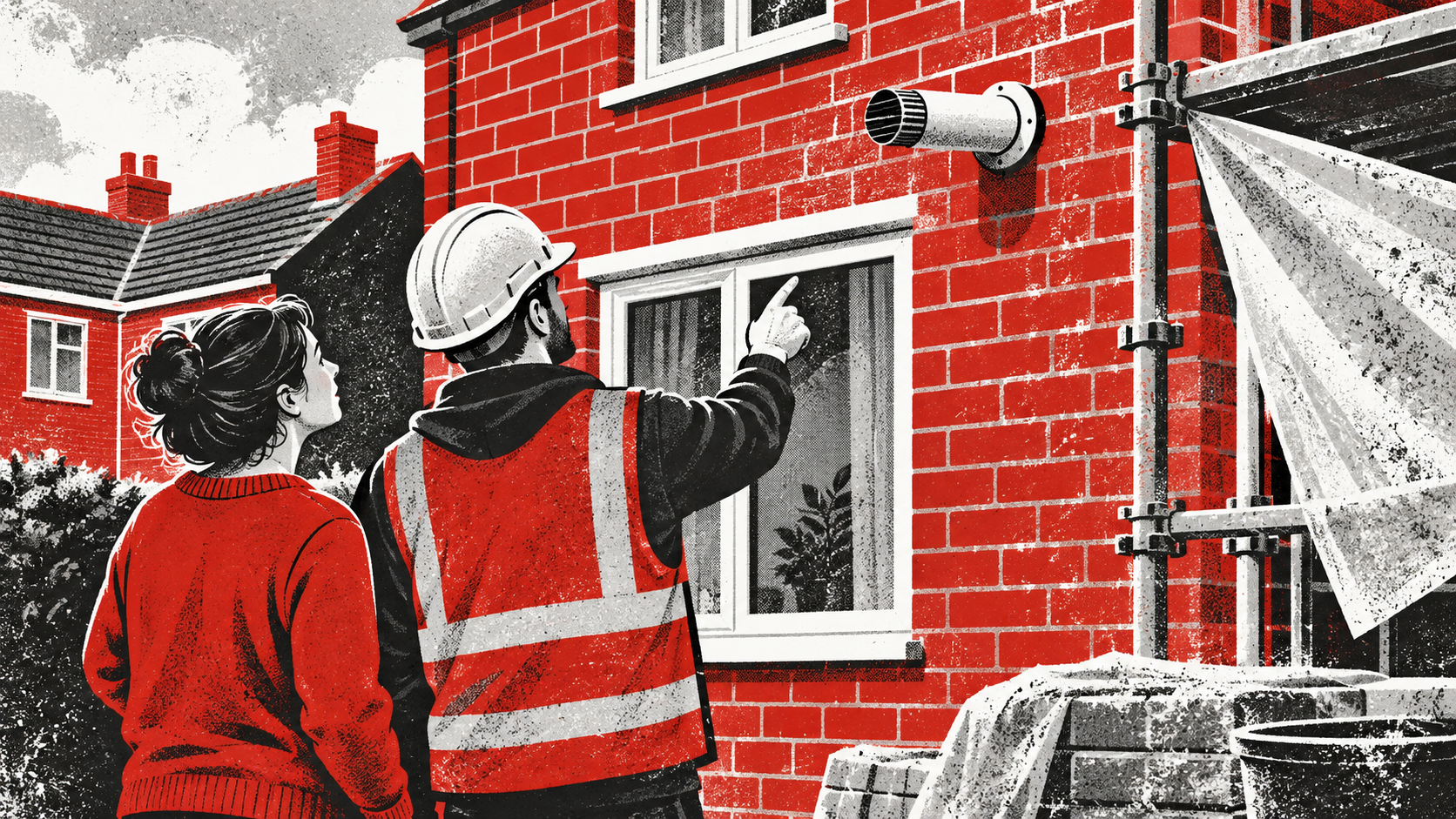
What should a homeowner check after building work near a boiler flue?
After an extension, new roof, rendering, cladding, scaffolding or other work near a boiler flue, check that the visible terminal is still clear, secure-looking and free from damage. Do this from a normal standing position. Do not climb, remove covers, seal gaps or alter any part of the flue.
If the flue has been moved, enclosed, struck, partly covered or made difficult to inspect, do not assume the boiler is safe because it still starts. Switch it off with its normal control and arrange a check by a Gas Safe registered engineer.
The short answer
A boiler flue carries combustion products safely outside. Building work can change the space around its outlet, disturb a concealed route or leave dust, mortar, sheeting and new structures close to the terminal. The exact clearances depend on the boiler, flue system and manufacturer instructions, so a generic measurement copied from the internet is not a reliable check.
Compare the finished work with photographs taken beforehand, if available. Look for an obvious change rather than trying to test the flue yourself.
Which types of work deserve a check?
Any work that changes the wall, roof or open space around a flue deserves a final look. Common examples include:
- an extension, conservatory, porch, canopy or lean-to;
- external wall insulation, cladding, rendering or repointing;
- roof repairs, loft work or changes to a flat roof;
- scaffolding, protective sheeting or temporary site screens;
- new windows, doors, fences, sheds, bins or planting near the outlet;
- work that covered a boxed-in or concealed flue route;
- drilling, cutting or fixing into the wall near the flue.
The concern is not limited to major projects. A small canopy or fixed panel can change where combustion gases disperse, while a screw or drill used in the wrong place could damage something hidden in the wall.
Start with a ground-level visual check
Stand where you can see the terminal without leaning from a window or climbing. Check whether it appears to be in the same position and condition as before. Look for:
- scaffold tubes, boards, netting or plastic sheeting close to or across the outlet;
- fresh render, mortar, insulation, paint or debris on the terminal;
- a terminal that looks bent, cracked, loose or out of line;
- a new roof, wall, window, air vent or boundary placed close to it;
- soot-like marks, unusual staining or scorching around the outlet;
- an inspection hatch or access panel that has been covered;
- a new indoor smell, boiler fault or carbon-monoxide alarm after the work.
White vapour in cold weather can be normal for a condensing boiler. A new mark, blockage or damaged-looking terminal is different and should not be dismissed as condensation.
Do not judge clearance by eye alone
Approved Document J covers safe air supply and discharge of combustion products, but the dimensions and permitted arrangements vary. Manufacturer instructions may set different distances from windows, doors, corners, roofs, boundaries, balconies and other surfaces.
A builder’s neat finish does not prove that the gas installation remains compliant. Ask the Gas Safe engineer to identify the boiler and flue system and compare the completed work with the correct current instructions.
What if scaffolding is still in place?
Scaffold components and protective sheeting must not obstruct a working flue. Do not untie sheeting, move a scaffold tube or climb to create a gap yourself. Contact the contractor and arrange competent assessment.
If the terminal is visibly covered or exhaust gases appear unable to disperse, turn the boiler off using its normal user control and leave it off until the arrangement has been checked. Tell everyone in the home why it is off so that it is not restarted casually.
What if the flue runs through a ceiling or wall?
Some room-sealed boiler flues pass through ceiling voids, boxed sections or stud walls. HSE guidance explains that engineers need to be able to inspect relevant concealed flue routes, joints and supports. Building work must not permanently cover an inspection hatch that is required for that purpose.
If a ceiling, wall or decorative panel has been renewed around a concealed route, confirm that every existing inspection point remains accessible. Do not cut your own hatch without advice: its position needs to relate to the actual flue route and other services.
Check the inside area without opening the boiler
From the room, look only at surfaces and fittings that are normally visible. Check whether new boxing presses against the boiler or flue, whether dust has entered an obvious air opening, and whether the casing or nearby wall has been damaged.
Do not remove the boiler case, pull on the flue, probe a gap, paint a joint or apply foam, silicone or tape. A flue joint that looks untidy still needs an engineer’s assessment rather than a cosmetic seal.
For work involving cupboards or panels, see how decorating or boxing can affect boiler access and ventilation.
Ask the contractor what changed
Request a simple written record of work close to the boiler or flue. Useful details include the areas drilled or opened, whether the flue was protected, whether it was touched or moved, and who completed any gas-related work.
A general builder should not alter a gas flue unless they are appropriately Gas Safe registered and competent for that work. If another trade believes the flue must move, pause that part of the project and arrange the right gas engineer.
When should the boiler stay off?
Keep the boiler off and arrange prompt advice if the flue is visibly damaged, loose, obstructed, newly enclosed or no longer inspectable. Do the same if the boiler starts locking out after the work, a carbon-monoxide alarm sounds, or anyone develops symptoms that improve outdoors.
If you smell gas, follow the national gas-emergency advice immediately. Do not operate electrical switches or go back to investigate the boiler.
Keep a useful record for the engineer
Take wide photographs of the wall and building work from a safe position. Add a closer photograph only if it can be taken without climbing or approaching a live outlet. Record the boiler make and model, what work was completed, when the change was noticed and any display message.
The engineer may need the builder’s drawings or the appliance installation instructions. Clear information can prevent an unnecessary second visit.
The practical conclusion
After work near a boiler flue, check that the terminal, route and inspection access still appear unchanged and unobstructed. Do not rely on the boiler firing as proof that the installation is safe.
If anything has moved, been covered or become difficult to inspect, leave the boiler off and arrange a Gas Safe assessment. Flue alterations are not a homeowner or general building repair.
Concerned that building work has affected the flue?
Keep the boiler off if the terminal or route has been disturbed and arrange a proper assessment.