
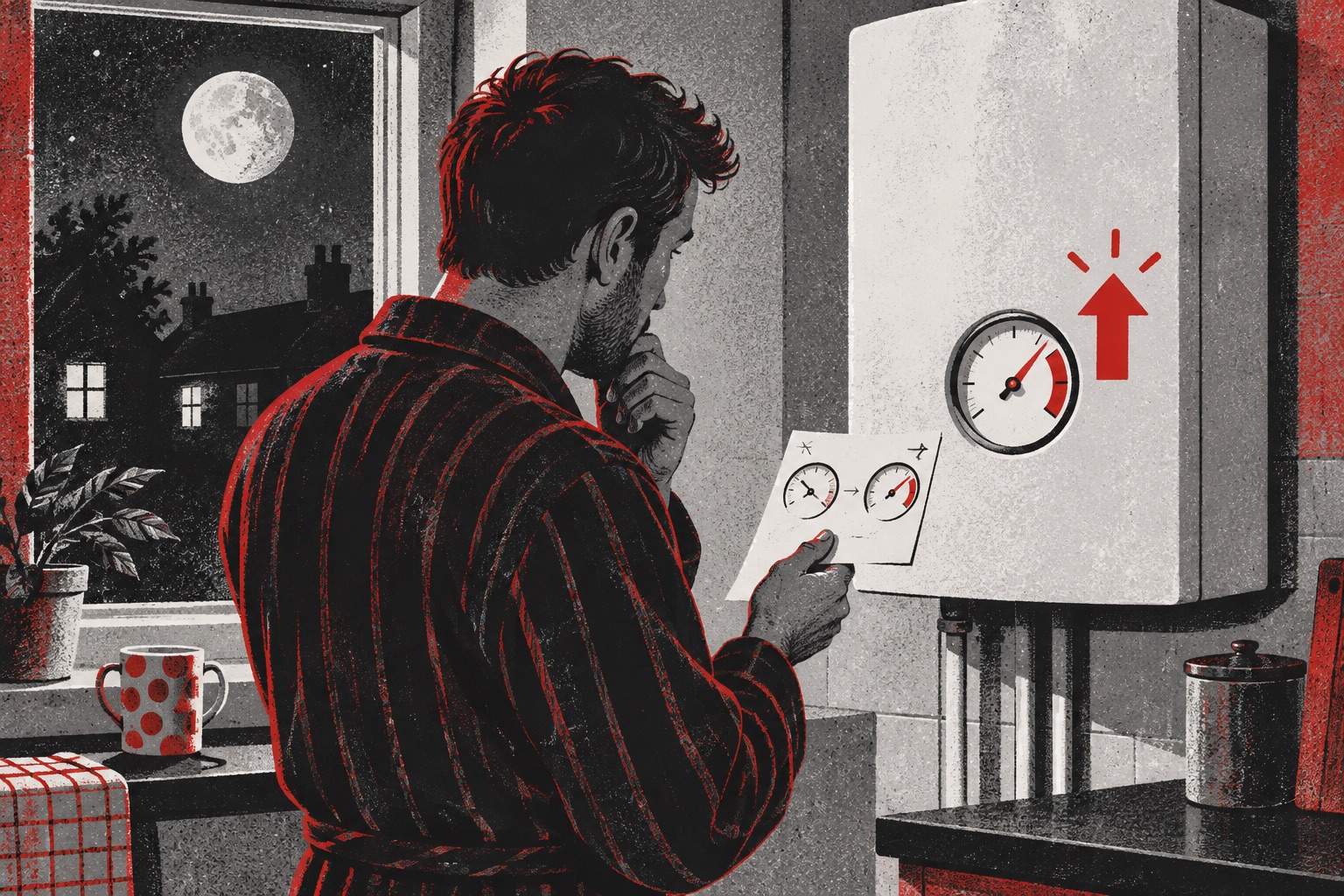
Why does the boiler pressure rise overnight when heating is off?
A sealed heating system should not steadily gain water simply because the heating is off. A small difference can come from comparing readings at different temperatures or from the gauge itself. A repeatable overnight rise while the system remains cold can point to water entering through the filling arrangement or, on some combi boilers, an internal cross-leak.
Do not try to identify or repair an internal component. Record the pressure under comparable cold conditions, check only the user controls described in the boiler manual, and arrange professional diagnosis if the rise continues.
The short answer
Take one reading when the boiler and radiators are fully cool, then another at the same cold condition the next morning. If the pressure is clearly higher without a heating cycle or recent top-up, check that any accessible filling control is in its normal closed position as the manufacturer directs.
If the pressure keeps rising, reaches the high zone, causes a fault or produces water at the outside discharge pipe, turn the heating off and contact a Gas Safe registered engineer. Do not keep bleeding radiators to offset water that is continuing to enter.
First confirm which pressure you are reading
The boiler gauge on a sealed heating system measures the water pressure in the central-heating circuit. It does not directly show the pressure at the hot taps. These two water paths normally remain separate.
Worcester Bosch says many sealed systems are around 1 to 1.5 bar when cool, but the correct range for your model is the one in its manual or marked on its display. Do not use a generic number to overrule the appliance instructions.
Compare like with like
Heating water expands when it warms, so boiler pressure normally rises during a heating cycle and falls again as the radiators cool. A late-evening reading taken while the system is still warm cannot be fairly compared with a cold morning reading.
For a useful comparison:
- Let the heating system cool fully.
- Photograph the gauge or display and record the time.
- Do not repressurise, bleed a radiator or alter valves.
- Check whether the programmed heating or a manual boost ran overnight.
- Take the next reading only when the system is at a similar cold temperature.
Repeat this once if necessary. Constant checking or changing controls can obscure the original pattern.
Was the heating really inactive?
A room thermostat can call for heat overnight if its set temperature is above the room temperature. A schedule, smart-control optimisation or a separate heating zone may also run without being noticed. Some boilers have frost-protection or other automatic functions when they remain powered, but the exact behaviour is model-specific.
Check the control history if your system provides it and note whether radiators, pipes or the boiler were warm. Do not disable safety functions or isolate power merely to create a test.
If the system ran, a modest temporary rise followed by a return towards the cold reading can be normal. Worcester Bosch notes that pressure is usually higher when the appliance is operating than when the heating is off.
Could the system have been overfilled?
If the heating was recently topped up, the starting cold pressure may already be too high. Baxi lists overfilling after a top-up or radiator work as a cause of high boiler pressure.
Do not add more water unless the model instructions actually call for it. If the cold pressure is already above the stated range, use the manufacturer guidance or arrange help. Bleeding a radiator is not a sensible routine response when the cause of a continuing rise is unknown.
Check the filling control from outside the casing
The filling loop or filling link connects the mains water supply to the sealed heating circuit when pressure needs to be restored. It should not keep admitting water after the top-up is complete.
Baxi advises checking that the filling loop is completely closed when boiler pressure is high. Worcester Bosch instructions likewise require filling valves to be returned to the closed position after the correct pressure is reached.
Only inspect or operate a filling control if it is clearly identified in your model’s user instructions and can be reached without removing the boiler casing. Do not force a stiff valve, improvise with unfamiliar levers or leave a temporary hose connected contrary to the instructions.
Why a closed control may still need an engineer
A control can appear closed yet still pass water because the valve is damaged or not sealing. The pressure may then climb slowly over several hours while the boiler is off.
Worcester Bosch fault-finding guidance for pressure that rises while a boiler is off tells engineers to confirm that the filling link is not stuck open or passing. That is a diagnostic task, not a homeowner repair.
If the rise stops only when a professional isolates the filling path, the engineer can identify the correct failed fitting and repair it safely.
What is an internal cross-leak?
Some combi boilers keep mains-fed domestic hot water and sealed heating water separated by an internal heat exchanger. If that separation fails, higher-pressure mains water can pass into the heating circuit and make the boiler gauge rise even when central heating is not running.
Worcester Bosch’s engineer fault-finding chart includes checking the plate heat exchanger for cross-leakage when pressure continually increases with the boiler off. The symptom does not prove that this part has failed; a passing filling connection and other causes must also be ruled out.
Testing and replacing an internal heat exchanger requires the boiler casing to be opened. Leave that work to a suitably qualified Gas Safe registered engineer.
How this differs from an expansion-vessel problem
An expansion vessel accommodates the increase in water volume as the heating warms. When it is ineffective, the typical pattern is a large rise during heating followed by a fall as the system cools, sometimes with water discharged through the safety pipe.
Worcester Bosch says a rise of more than about 1 bar as the heating reaches temperature can indicate that the expansion vessel needs attention. That is a different pattern from pressure creeping up while the system remains cold overnight, although more than one issue can exist.
Do not press valves, drain water or attempt to recharge an expansion vessel. It is an internal service task.
Look for the effect of high pressure
Check the display for an exact message and, from ground level, look at the end of the safety-discharge pipe outside if you can identify it safely. Do not climb or block the pipe. Water there may show that the pressure-relief valve has opened.
Once a relief valve has discharged, it can sometimes continue to drip. Repeatedly lowering and refilling the system can dilute protective inhibitor and create a cycle of pressure problems, so arrange a diagnosis.
Our published guide to boiler pressure that is too high explains the immediate safe response. The guide to pressure falling after hot-water use covers the opposite timing pattern.
Details that will help an engineer
- the cold pressure before bed and after the same cooling period;
- whether heating, hot-water preheat or a frost function operated;
- when the system was last topped up;
- the type and position of the filling control, without altering it;
- whether pressure rises during ordinary heating as well;
- any water from the outside discharge pipe; and
- any exact fault code, leak or unusual sound.
When should you stop using the boiler?
Follow the appliance manual if the pressure enters its high zone or a fault appears. Turn the heating off and arrange help if pressure continues to climb, the discharge pipe runs, water leaks from the appliance or controls do not behave normally.
Keep away from water affecting electrical fittings. If you smell gas, open doors and windows, avoid electrical switches and call the National Gas Emergency Service on 0800 111 999 from a safe place. A carbon-monoxide alarm also requires immediate safety action.
The practical conclusion
Pressure rising only while the system heats is usually a temperature-related pattern. Pressure that repeatedly climbs while the whole system stays cold is different. Check comparable cold readings and the documented position of the filling control, then let an engineer test for a passing filling path or internal cross-leak.
Pressure still rising overnight?
Save the cold readings and timing before arranging a diagnosis.