
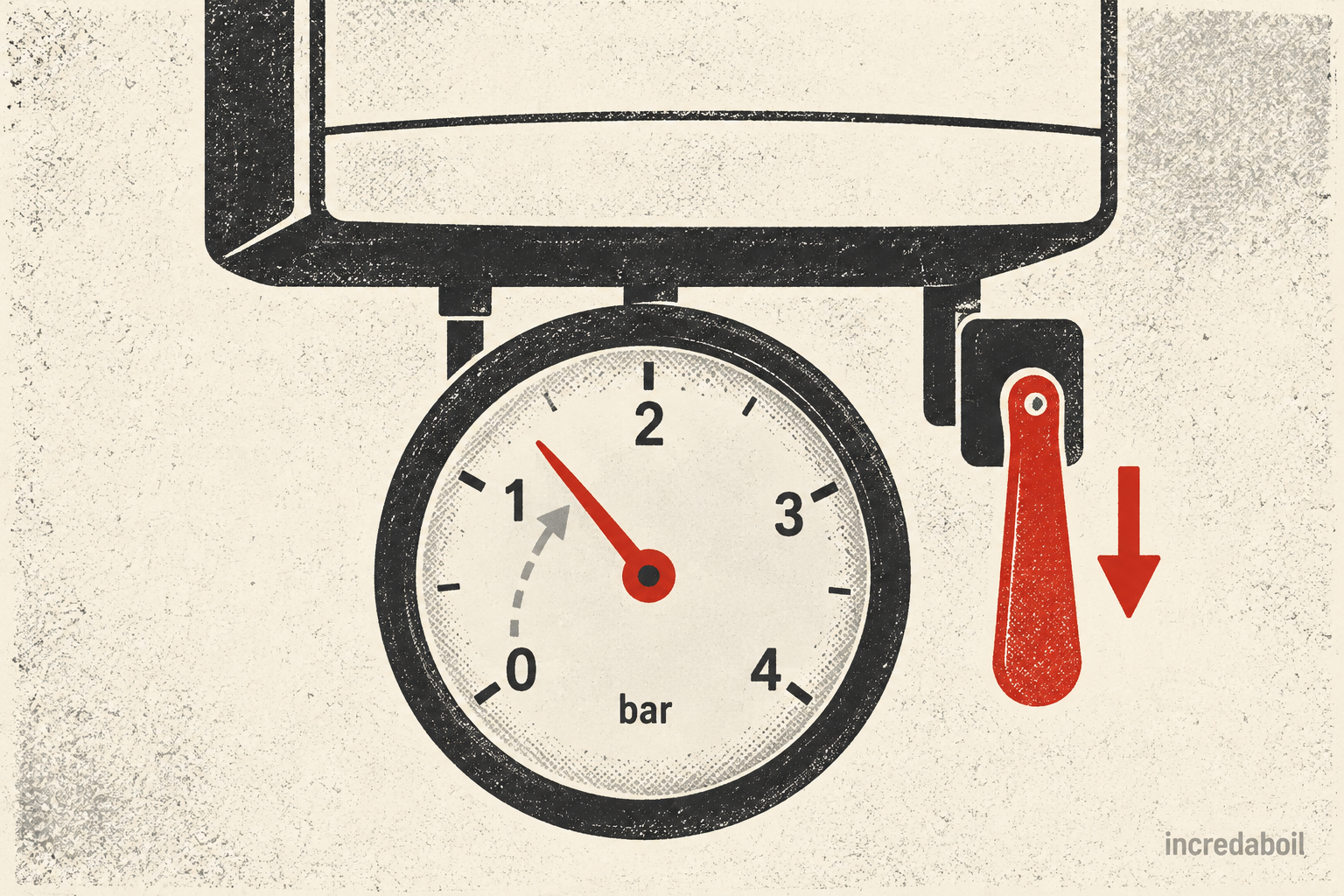
If your Ideal boiler pressure has fallen, you may be able to top up the sealed heating system through its filling loop. Many Ideal Logic combis use a detachable short hose beneath the boiler, with a domestic-hot-water inlet handle and a separate filling-loop handle. Other Ideal boilers use an external filling loop installed elsewhere.
Do not turn handles simply because they are visible. In particular, leave the yellow gas isolation handle alone, and do not move a black central-heating return handle during a routine top-up unless the exact user guide specifically tells you to. Identify your model and follow its diagram.
Quick answer: what pressure should an Ideal boiler be?
Many Ideal user guides specify 1 to 1.5 bar when the boiler is off and the system is cold. Some manuals describe a broader original installation pressure, such as 1 to 2 bar. Use the range shown for your exact model.
Pressure rises as heating water becomes hot. Always check and top up from cold so you do not accidentally overfill the system.
Before you begin
- Turn the heating off and allow the boiler and radiators to cool.
- Read the gauge or pressure display and note the starting pressure.
- Find the full Ideal model name and its official user guide.
- Match the filling loop and handles to the manual’s picture.
- Stop if you can see a leak, the pressure is already normal or the controls do not match.
Watch the gauge continuously while filling. The pressure can rise quickly, and the filling control must be closed fully afterwards.
The common Ideal Logic detachable filling loop
On several Ideal Logic and Logic MAX Combi models, the user guide shows a short detachable filling-loop hose beneath the boiler. One end connects at the domestic-hot-water inlet and the other at the dedicated filling-loop connection.
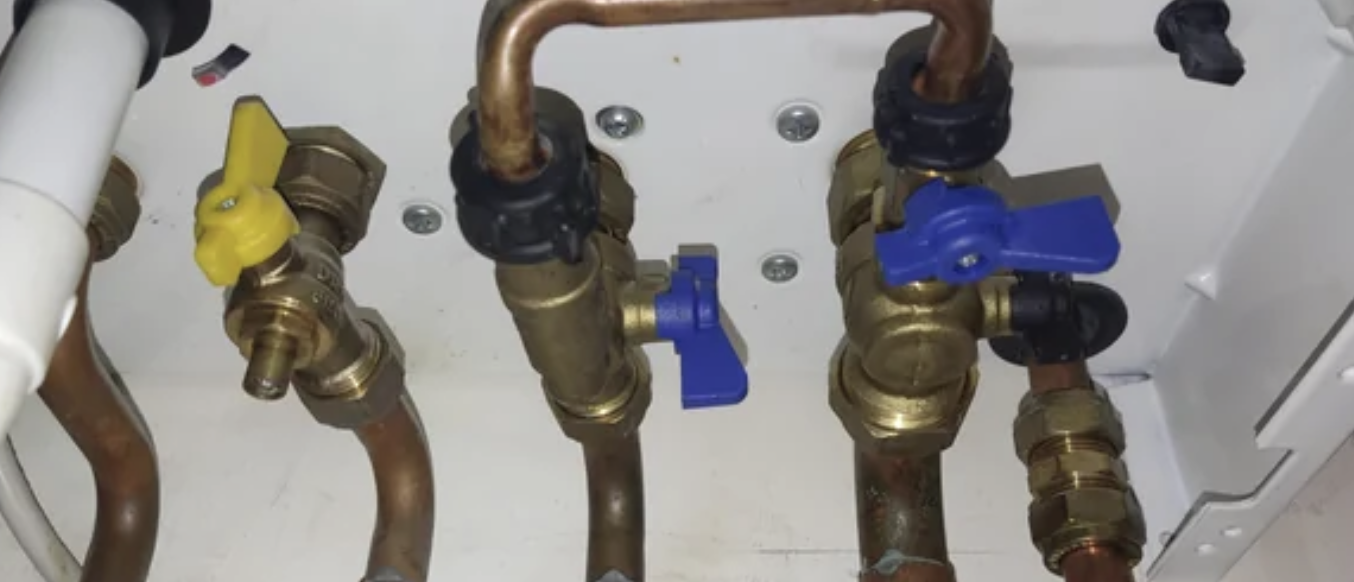
The current Logic MAX Combi2 guide identifies:
- a domestic-hot-water inlet handle, shown blue in the manual;
- a filling-loop handle, shown green;
- a central-heating return isolation handle, shown black;
- a cap and plug used when the loop is disconnected.
Those colours describe the illustrated product. Age, lighting and earlier models may look different, so never use colour without confirming the component’s position and function.
How to top up an Ideal Logic MAX Combi2-style loop
- Make sure the domestic-hot-water inlet handle and filling-loop handle are in the closed positions shown in the manual.
- Remove the cap and plug and keep them safe.
- Connect the approved filling-loop hose to the domestic-hot-water inlet and make sure the other end is hand-tight, following the guide.
- Turn the domestic-hot-water inlet handle to the horizontal top-up position shown.
- Check for leaks around the hose connection.
- Gradually turn the dedicated filling-loop handle to its horizontal open position.
- Watch the gauge and stop when the cold pressure reaches 1 to 1.5 bar.
- Turn the filling-loop handle back to its closed position.
- Return the domestic-hot-water inlet handle to its normal open position as shown in the guide.
- Disconnect the filling loop and replace its cap and plug. Expect a small amount of residual water and protect the surface beneath.
Do not overtighten connections or use grips on plastic handles. If the loop will not connect by hand, the valve sticks or water leaks, stop and arrange professional help.
Do not touch the yellow lever
A yellow handle beneath a gas boiler commonly identifies the gas service isolation valve. It is not a filling control. Moving it will not safely increase heating pressure and can interrupt the gas supply or create confusion about the appliance’s condition.
Do not use the yellow handle for repressurising. If it has been moved unintentionally, do not remove the case or attempt gas work. Follow the user manual or contact a Gas Safe registered engineer.
Do not move the black return handle during a normal top-up
In the Ideal Logic MAX Combi2 user diagram, the black handle is the central-heating return isolation valve. The routine homeowner top-up steps use the domestic-hot-water inlet handle and the separate filling-loop handle; they do not instruct the user to alter the black return handle.
Other Ideal installations may use different arrangements, but the manual remains decisive. If a video or online answer shows a different boiler, do not transfer its valve sequence to yours.
Ideal system and Vogue boilers with an external loop
Some Ideal system boilers and Vogue installations are repressurised through an external filling loop rather than the detachable Logic combi arrangement. An external loop is usually a short braided hose between the mains-water supply and sealed heating circuit, with one or two user valves.
The Vogue MAX System user guide tells users to fill through the installed loop to 1 to 1.5 bar, close the tap and contact an installer if pressure continues to fall. Because the external loop is positioned by the installer, valve appearance and location vary.
- Confirm the loop and both filling valves from the handover information or installer.
- With the boiler cold, open the first valve slowly.
- Open the second valve gradually until you hear water entering.
- Watch the gauge and close the second valve at 1 to 1.5 bar or the manual’s stated target.
- Close the first valve and confirm the gauge stops rising.
- Remove the hose only when the approved instructions require it.
If several handles are close together or the loop has no clear identification, stop. Guessing beneath a boiler is not a safe troubleshooting method.
When is topping up normal?
A small one-off top-up can be needed after bleeding radiators, after heating-system work or as residual air leaves a recently filled system. Pressure should then settle.
Regular pressure loss is not normal maintenance. Ideal user guides state that continued falling pressure may indicate a water leak and advise contacting a Gas Safe registered engineer. Repeatedly adding mains water can introduce oxygen and contribute to corrosion without fixing the cause.
Why does my Ideal boiler keep losing pressure?
Possible causes include a leak from accessible radiator valves or pipework, an internal boiler leak, a passing pressure-relief valve or an expansion-vessel problem. The pressure pattern can help an engineer: for example, a reading that rises sharply when hot and falls low again when cool may point to an expansion issue.
Without opening the boiler, you can look for water marks beneath it, damp radiator valves, corrosion on visible heating pipes and a dripping copper discharge pipe outside. Photograph what you find. Internal diagnosis and repair require a Gas Safe registered engineer.
What if the pressure is too high?
Close the filling handle and water-inlet filling control immediately. Make sure the gauge has stopped rising. Do not operate a pressure-relief valve and never loosen the filling hose while it is under pressure.
If you simply added too much water and already know the safe homeowner procedure, bleeding a cool radiator can lower the pressure. Protect the floor, open the bleed point slowly and close it when water appears. If the pressure remains high, continues rising or discharges outside, book an engineer.
What if nothing happens when I open the filling controls?
Return the controls to their correct positions. Do not turn the yellow gas handle, black return isolation handle or other nearby valves in search of water. The loop may be disconnected, the mains supply may be isolated, a filling valve may be faulty or the gauge may not be responding.
Contact an engineer and give them the exact Ideal model, pressure reading and a clear photograph of the approved user-accessible controls.
Will the low-pressure fault clear by itself?
Some Ideal boilers restart when adequate pressure is restored; others may ask for a normal user restart. Follow the exact display message and user guide. Do not repeatedly restart the appliance if the pressure falls again or a fault code returns.
Ideal manuals show that some models will not operate below a low-pressure threshold. The threshold varies, so do not quote one model’s figure as universal.
Common mistakes to avoid
- Topping up while hot: pressure will rise further as the system heats.
- Turning the yellow gas handle: it is not the filling control.
- Moving the black return handle unnecessarily: follow the exact top-up diagram.
- Leaving the filling-loop valve open: the system can over-pressurise.
- Forcing the hose or handles: damaged filling parts can leak.
- Copying another Ideal model: Logic, Logic2, Vogue and system arrangements differ.
- Continually masking pressure loss: repeated topping-up needs diagnosis.
Frequently asked questions
Should an Ideal boiler be at 1 bar or 1.5 bar?
Many Ideal manuals use 1 to 1.5 bar as the cold refill range. Aim within the range shown in your model guide rather than exactly chasing one number.
Which valves top up an Ideal Logic boiler?
On the common detachable Logic MAX Combi2 arrangement, the manual uses the domestic-hot-water inlet handle and dedicated filling-loop handle. Do not assume the black central-heating return or yellow gas handle forms part of the homeowner top-up.
Do I leave the filling hose attached?
Several Ideal Logic manuals instruct users to disconnect the loop and replace the cap and plug after filling. External installations vary, so follow the supplied instructions.
Why is water dripping after I disconnect it?
A small amount held in the hose can spill. Continuing leakage from a closed connection or valve needs attention.
How often should I top up?
An occasional correction after radiator bleeding may be expected. Continued pressure loss indicates a leak or fault and should be investigated.
Related boiler-help guides
- Why does my boiler keep losing pressure?
- How to bleed a radiator safely
- Ideal boiler fault codes explained
Does your Ideal boiler pressure keep dropping?
Do not keep masking a leak or system fault with fresh water. Book a fixed-price Incredaboil repair visit for a proper diagnosis.