
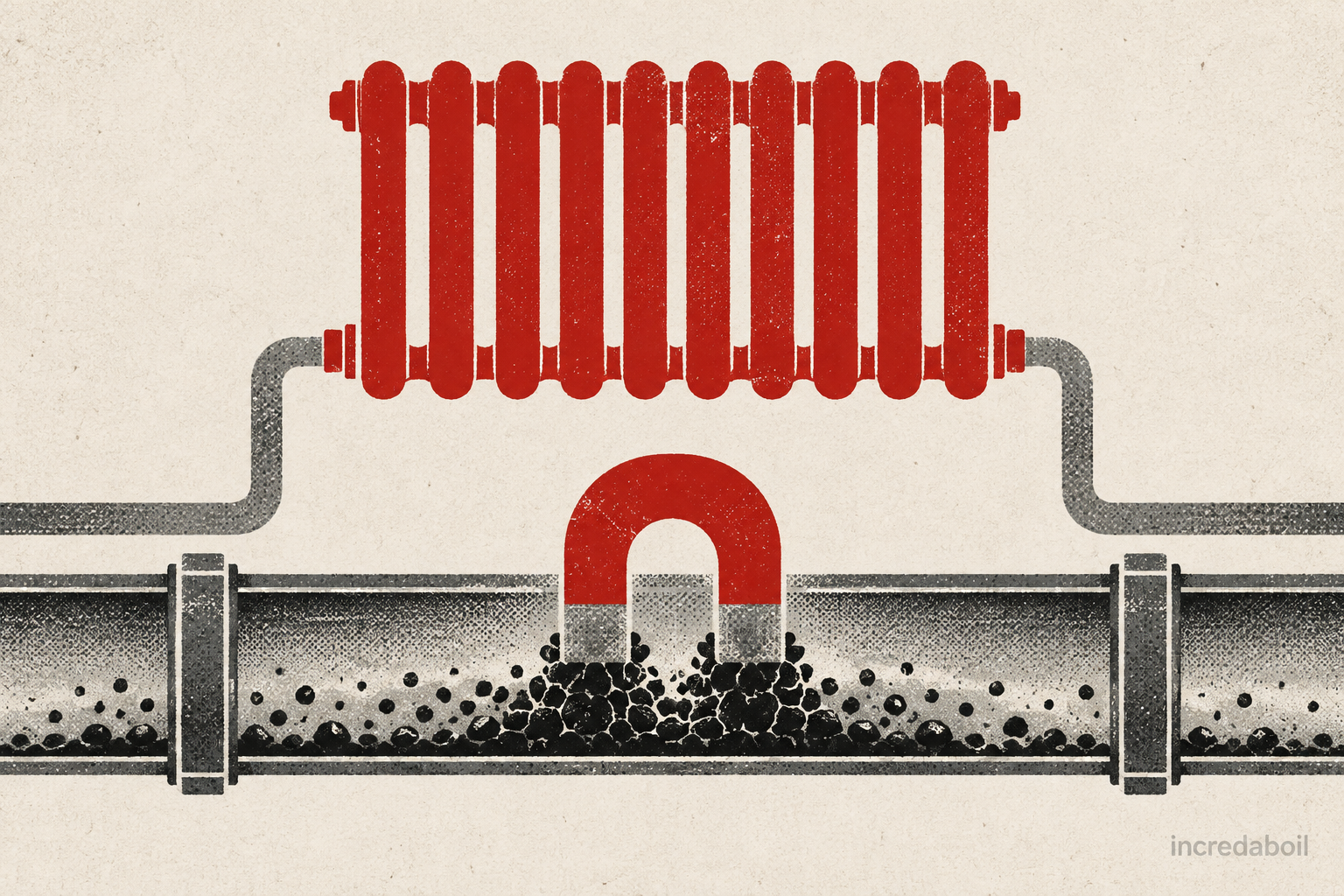
Magnetite is a black iron-oxide material produced by corrosion inside wet central-heating systems. Tiny magnetic particles can circulate in the water, settle in radiators and collect in narrow boiler components. Homeowners often call the resulting mixture “black sludge”.
Magnetite is not the same thing as limescale, although both can be present in dirty system water. It cannot be diagnosed from one cold radiator or one noisy boiler alone. A heating engineer can inspect the system, test the water and recommend cleaning and protection that matches the actual contamination.
How does magnetite form?
Most traditional radiators and some heating components contain steel. When oxygen-bearing water reacts with iron in the system, corrosion products form. Baxi describes magnetite as the main component of central-heating sludge, created when water and oxygen interact with steel pipes and radiators.
A closed heating system is designed to limit the continual entry of fresh oxygen, but it is not magically corrosion-proof. Leaks, frequent topping up, repeated draining, unsuitable water chemistry or missing and depleted inhibitor can contribute to the conditions in which corrosion continues. Connections between different metals and poor commissioning can also affect water quality.
Over time, the very small black particles become suspended in circulating water or settle where flow is slow. The sludge found in practice may also contain non-magnetic debris, installation residue and scale. That is why a magnet is useful but not a complete water-treatment plan.
What colour is magnetite?
Magnetite contamination is commonly black or very dark grey. Water released during radiator or filter work may look inky. Worcester Bosch warns that magnetite sludge can stain certain sinks and basins, which is one reason filter servicing should be contained and handled carefully by the engineer.
Clear-looking water does not prove the system is healthy, and dark water does not reveal the amount, location or cause by itself. Some particles may have settled in radiators while the sampled water appears less contaminated. Proper assessment considers the water, symptoms and system history together.
Signs that may point to sludge
- radiators hot at the top but cold across the bottom;
- some radiators taking much longer than others to warm;
- poor circulation or a large temperature difference around parts of the system;
- gurgling, kettling or increased system noise;
- radiators needing attention repeatedly;
- dirty material collected during professional filter servicing; and
- pump or boiler problems associated with restricted water flow.
Baxi lists cold radiator bottoms, frequent bleeding, noisy operation, poor circulation and pump problems among possible sludge indicators. Ideal’s current warranty terms also identify a noisy boiler, cold radiator spots, sludge in pipes and poor circulation as indications that cleaning or treatment may be required.
These symptoms overlap with trapped air, closed valves, balancing problems, weak pumps and component faults. For example, a cold patch at the top of a radiator is more commonly associated with air, while sludge tends to settle lower down. Neither pattern should trigger an expensive flush without investigation.
Why magnetite matters to a boiler
Modern boilers use compact waterways and controlled pumps and valves. Circulating debris can restrict flow, wear moving components and collect in heat exchangers. Baxi says sludge can block pipes and damage the boiler and heating system. Worcester Bosch explains that its system filter captures iron-oxide sludge before it circulates into the heat exchanger, pump and valves.
Restricted circulation can make radiators less effective and may cause the boiler to operate poorly or noisily. It does not follow that every breakdown was caused by magnetite. An engineer should prove the relevant condition rather than attribute any fault to “dirty water” without evidence.
Is magnetite the same as limescale?
No. Magnetite is an iron-oxide corrosion product and is magnetic. Limescale is a hard mineral deposit associated with hard water. Baxi notes that central-heating sludge can contain both magnetite and limescale along with other debris.
The distinction matters because treatment differs. A magnetic filter captures magnetic iron-oxide particles but cannot remove every non-magnetic contaminant or reverse hard deposits already attached to a component. The engineer needs to identify whether the problem is system-side corrosion, domestic-hot-water scaling, installation debris or something else.
What does a magnetic filter do?
A magnetic system filter is installed in the heating circuit. Water passes through it and a strong magnet attracts suspended iron-oxide particles. Designs may also trap some non-magnetic debris. The filter protects the system by removing circulating material; it does not stop the underlying corrosion chemistry on its own.
Worcester Bosch’s current Greenstar System Filter instructions say the magnet captures potentially damaging iron-oxide sludge and recommend cleaning the filter annually during the boiler service. A heavily contaminated existing system should be cleaned appropriately before relying on a newly fitted filter.
Filter servicing involves isolation, pressure and dirty water. Leave it to a competent heating engineer unless the exact manufacturer explicitly provides a safe homeowner procedure and you are fully confident. Never open the boiler casing while looking for a filter; it is normally a separate component fitted to the heating pipework.
Does a magnetic filter remove all sludge?
No. It captures magnetic material that reaches it. Sludge already settled in a radiator, a poorly circulating branch or another low-flow area may remain. Non-magnetic debris may require other separation or cleaning. If a system is already badly contaminated, the engineer may recommend a chemical clean, gravity flush, powerflush or another method after assessing pipework, boiler and water condition.
A powerflush is not automatically necessary for every dark sample or cold radiator. Worcester Bosch says an installer should recommend whether a system requires one. The correct method should be proportionate and compatible with the appliance and older pipework.
What is inhibitor?
Central-heating inhibitor is a chemical treatment added at the correct concentration to reduce corrosion and scale formation. It helps prevent new magnetite; it is not a substitute for removing an established heavy deposit. After cleaning, the system is normally refilled and protected in line with the boiler, chemical and relevant industry instructions.
Repeatedly topping up a sealed system dilutes inhibitor and introduces fresh water. If boiler pressure keeps dropping, fix the reason for the water loss rather than continually refilling. A leak or pressure fault can be both a symptom and a contributor to deteriorating system water.
What should happen when a new boiler is installed?
The existing system should be assessed, cleaned as required and commissioned with appropriate water treatment. Baxi’s professional guidance says new installations should be cleansed and flushed, treated with inhibitor and fitted with an in-line filter. Worcester Bosch likewise describes flushing, inhibitor and filtration as parts of maintaining good system water.
Requirements and guidance depend on the work, location and applicable edition. GOV.UK publishes the current Approved Document L for England, including the standards relevant to energy performance and building services. Your installer should follow current regulations, manufacturer instructions and recognised water-treatment standards rather than relying on an old rule of thumb.
Baxi, Worcester Bosch and Ideal systems
Baxi
Baxi’s homeowner guidance defines magnetite clearly and lists the signs an engineer should consider. If a Baxi boiler has a circulation-related fault, tell the engineer about cold radiator bottoms, topping up, previous leaks and when the system was last cleaned. Do not assume a boiler part alone will cure contaminated system water.
Worcester Bosch
Worcester Bosch publishes detailed instructions for its magnetic filters and says the filter should be cleaned during annual servicing. A Worcester boiler can also be connected to another approved filter, but servicing must follow that filter manufacturer’s instructions.
Ideal
Ideal’s warranty wording highlights that aggressive water, scale and sludge can damage a boiler and may fall outside warranty cover. Keep commissioning and service records, and have water quality considered when poor circulation or repeated component trouble affects an Ideal boiler.
Safe checks for homeowners
- Compare radiator temperatures after the heating has run long enough to stabilise.
- Note whether cold areas are mainly at the top or bottom.
- Record any boiler code, noise or pressure change exactly.
- Check service paperwork for a fitted filter and previous water treatment.
- Tell the engineer how often the system has been topped up or drained.
Do not drain black water into a decorative basin, add chemicals blindly, dismantle a filter or remove the boiler casing. Gas Safe Register explains that a functional boiler case can form part of the combustion circuit and should not be removed by a consumer.
Frequently asked questions
Is magnetite magnetic?
Yes. That is why a magnetic filter can capture much of the circulating black iron oxide.
Does black radiator water mean I need a powerflush?
Not automatically. It justifies assessment. The amount, distribution, symptoms, pipe condition and appliance requirements determine the suitable cleaning method.
Can magnetite make a radiator cold at the bottom?
Yes, settled sludge is one possible cause. A flow, valve or balancing issue can produce similar symptoms, so confirm before treatment.
Will inhibitor dissolve existing sludge?
Inhibitor mainly protects against further corrosion. Established contamination may need a suitable cleaner and flushing process chosen by an engineer.
How often should a magnetic filter be cleaned?
Follow its manufacturer’s instructions. Worcester Bosch recommends annual cleaning of its system filter during the boiler service.
Related boiler-help guides
- Why is a radiator cold at the bottom?
- Boiler makes a humming or vibrating noise
- Why does boiler pressure keep dropping?
- Does my heating system need a powerflush?
Could dirty system water be affecting your boiler?
Book a fixed-price Incredaboil repair for an eligible Baxi, Worcester Bosch or Ideal boiler and have the fault assessed properly.