
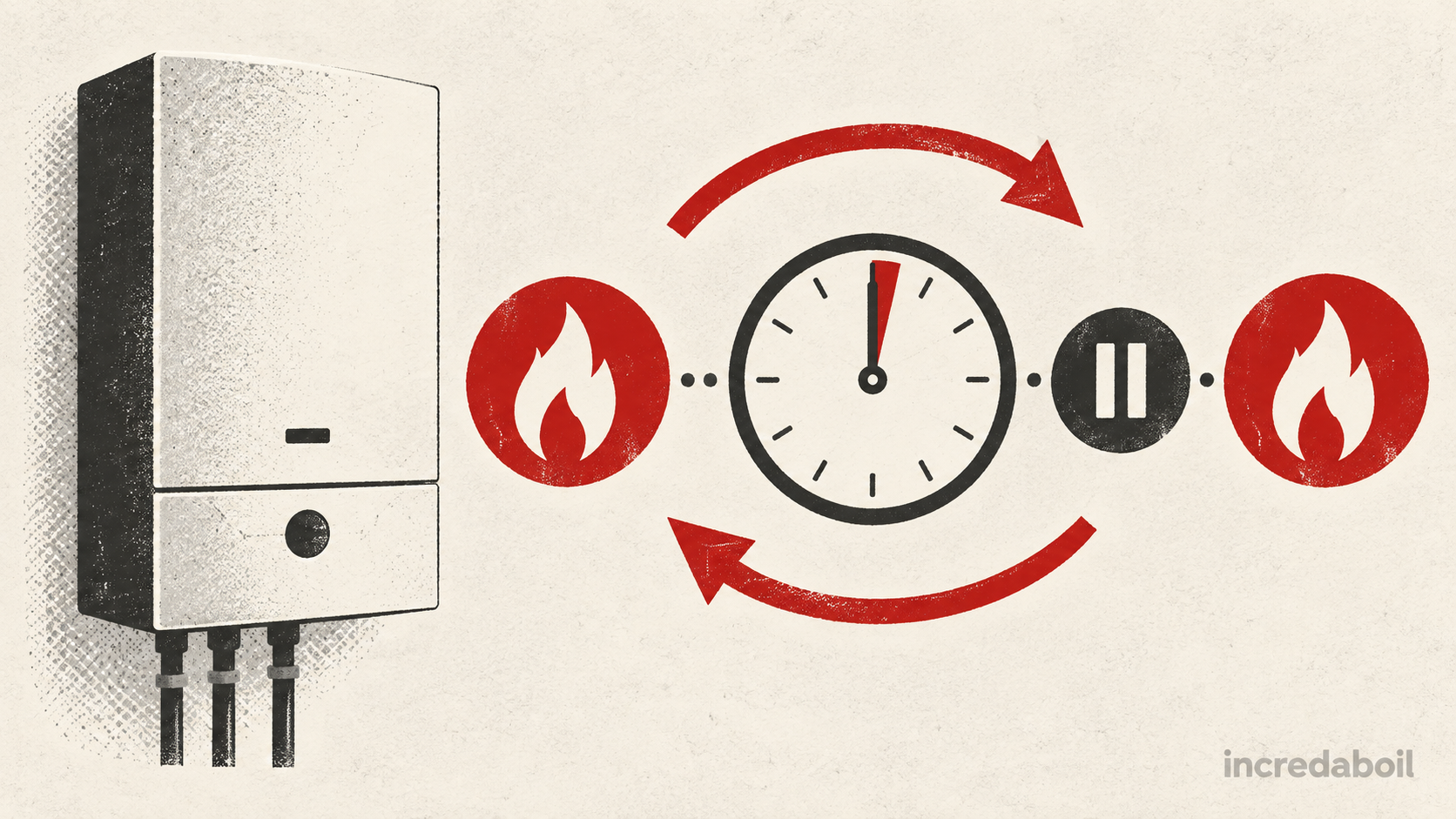
A Baxi boiler that fires for about a minute and then stops is not automatically faulty. Modern boilers turn the burner down, pause between demands and stop when controls are satisfied. The concern is a repeated pattern of very short burner runs that fails to heat the home or hot water properly, produces a fault code, or keeps restarting every few minutes.
This repeated stop-start pattern is often called short cycling. Baxi says correct setup of heating times and temperature demand can reduce short cycling. The right next step is to establish which mode triggers it and whether the boiler is stopping normally, entering an anti-cycle pause or locking out.
First identify what is actually stopping
A boiler contains a burner, fan and pump that do not always start and stop together. The flame symbol may disappear while the pump continues moving water. A fan may run before ignition or after the flame stops. Those sequences can be normal.
Watch only the user display and listen from a safe distance. Do not remove the case. Record:
- whether the flame symbol goes out but the boiler stays powered;
- whether it restarts after a fixed pause;
- whether a fault code or lockout appears;
- whether the room thermostat still shows demand;
- whether it happens on heating, hot water or both; and
- whether radiators or tap water reach the expected temperature.
When a short burner run can be normal
The burner should stop when the requested temperature is reached or when there is no longer a demand. A room thermostat turns heating off once the room reaches its set temperature. A cylinder thermostat does the same for stored hot water. Energy Saving Trust describes this control behaviour as part of normal, efficient operation.
A modern boiler can also modulate—reduce its flame—to match a smaller load. If the remaining demand falls below the appliance’s minimum output, it may pause and later restart. Some control platforms deliberately impose an anti-cycle waiting period between heating burns. A stop is therefore not, by itself, evidence of flame failure.
What short cycling looks like
Short cycling is a repeated pattern rather than one isolated stop. Typical observations include:
- the burner lights, runs for roughly a minute and stops;
- it restarts a few minutes later while the thermostat still calls for heat;
- the boiler temperature rises very quickly during each burn;
- radiators remain uneven or the room never reaches its setpoint;
- the pattern continues for many cycles; or
- a temporary warning eventually becomes a fault or lockout.
Baxi specifically refers to reducing “short cycling” through correct heating setup. Frequent starts can add wear and may reduce efficiency, so a persistent pattern deserves diagnosis even if the boiler eventually warms the home.
Check whether the controls are creating brief demands
Energy Saving Trust explains that the programmer, room thermostat and thermostatic radiator valves have different jobs. The programmer sets when heating is allowed; the room thermostat calls for heat until its area reaches temperature; TRVs regulate individual radiators.
Check the visible settings against the intended schedule. Look for overlapping smart-thermostat programmes, a temporary boost ending, geofencing changes or a room thermostat positioned near another heat source. Do not enter installer menus or rewire a control.
If the room is already at the set temperature, one brief burn followed by a stop may be ordinary. If the thermostat clearly continues to request heat through repeated one-minute cycles, record that for the engineer.
Are most radiator valves closed?
If only a small part of the system can accept heat, the boiler flow temperature may rise quickly and the burner may stop. Check that the radiators intended to heat are not all turned off and that the room containing the main thermostat can warm in the way the installer intended.
Do not alter lockshield valves, bypass settings or hidden zone controls. Those affect system balance and flow and should be assessed by someone who understands the installation. Simply opening every valve is not a guaranteed cure, especially if there is a separate circulation problem.
Could the boiler flow temperature be too high?
The boiler thermostat sets the temperature of water sent to radiators, while central-heating controls decide when heat is required. Energy Saving Trust says a flow temperature set higher than needed can be lowered carefully on suitable systems, improving efficiency, but it must still keep the home warm.
Use only the normal homeowner control described in the exact Baxi guide. Do not copy a universal number onto a conventional boiler with a hot-water cylinder: stored-water safety requirements differ. If weather or load compensation is fitted, ask the installer how it should manage flow temperature.
What if it happens during hot-water use?
On a combi, a hot tap creates a domestic-hot-water demand. Very low or unstable tap flow can make demand detection intermittent, while a temperature or circulation problem can make the burner pause. First test one ordinary hot tap at a steady flow with every other outlet off.
Note whether the tap water goes hot and cold in time with the flame symbol. If only one shower is affected but ordinary hot taps stay stable, the shower mixer or local flow may be involved. If every outlet follows the same cycle, include the boiler in the investigation.
Could poor circulation make it stop?
Baxi’s current error table includes model-specific messages for no circulation and for flow temperature rising too quickly. Those codes do not apply universally, but they show why a rapid temperature rise and water movement are relevant to professional diagnosis.
Possible investigation areas include system flow, air, pump performance, restricted waterways, valves and temperature sensing. The one-minute timing does not identify which one is responsible. Do not bleed every radiator, turn an internal pump shaft or dismantle a filter on speculation.
Is it firing, failing to light, or losing the flame?
A boiler that lights cleanly and then intentionally pauses is different from one that repeatedly attempts ignition, loses flame and locks out. Photograph any full code. Baxi’s tables use different codes for ignition failure, temporary flame loss, circulation and sensor conditions across product generations.
Do not reset repeatedly. Baxi’s reset guide says frequent lockout indicates a fault and the installer or service engineer should be contacted. One correct reset may be used only where the exact user guide permits it.
Cold-weather checks
If the problem begins during freezing weather and the boiler gurgles or locks out, an external condensate pipe may be frozen on some installations. Baxi publishes a safe homeowner method using a warm cloth, hot-water bottle or warm—not boiling—water on an accessible external blockage.
Only consider that route if you can positively identify the condensate pipe and reach it safely from the ground. Do not use a flame, heat gun, boiling water or a ladder. If no pipe is visibly frozen, do not warm random pipes.
Safe checks before booking
- Confirm the exact Baxi model and photograph the display.
- Check the programmer and room-thermostat demand.
- Note the boiler flow-temperature setting without changing installer parameters.
- Confirm intended radiators are not all shut off.
- Record the cold pressure and any change during the cycle.
- Time two or three cycles rather than estimating.
- Test heating and one steady hot-water demand separately.
- Write down any noise, gurgling, code or temperature swing.
Stop the test if a warning appears, the boiler becomes unusually noisy or hot, water leaks or combustion seems abnormal. These observations are for diagnosis, not permission to keep a faulty boiler running.
What not to do
- Do not remove the boiler case.
- Do not adjust gas-valve, combustion or service parameters.
- Do not bridge thermostats, flow switches or sensors.
- Do not repeatedly reset a lockout.
- Do not drain, flush or add chemicals without a diagnosis.
- Do not assume the fan, pump or PCB needs replacement from timing alone.
Gas Safe Register explains that a case fixed with screws may form part of the appliance’s combustion circuit. Internal checks and repair must be carried out by a suitably qualified Gas Safe registered engineer.
What an engineer may investigate
The engineer can reproduce the symptom under controlled demand, confirm whether the burner is modulating, anti-cycling or locking out, compare flow and return behaviour with Baxi data, assess circulation and controls, inspect relevant sensors and verify safe combustion.
System design can matter too. A boiler serving a very small active zone, an incorrectly configured bypass or unsuitable control setup may behave differently from a component fault. The correct repair follows measurements, not a generic parts list.
When it needs prompt attention
Arrange a repair when short runs repeat while the home remains cold, hot water fluctuates, a fault code appears, pressure moves abnormally, the boiler bangs or kettles, or it frequently locks out. Switch it off using the normal control if operation seems unsafe.
If you smell gas, a carbon monoxide alarm operates or anyone feels unwell, leave the appliance alone and follow the National Gas Emergency Service guidance. The cycling pattern is secondary to immediate safety.
What to tell the booking team
- the full Baxi model and age;
- whether it happens on heating, hot water or both;
- the approximate burner-on and pause times;
- whether the thermostat still calls for heat;
- the pressure and flow-temperature display;
- any complete code, noise or gurgling; and
- whether rooms or tap water reach temperature.
Frequently asked questions
Is it normal for a Baxi boiler to turn off after a minute?
It can be normal if demand has been satisfied or the boiler enters an anti-cycle pause. Repeated one-minute burns that fail to provide heat or hot water are different.
What is boiler short cycling?
It is frequent burner stopping and restarting over short intervals instead of a stable run matched to demand.
Can a thermostat cause stop-start firing?
Brief or conflicting demands can contribute. Check visible schedules and settings, but do not rewire or enter installer menus.
Should I keep resetting it?
No. Baxi says frequent lockout indicates a fault. Follow the exact manual for one permitted reset, then arrange help if it returns.
Related boiler-help guides
- Why does my boiler keep turning on and off?
- Baxi boiler fault codes
- Why is my boiler overheating?
- No hot water but heating works
Is your Baxi repeatedly firing and stopping?
Book a fixed-price Incredaboil repair when short cycles are leaving the home cold, disrupting hot water or producing a fault.