
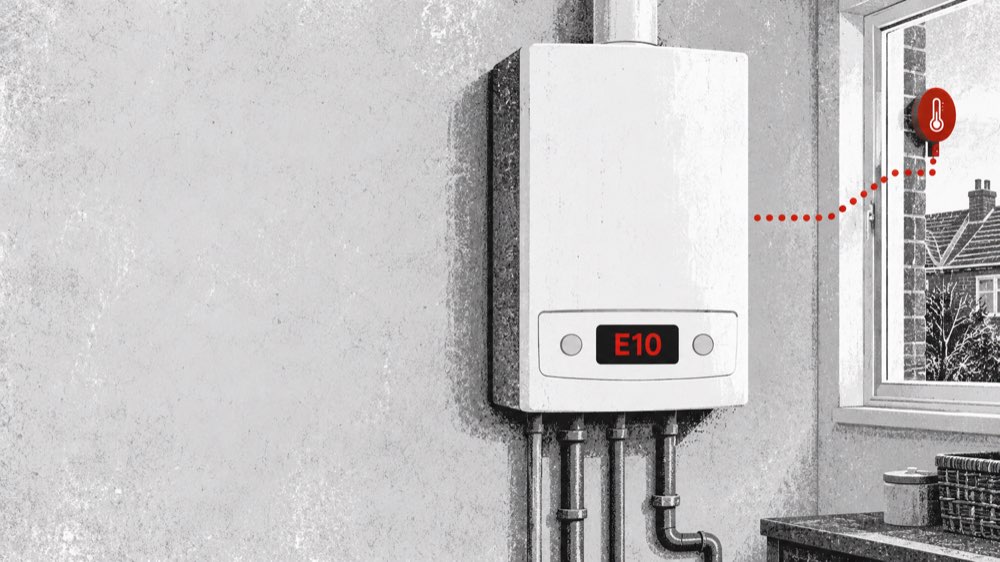
If your Baxi boiler is displaying E10, Baxi’s current error-code reference describes it as an external probe fault on the covered models.
An external probe is normally used to provide outdoor-temperature information to compatible controls. E10 does not have the same meaning on every Baxi range, so the exact model and control arrangement matter.
What does Baxi E10 mean?
On the models listed in Baxi’s relevant code group, E10 means the boiler is not receiving the external-probe signal it expects. The cause could involve the probe, its connection, wiring, configuration or another control issue.
The display code does not prove which part has failed. It identifies the circuit that the engineer needs to test using the instructions for that model.
Which Baxi boilers use E10?
Baxi lists E10 for a group that includes Platinum Compact, Duo-tec Compact, Megaflo Compact, 600, 800, Assure, Platinum, Duo-tec, Megaflo and EcoBlue combi or system appliances as specified on the manufacturer’s page.
Some newer Baxi Combi 2 and System 2 appliances use a different dotted-code format. Check the complete boiler name and all characters shown on the display before comparing codes online.
What is the external probe?
An external probe measures outdoor temperature for compatible weather-compensating controls. The heating system can use that information to adjust water temperature as outside conditions change.
E10 does not necessarily mean the boiler’s main heating components are damaged. It means the expected external-temperature input has not been accepted correctly.
Safe checks you can make
- Record the full model and display. Photograph any alternating code or symbol.
- Check whether your system has an outdoor sensor. Look only from a safe position; do not open it, remove covers or trace wiring.
- Check the heating controls. Make sure the thermostat and programmer have power and are requesting heat.
- Check the system pressure externally. Compare it with the normal range in the user guide, but do not expect topping up to repair an external-probe fault.
- Use one reset only if your exact Baxi user guide allows it. If E10 returns, stop resetting and arrange a repair.
Do not remove the boiler casing or attempt to reconnect sensor wiring. Electrical testing and configuration checks should be completed by a suitably qualified engineer.
Will the heating still work with E10?
The behaviour depends on the boiler, control setup and how the fault is handled. The boiler may lock out, continue in a fallback mode or provide heating that does not respond as expected to outdoor conditions. Do not assume continued operation means the fault can be ignored.
Can weather cause the code?
Rain, frost or accidental damage may affect an outdoor sensor or its connection, but the display alone cannot establish the cause. Tell the engineer if building work, external decoration or severe weather occurred shortly before E10 appeared.
If you smell gas, suspect carbon monoxide or see heat damage, treat that as a separate safety issue and follow Gas Safe Register guidance immediately.
What will the engineer check?
The engineer will confirm the model-specific meaning, review the control configuration and test the external-probe circuit in line with Baxi instructions. The correct repair could involve the probe, a connection, wiring or system configuration; testing determines which.
Get your Baxi boiler working properly
Book a fixed-price boiler repair so the E10 fault can be checked and the heating put right.
Quick answer
Baxi E10 means an external-probe fault on the models covered by the manufacturer’s current reference. Record the exact model and controls, make only safe external checks and arrange a repair if one permitted reset does not clear it.