
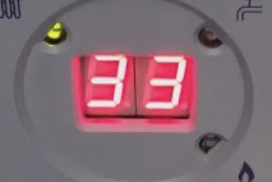
A Baxi boiler showing E133 has locked out because the gas supply was interrupted, ignition failed or the flame was not detected. Baxi also says a blocked or frozen condensate pipe can produce this code on some models. The same E133 wording appears across a number of related Main and Potterton boilers, but always check the manual for the exact appliance.
E133 identifies the point where the boiler’s safe operating sequence failed; it does not prove that any one component needs replacing. Start with the limited checks below, try no more than the reset procedure in your user manual, and arrange a Gas Safe engineer if the code returns.
What does Baxi E133 mean?
Baxi’s current fault-code information calls E133 a gas-supply fault and lists the power supply, sensing electrode, spark electrode and cable among the areas an installer may need to check. Its homeowner reset guide explains the code more broadly as a problem involving the gas supply, ignition or flame, or a blocked condensate.
In plain English, the boiler tried to light or remain alight but could not confirm a safe flame. It shut the gas valve and locked out. That is an intentional safety response, not something to bypass.
Does E133 also apply to Main and Potterton?
Yes, on various models that share Baxi Heating technology. Baxi’s own fault-code table groups models including the Main Eco Compact and Potterton Assure with Baxi ranges and gives E133 the same gas-supply and ignition context. Older Potterton manuals also describe E133 as interrupted gas supply, failed ignition or flame not detected.
Brand alone is not enough to choose instructions. Find the complete model name on the boiler or paperwork, then use that model’s operating manual. Displays differ: some show E133 continuously while others alternate between E1 and 33.
Safe checks you can make
Check for a wider gas-supply problem
If you have a gas hob that you normally operate safely, check whether it works. Do not do this if you smell gas. If other appliances are also affected, check prepayment credit where relevant and contact your gas supplier. Never operate, dismantle or force gas valves.
Check electrical power and heating controls
Make sure the boiler display is on, its external switch has not been turned off, and your thermostat or programmer is requesting heat. A power cut can alter a timer. Do not remove a fused-spur cover, replace internal fuses or interfere with boiler wiring.
Look at the system pressure
Read the boiler’s pressure gauge or display when the system is cool and compare it with the user manual. Low pressure normally has its own code—often E119 on applicable Baxi-family models—so topping up a system that is already within range is unlikely to cure E133. Do not keep adding water “just in case”.
Consider a frozen condensate pipe
Freezing weather, gurgling as the boiler tries to start and an exposed white or grey plastic pipe outside can point towards frozen condensate. Baxi says E133 or E28 may appear when the condensate pipe freezes.
Only inspect a pipe that is clearly accessible from ground level. Baxi recommends a hot-water bottle, microwaveable heat pack or cloth soaked in hot water. It specifically warns against boiling water because this could damage the pipe. Take care around ice and electrical equipment, and never climb to reach pipework.
Once safely thawed, restart the boiler only as its operating instructions describe. If freezing returns, the external pipe route, fall, size or insulation may need professional correction.
Try one correct reset
Baxi boilers use different reset controls. Some have a dedicated button; others use an on/off/selector switch or temperature knob. Baxi’s guide says certain selector-switch models are reset by holding the control in the R position for at least five seconds. Do not copy that timing unless it matches your manual.
Try the permitted reset once after the supply checks. If E133 returns, stop. Frequent lockout indicates a fault and Baxi advises contacting an installer or service engineer.
Why can E133 keep returning?
A repeat code may involve intermittent gas supply, ignition or flame-sensing components, condensate drainage, combustion conditions, electrical connections or the boiler control system. An engineer may need to measure gas pressure, inspect the condensate route, test ignition and flame proving, and verify safe combustion.
Those tests are necessary because symptoms overlap. Replacing an electrode from an internet guess could waste money and would involve opening a gas appliance. Gas Safe Register says householders must not attempt to fit, fix or move gas appliances themselves.
E133 after a gas meter change or supply interruption
Air can be present in supply pipework after planned work or a supply interruption, and an appliance may fail its first ignition attempt. Do not repeatedly reset it. Confirm the supplier or attending engineer has said the supply is available, then follow the boiler’s normal single-reset procedure. If it still locks out, call a Gas Safe registered engineer.
E133 only in freezing weather
A weather-related pattern makes the external condensate route worth checking, especially if you hear gurgling. Thawing may restore operation, but repeated freezing is not normal maintenance. Correct installation aims to minimise exposed runs and protect external condensate pipework appropriately.
When this is an emergency
E133 by itself usually means the boiler has safely stopped. If you smell gas or suspect carbon monoxide, however, leave the property, avoid flames and electrical switches, and call the National Gas Emergency Service on 0800 111 999 in Great Britain.
Carbon monoxide cannot be seen, smelled or tasted. Headache, dizziness, nausea, breathlessness, collapse or loss of consciousness can be warning symptoms. Move to fresh air and seek urgent medical help if exposure is suspected.
What not to do
- Do not remove the boiler casing.
- Do not clean, bend or replace ignition or sensing electrodes.
- Do not adjust the gas valve or combustion settings.
- Do not bypass a safety control.
- Do not use boiling water on a condensate pipe.
- Do not keep resetting a boiler that repeatedly locks out.
What to tell the engineer
- Whether the boiler is Baxi, Main or Potterton and its full model.
- Exactly how the display presents E133.
- Whether other gas appliances work.
- Whether the fault began after a supply interruption.
- Whether the weather is freezing or the boiler gurgles.
- The cool system pressure.
- Whether one manual reset worked temporarily.
- Any previous E133 visits and parts replaced.
A photograph of the display and boiler data label can help the engineer identify the correct technical literature and arrive better prepared.
Frequently asked questions
Is E133 definitely an ignition electrode?
No. An electrode or its connection is one possible diagnostic area, but gas supply, flame sensing, condensate drainage and other faults can lead to the same lockout.
Can low boiler pressure cause E133?
Low water pressure usually has a different code on applicable models, commonly E119. Check the gauge, but do not overfill the system in an attempt to clear E133.
Can I reset E133?
You may perform the normal user reset stated in the exact boiler manual after checking supplies. If the code returns, arrange a repair rather than repeating it.
Does E133 mean the gas valve is broken?
No. The code alone cannot establish that. The gas valve is only one part of a wider supply and ignition sequence that requires competent testing.
Will thawing the condensate always fix it?
No. It helps only when freezing is the cause. If conditions are mild, the pipe is clear or E133 returns, the boiler needs diagnosis.
Related boiler help
Read how to reset a boiler safely, why condensate pipes freeze, safe checks when a boiler will not fire and Baxi E119 explained.
Baxi E133 still locking the boiler out?
Book a clear, fixed-price Baxi, Main or Potterton boiler repair visit with Incredaboil.