
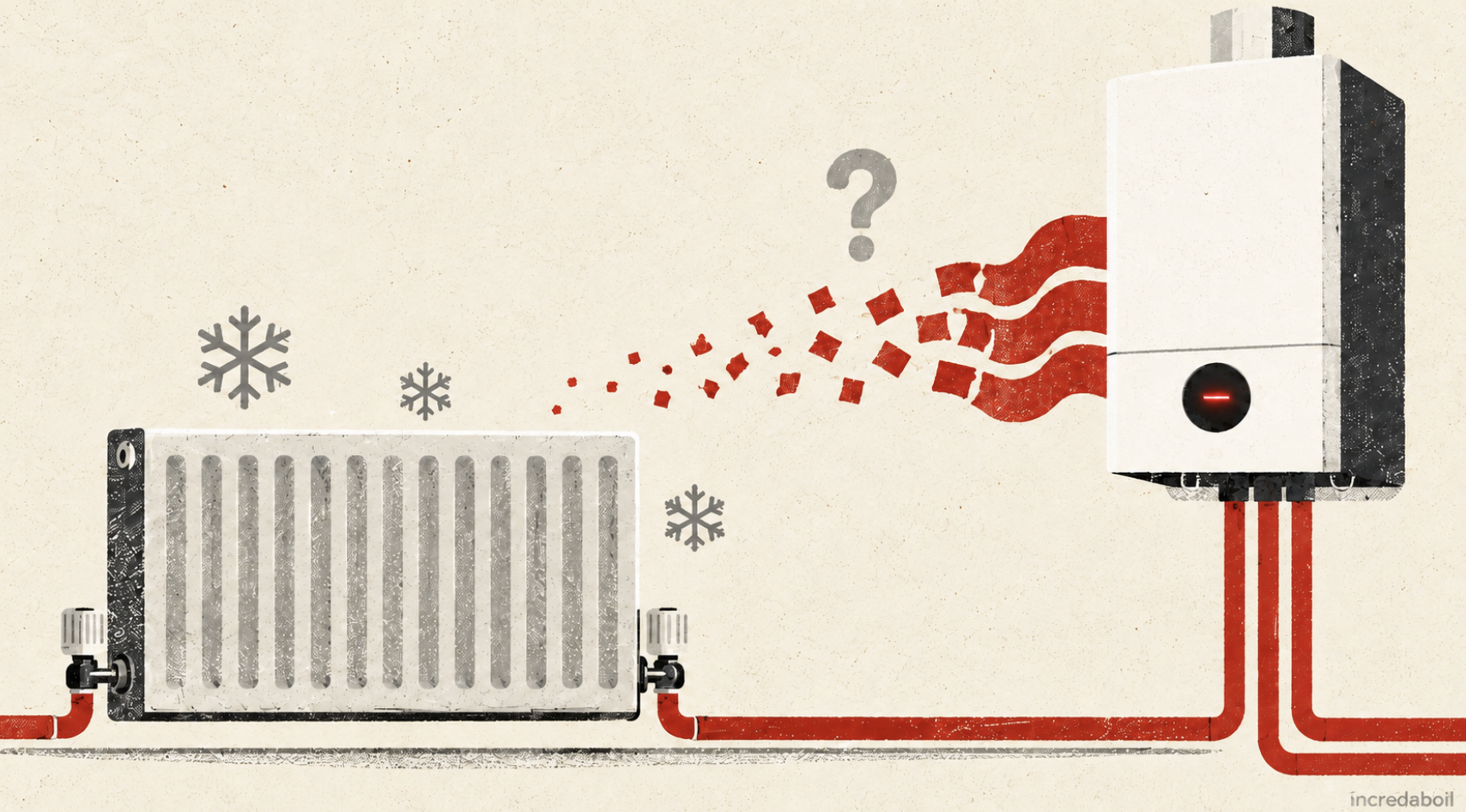
If the boiler sounds as though it is running but the radiators remain cold, first establish what “running” means. A lit display or humming pump does not necessarily mean the burner is heating water for the radiators. The boiler could be waiting, serving hot water, circulating without firing, or stopping on a fault.
This guide covers checks you can make without opening the boiler or altering fixed wiring. Note the exact symptoms and follow the user instructions for your Baxi, Worcester Bosch or Ideal model.
Check whether the boiler is actually firing for heating
Turn the room thermostat several degrees above the room temperature and set the programmer to heating on. Look for a heating-demand or flame symbol on the thermostat, receiver and boiler. Allow a few minutes because some systems introduce a delay.
Listen carefully. A pump or fan can run while the burner is off. Check whether the boiler flow-temperature display rises after a heating demand. Do not rely on sound alone.
Are all radiators cold or only some?
If every radiator is cold, look first at controls, pressure, a system valve, circulation or a boiler fault. If one radiator is cold, its valves, trapped air or local blockage are more likely. If upstairs heats but downstairs does not, or one zone works and another does not, a zoned control or motorised valve may be involved.
Cold at the top commonly suggests trapped air. Cold at the bottom is more consistent with restricted flow or deposits. An entirely cold radiator with hot pipes nearby may have a closed or stuck valve. These patterns guide diagnosis but do not prove a cause.
Safe checks in order
1. Check the thermostat and programme
Confirm the correct time, day and heating period. Power cuts and clock changes can alter schedules. Replace removable wireless-thermostat batteries if needed. If the thermostat shows demand but the receiver does not, check the model-specific pairing guidance rather than opening the receiver.
2. Check radiator valves
Make sure at least several thermostatic radiator valves are turned up and that any manual valves have not been closed. Do not force a stiff valve. TRVs regulate the flow through individual radiators; Energy Saving Trust recommends using them to control rooms rather than treating every radiator identically.
A lockshield valve at the opposite end is used when balancing the system and is normally left at its set position. Randomly opening every lockshield can upset the balance and make distant radiators colder.
3. Read the boiler pressure
Check pressure when the system is cool and compare it with the exact boiler manual. Many sealed systems operate around 1 to 1.5 bar when cool, but the manufacturer range takes priority. Low pressure can prevent circulation or firing.
Only top up if the manual permits it and you recognise the correct filling control. Stop at the stated level and close the filling device fully. Repeated pressure loss needs investigation; it is not solved by endlessly adding water.
4. Feel the radiator pattern carefully
With heating on, cautiously compare the pipes and panels. Stop if anything is too hot to touch safely. If the pipe entering a radiator is hot but the panel remains cold, the valve or radiator flow may be restricted. If all flow pipes stay cold, the problem is more likely upstream.
5. Bleed only radiators that are cold at the top
Air is not the answer to every cold radiator. If the top is cold and the bottom warmer, switch the heating off and allow it to cool before bleeding. Use a cloth and radiator key, open the bleed point gently, and close it as soon as water flows steadily.
Check boiler pressure afterwards and top up only according to the manual. Worcester Bosch cautions against venting while heating is on and notes that repeated air can indicate system corrosion or gassing that needs professional attention.
6. Check for a displayed fault
Record every code or warning symbol. A circulation, pressure or temperature-related fault can leave a pump running while preventing normal heating. Use one reset only if the user manual specifically allows it. If the code returns, arrange diagnosis.
Possible causes that need an engineer
Pump or circulation problem
A pump may be stuck, underperforming or receiving the wrong control signal. Air, debris or a restriction can also limit circulation. Hearing a pump does not prove it is moving enough water. Testing and internal work belong to a competent engineer.
Motorised or diverter valve fault
Systems with a hot-water cylinder often use motorised valves to direct heated water. A combi boiler uses an internal arrangement to switch between hot water and heating. If hot water works but all radiators stay cold, a valve or its control may be relevant, but the symptom alone does not justify replacing it.
System imbalance
If nearby radiators heat rapidly while distant ones remain cool, water may be taking the easiest route. Correct balancing adjusts lockshield valves so the system distributes flow sensibly. It is a measured commissioning task, not simply opening every valve fully.
Sludge or magnetite
Dark deposits can restrict radiators, valves, pipework and boiler waterways. Baxi advises telling the service engineer if radiators have cold patches at the bottom, need regular bleeding or the system is unusually noisy. Cleaning should be based on evidence and followed by appropriate inhibitor treatment.
Incorrect flow-temperature setting
Worcester Bosch lists a low central-heating flow-temperature setting as one reason a room may not reach temperature. Increase it gradually using the normal user control if the manual permits. Do not alter installer parameters. Baxi warns that advice about lowering flow temperature differs for combis and systems with a hot-water cylinder.
Boiler control or sensor fault
The boiler may receive a demand but fail to fire or may stop because a sensor detects an unsafe condition. Record the display and sequence. Do not remove the casing, bridge controls or test internal components.
When cold radiators are normal
Radiators need not stay hot continuously. Once rooms reach target temperature, the thermostat stops demand and TRVs reduce flow. Weather and load-compensating controls may run radiators cooler for longer. A hot-water priority system may temporarily pause central heating while a cylinder reheats.
The question is whether the home reaches the selected temperature in a reasonable time, without faults or extreme unevenness.
When to book a repair
Call an engineer if all radiators remain cold despite a confirmed demand, boiler pressure is unstable, a fault returns after one reset, the boiler leaks, electrical protection trips, or the system repeatedly fills with air. Also seek help when only one zone works or when hot water works but the heating never receives heat.
Gas Safe Register says householders must not repair gas appliances themselves. If you smell gas or suspect carbon monoxide, stop troubleshooting, move to fresh air, avoid flames and electrical switches, and call 0800 111 999 in Great Britain.
What to tell the engineer
- Which radiators or zones are affected.
- Whether their inlet pipes become hot.
- Whether hot water works normally.
- The boiler pressure when cool and hot.
- Thermostat, receiver and boiler indications.
- Any code, noise, leak or recent system work.
- Whether radiators are cold at the top, bottom or all over.
Frequently asked questions
Why is the boiler hot but radiators cold?
The boiler may be serving hot water, in a delay, or unable to circulate heating water. Controls, valves, pump performance, pressure or restrictions may be involved.
Should I bleed every radiator?
No. Bleed a radiator when its pattern indicates trapped air—usually a cold top—and only while the heating is off and cool.
Can all TRVs be closed?
Closing TRVs stops flow through those radiators. System design normally provides an appropriate bypass or uncontrolled route, but do not change commissioning valves. Open the rooms you want heated.
Will resetting fix cold radiators?
A reset may clear a temporary boiler lockout, but it will not repair a stuck valve, poor circulation, imbalance or sludge. Do not repeatedly reset.
Related boiler help
Read what radiator cold patches mean, radiators cold at the bottom, normal boiler pressure and thermostat communication checks.
Boiler running but the house still cold?
Book a clear, fixed-price boiler repair visit with Incredaboil.