
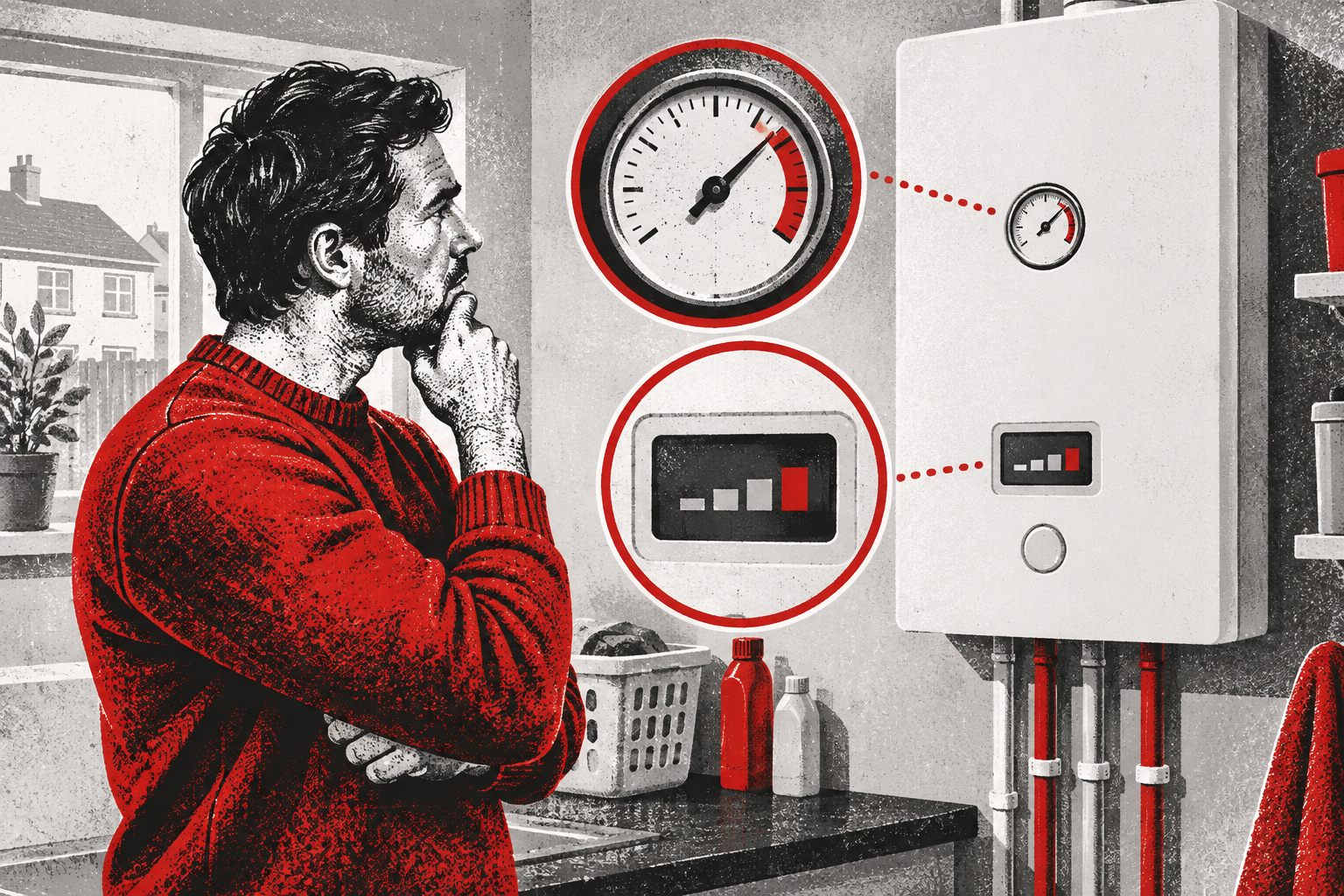
Boiler pressure display and analogue gauge do not match
A small difference between a boiler’s digital pressure reading and its round analogue gauge is not automatically a fault. They may update at different speeds, use different scales or tolerances, and one may be easier to read accurately. A large, persistent or changing disagreement should be checked.
Do not add water simply to make two indicators match. First establish what each display is showing and compare them when the heating system is cool and stable.
Make sure both readings are actually system pressure
A boiler screen normally shows its flow temperature. You may need to select a pressure menu or press an information button to see pressure in bar. A number such as 65 may be water temperature in degrees Celsius, not 6.5 bar.
The round dial may also be partly hidden beneath the boiler or behind a flap. Check the exact user manual to identify the pressure display, its units and the normal cold range. Do not use instructions for a visually similar model.
Why two correct readings may differ slightly
An analogue gauge uses a mechanical sensing element and needle. A digital display uses an electronic pressure sensor and software. Each has a permissible accuracy and resolution. A digital screen may show tenths of a bar while an analogue needle has broad markings that make an exact value difficult to judge.
The display may also refresh after a short delay. The needle can move continuously while the digital value changes in steps. A small gap that remains steady and leaves both readings within the manufacturer’s normal zone can be less important than a reading that is rising or falling.
Compare like with like
Switch the heating off using its normal control and allow the system to cool fully. Read both indicators from directly in front, in good light. A needle viewed from an angle can appear to point at a different mark.
Photograph both at the same moment. Then, if safe and the boiler has no fault warning, observe them again during a normal heating cycle. Water expands as it warms, so system pressure commonly rises when heating is operating and falls again as it cools.
Do not compare a photograph taken cold with a digital reading taken while the radiators are hot. The two readings describe different moments.
Check the scale and coloured zones
Some dials use a green area to show an acceptable operating range, while others have movable marker needles or different markings. A coloured zone is guidance for that product, not a universal rule for every boiler.
Use the model manual for the intended cold pressure. Manufacturer examples often refer to roughly 1 to 1.5 bar when cool, but exact instructions vary. If either reading is outside the stated range, do not rely on the other one to dismiss it.
Could the analogue needle be sticking?
A mechanical gauge can become slow or stick, but the homeowner cannot confirm that by tapping the case or opening the boiler. Useful evidence is a needle that never moves while the digital pressure changes normally between cold and hot, or a needle that remains in one place after the system pressure has clearly been altered by an engineer.
Do not strike the gauge, insert anything around it or remove the boiler front. An engineer can compare both indications with a test instrument and decide whether the gauge, sensor or connection is inaccurate.
Could the digital sensor be wrong?
An electronic pressure sensor or its wiring can also give an implausible reading. Warning signs include a digital value that jumps abruptly, shows a pressure fault while the mechanical gauge appears stable, or remains unchanged through a normal heating cycle.
Those signs are not proof of a failed sensor. The analogue gauge may be wrong, or the system may have a real pressure or circulation issue. Internal diagnosis and replacement belong with a competent engineer.
Do not top up to the higher reading
If one indicator reads low and the other normal, adding water can overfill the system if the low reading is inaccurate. If one reads high, releasing water can leave the system underfilled if that indicator is wrong.
Follow the manual only when the correct pressure indication is clear. If the disagreement is large enough to make that uncertain, stop and arrange a check. This is safer than repeatedly filling and bleeding to chase two different numbers.
Look at the pattern, not one number
Record both readings cold, when heating has been running, and after it cools. Note whether pressure rises by a modest amount and returns, keeps climbing while everything is off, or drops over several days.
A large rise as the system heats can point towards an expansion problem. A steady rise while cold may relate to water entering the heating circuit, including through a filling arrangement that is not fully closed. A continuing fall may indicate water loss. These patterns require diagnosis; the displays alone do not identify the faulty part.
What if the boiler is locked out?
Read and photograph the exact fault code before resetting. Check whether the user manual links it to system pressure. Use only the stated reset procedure, and do not keep resetting a fault that returns.
If the boiler will not operate and the gauges disagree, tell the engineer both readings and whether the system is cold. Do not assume the lower value is correct because it explains the lockout.
Safe observations to make
Check for visible leaks at radiators, valves and accessible pipework. Look outside for water from a boiler discharge pipe, without touching or blocking it. Note any recent topping up, radiator bleeding, power interruption or work on the heating.
Do not remove the casing, test the sensor, drain the boiler, adjust an expansion vessel or operate an unfamiliar filling device. Work on a gas boiler must be carried out by a Gas Safe registered engineer competent for that appliance.
When to arrange a repair
Arrange a check when the readings differ substantially, move in opposite directions, one sticks or jumps, either sits outside the model’s safe range, or the boiler locks out. It also needs attention if pressure repeatedly rises too high, falls, or water is discharged.
A stable photograph of both readings is valuable. The engineer can compare them with an independent measurement and investigate the system behaviour without relying on a description from memory.
What an engineer may need to establish
The first task is to confirm the actual system pressure with suitable test equipment. That separates an indication problem from a real pressure problem. The engineer can then observe how pressure changes as the system warms and cools and check whether the boiler records a pressure-related fault.
If an indicator is inaccurate, the cause may sit with the gauge, its connection, the electronic sensor, wiring or control electronics. If both indicators follow the test pressure, the real issue may instead involve expansion, filling or water loss. This is why changing a display part without measuring the system can waste time and leave the original fault untouched.
Reporting the issue in a rented home
A tenant should send the landlord or managing agent photographs showing both readings at the same time, plus the boiler make, model, fault code and whether heating or hot water is affected. State whether the system was cold or operating.
Do not keep topping up an unfamiliar boiler on someone else’s instruction if the indicators make the safe level unclear. The landlord should arrange competent diagnosis and should not ask a tenant to remove a casing or test internal components.
Common questions
Which reading should I trust?
Without testing, neither should automatically overrule the other. Use the manual, compare both when cold and arrange a check if the difference affects safe operation or topping up.
Is a difference of 0.1 bar a problem?
Not necessarily. Digital resolution, viewing angle and instrument tolerance can create a small difference. What matters is whether the gap is stable and both readings remain sensible for the model.
Can a power cut change the analogue gauge?
The mechanical gauge can usually indicate without electrical power, while a digital display cannot. After power returns, allow the boiler to complete its normal start-up before comparing them.
Related guides: What should boiler pressure be? and Why is my boiler pressure too high?
Pressure readings still disagree?
Have both indicators and the sealed system checked before adding water.