
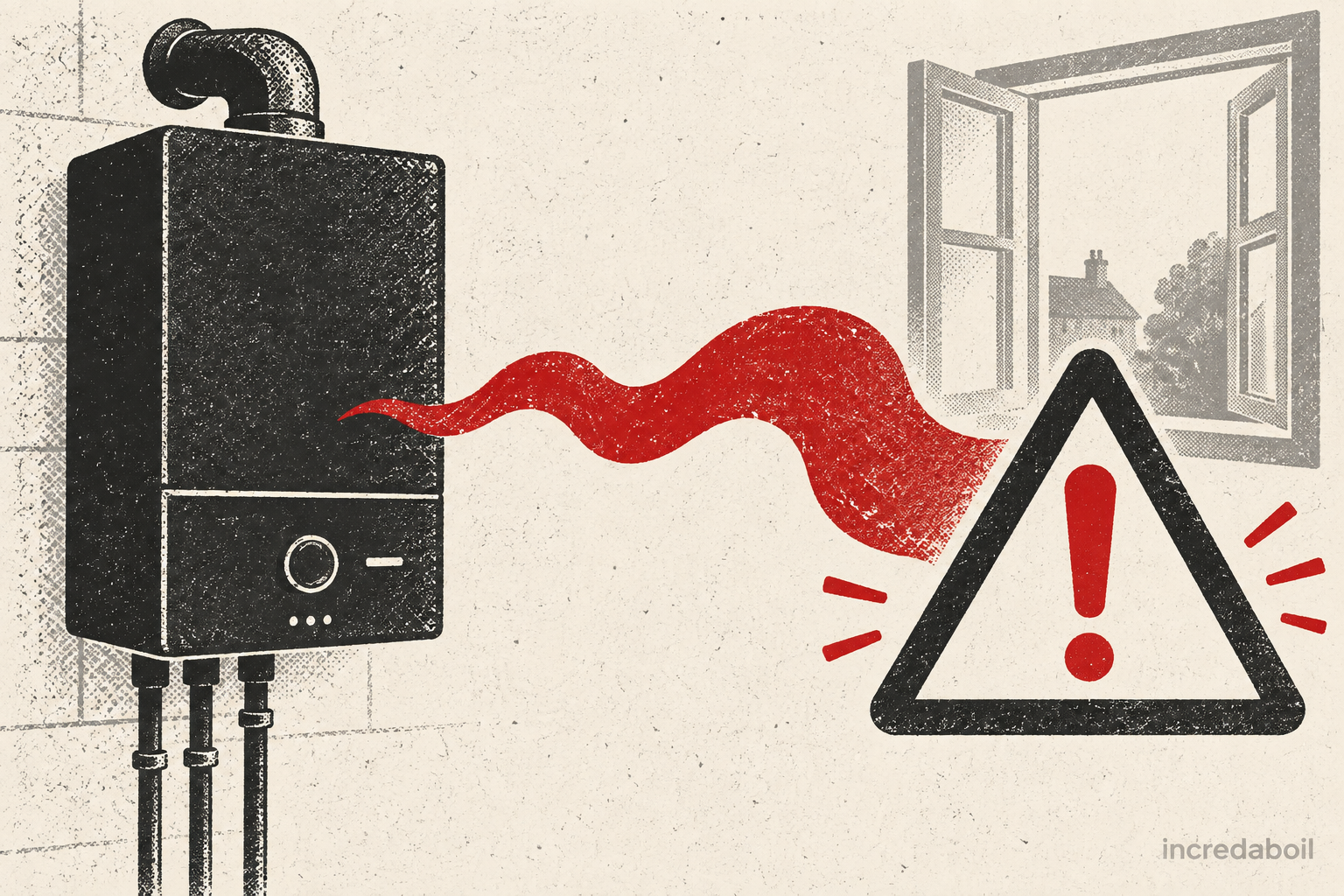
An unusual smell near a boiler should never be diagnosed by scent alone. A gas-like smell, burning or melting-plastic smell, smoke, scorching, a carbon-monoxide alarm, or symptoms such as headache and dizziness all require immediate action. Other odours may come from dust, drains, damp or nearby products, but persistent smells still need checking.
This guide separates emergencies from non-urgent observations. It does not ask you to remove the boiler case, inspect combustion parts or attempt a repair.
If you can smell gas: act now
If you smell gas or suspect a gas leak, do not investigate where it is coming from. HSE guidance says to call the National Gas Emergency Service on 0800 111 999, open doors and windows, and turn off the gas at the meter control valve if you know where it is and it is safe to reach.
- Do not smoke, light a match or use any naked flame.
- Do not operate electrical switches, plugs, doorbells or other equipment.
- Open doors and windows without operating electrical fans.
- Turn off the gas at the meter only if you can do so safely.
- Get everyone out and call 0800 111 999 from outside.
- Follow the emergency adviser’s instructions and do not return until told it is safe.
Do not delay while trying to book an ordinary boiler repair. The emergency service deals with making the situation safe; any boiler fault can be assessed afterwards by a suitably qualified Gas Safe registered engineer.
Carbon monoxide has no smell
Carbon monoxide (CO) is colourless, tasteless and odourless. You cannot confirm that a boiler is safe because there is no smell, and an unusual smell is not itself a reliable CO detector. Gas Safe Register and the NHS both emphasise that CO cannot be detected by human senses.
Possible symptoms include headache, dizziness, nausea or vomiting, weakness, tiredness, confusion, chest or muscle pain and shortness of breath. Symptoms may get worse inside the property and improve outside. If you suspect exposure, stop using the appliance if you can do so without delay, go outside and get medical advice.
Call NHS 111 if you think you may have symptoms. Call 999 or go to A&E for severe breathing difficulty, sudden confusion, loss of consciousness, weakness, or chest or muscle pain. Do not drive yourself to A&E. Also call the National Gas Emergency Service on 0800 111 999 if a gas appliance may be involved.
If a CO alarm sounds
Treat it as a warning, even if nobody can smell anything. Leave the property, seek fresh air, follow the alarm manufacturer’s emergency instructions and obtain advice before going back inside. Do not remove the battery to silence the alarm and then continue using the boiler.
A CO alarm is an additional precaution, not a replacement for correct installation, servicing and safety checks. HSE recommends an alarm meeting BS EN 50291, while landlords in England have specific duties for rooms containing fixed combustion appliances under the Smoke and Carbon Monoxide Alarm regulations.
Which boiler smells need urgent action?
A gas-like or sulphurous smell
Natural gas is given a distinctive warning odour so leaks can be noticed. People describe it in different ways, including sulphurous, egg-like or simply “gas”. Do not rely on a comparison from the internet. If you think it might be gas, use the emergency steps above.
LPG also has an added warning smell. If an LPG appliance or tank may be involved, leave the area and use the emergency details supplied for that installation or fuel supplier. Do not search for a leak with a flame or by touching fittings.
Burning, hot-plastic or electrical smells
A new burning smell, melting-plastic odour, crackling, buzzing, smoke, visible scorching or an unusually hot electrical control can indicate overheating or an electrical fault. Stop using the heating if it is safe to do so without approaching smoke or damaged equipment.
If there is smoke, flame or an immediate fire risk, get out, stay out and call 999. Do not remove the boiler case, pour water onto electrical equipment or keep resetting a tripped circuit. If there is no active fire but a burning smell returns whenever the boiler starts, leave it off and arrange urgent professional inspection.
Fumes, soot or an exhaust-like smell
Flue gases should be carried safely outside. If you notice an exhaust-like or combustion smell indoors, soot or staining around an appliance, unusual condensation, or a damaged flue, stop using the appliance, ventilate, leave the area and seek urgent advice.
Worcester Bosch operating instructions say that if flue gas is suspected, the heat source should be switched off, doors and windows opened, occupants warned, the building left and an approved contractor notified. Do not touch, patch or alter the flue.
Any smell accompanied by illness
Do not spend time identifying whether the smell is gas, fumes, cleaning chemicals or something else when someone feels unwell. Move to fresh air and seek medical help. Tell the clinician that a boiler or combustion appliance may be involved.
Less urgent smells that still deserve attention
Dusty or warm-dust smell
Dust on radiators and nearby surfaces can smell when the heating first runs after a long break. The smell should be mild, clearly associated with warming external surfaces and fade quickly. Let the system cool before cleaning accessible radiator surfaces according to their instructions.
Do not assume a smell from inside the boiler is “only dust”. If it is strong, acrid, persistent, accompanied by smoke or returns at the appliance itself, switch it off and get it checked.
Damp, musty or mouldy smell
Damp cupboards, a small water leak, condensation or mould near—not necessarily inside—the boiler can create a musty smell. Look only at accessible surroundings for water staining or damp belongings. Do not open the casing or disturb electrical connections.
Water beneath a boiler, dripping from its case or wet electrical equipment needs prompt attention. Turn the boiler off if safe, keep people away from affected electrics and contact a professional.
Drain or sewage-like smell
Condensing boilers discharge water to a drain, so an odour may appear to come from the boiler area when its true source is a dry, damaged or poorly sealed drain connection nearby. A blocked or incorrectly arranged condensate system can also cause boiler faults.
Do not pour chemicals into boiler pipework or disconnect the condensate pipe. Note when the smell occurs and ask an engineer or plumber to identify the source.
Paint, solvent or chemical smells
Paint, aerosols, cleaning products, thinners and stored chemicals can release strong odours and may be unsafe near an appliance. Move products away only if there is no gas, fire or electrical emergency and it is safe to do so. Ventilate in accordance with their labels.
Manufacturers warn against storing combustible or chemically aggressive materials close to boilers. Vapours can be drawn toward an appliance, and corrosive chemicals can damage components. If the boiler has been exposed, leave it off and ask for professional advice.
A safe decision guide
- Gas might be present: no switches or flames; ventilate, leave and call 0800 111 999.
- CO alarm or possible CO symptoms: go outside, get medical advice, call 999 for severe symptoms and contact the gas emergency service.
- Smoke, flame or active scorching: leave and call 999.
- Burning or hot-plastic smell without smoke: stop using the appliance if safe and arrange urgent inspection.
- Fume or exhaust smell: switch off if safe, ventilate, leave and seek urgent professional advice.
- Mild dust, damp or drain smell: observe accessible surroundings, but book a check if it persists, worsens or cannot be confidently traced away from the appliance.
If you are unsure which branch applies, choose the safer response. Emergency services would rather assess a suspected leak or fire than have someone continue using an unsafe appliance.
What not to do
- Do not remove the boiler case to sniff inside.
- Do not use a naked flame, lighter or match to search for gas.
- Do not operate switches or unplug equipment if gas may be present.
- Do not tape, block or alter a flue or ventilation opening.
- Do not spray fragrances or cleaner into the boiler.
- Do not repeatedly reset a boiler associated with a burning smell or fumes.
- Do not rely on a CO alarm’s silence as proof that there is no gas leak or other fault.
- Do not ask an unregistered person to open or repair a gas boiler.
Information to give the engineer
Once any emergency has been made safe, record the boiler make and model, when the smell began, whether it occurs during heating or hot-water demand, how long it lasts and whether there are noises, leaks, soot, error messages or electrical trips. Mention recent decorating, cleaning products, building work or drain problems.
Do not recreate the smell deliberately. A photograph of visible staining or a fault display can help, but never approach smoke, suspected gas or unsafe electrical equipment to take one.
Baxi, Worcester Bosch and Ideal boilers
Baxi
Baxi’s repair guidance treats a suspected gas or CO leak as an emergency, directing UK users to 0800 111 999 and advising ventilation, avoidance of electrical equipment and naked flames, and isolation at the gas meter. This emergency advice takes priority over ordinary fault-finding.
Worcester Bosch
Worcester Bosch safety instructions distinguish gas and flue-gas concerns but require urgent action for both. They also say the appliance casing must stay fitted and closed during operation and that only a competent engineer should remove it.
Ideal
Ideal user manuals carry gas-escape instructions and direct users toward the National Gas Emergency Service. Exact layouts and shutdown controls vary by model, so use the emergency principles rather than copying a model-specific repair sequence.
Landlords and tenants
In England, relevant landlords must provide a CO alarm in any room used as living accommodation that contains a fixed combustion appliance, except a gas cooker, and repair or replace a reported faulty alarm after checking it. Requirements differ across UK nations, so landlords should follow the rules for the property’s location.
A tenant should report unusual boiler smells, alarm faults and visible signs promptly, but should still call the emergency services directly when gas, CO or fire is suspected. Do not wait for a landlord or managing agent to answer before leaving danger.
Frequently asked questions
What does a gas leak smell like?
Gas supplied to homes has an added warning odour that people often describe as sulphurous or egg-like. Descriptions vary. If you suspect gas, do not test the smell—leave and call 0800 111 999.
Can carbon monoxide smell like gas?
No. Carbon monoxide itself has no smell, colour or taste. A smell may indicate another combustion or appliance problem, while CO could also be present without any smell.
Is a dusty smell normal when heating starts?
A mild smell from dust warming on external radiators can happen after a long period without heating and should fade. A strong, acrid, smoky or persistent smell at the boiler should not be dismissed as dust.
Should I turn the boiler off if it smells?
If gas is suspected, avoid electrical switches and follow emergency advice rather than approaching the boiler. For burning or fume smells without suspected gas, switch it off only if safe, ventilate and seek help. If there is smoke or fire, leave and call 999.
Can I still use hot water while waiting?
Not if the appliance is the suspected source of gas, fumes, burning or CO. Leave it off after the emergency has been made safe until a competent person confirms it can be used.
Related boiler-help guides
- What to do when a carbon-monoxide alarm sounds
- Boiler display is blank but power is on
- Boiler humming or vibrating: what the noise may mean
- Why is my boiler leaking water?
Unusual boiler smell after the emergency is safe?
For a non-emergency fault on an eligible Baxi, Worcester Bosch or Ideal boiler, book a fixed-price Incredaboil repair visit and have the cause professionally checked.