
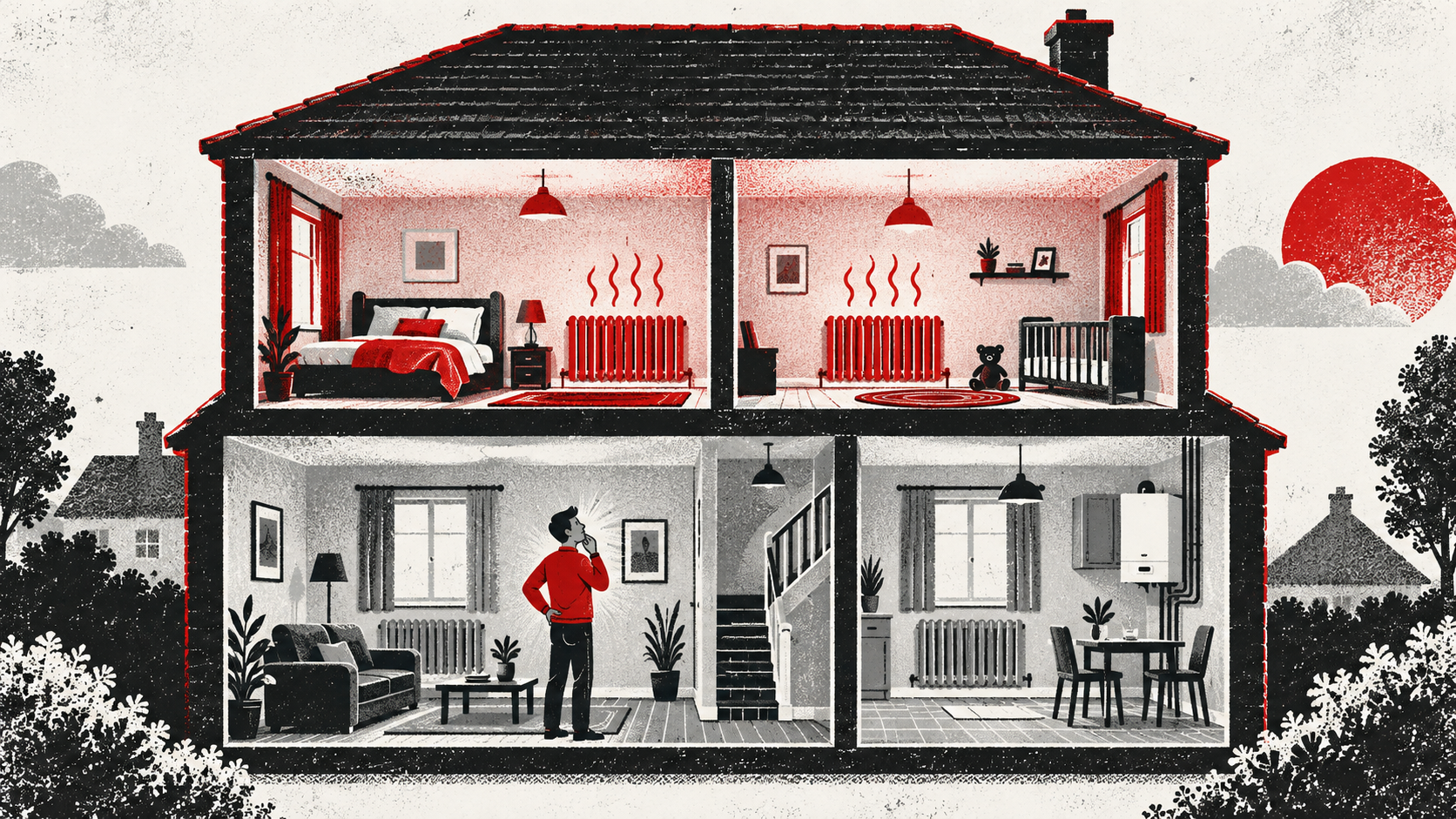
Boiler works upstairs but downstairs radiators stay cold
Hot upstairs radiators show that the boiler can produce heat, but they do not prove every heating zone or pipe branch is receiving flow. When an entire downstairs area stays cold, start with floor-by-floor controls and the pattern of the pipes and radiators you can safely observe.
Do not open the boiler, wiring centre, pump or motorised valve. Several different faults can create the same upstairs-hot, downstairs-cold symptom.
First decide whether downstairs is a separate zone
Some homes have one thermostat for the whole property. Others divide heating into zones, often by floor, with separate thermostats, schedules and motorised valves. Energy Saving Trust notes that systems can use separate programmable thermostats upstairs and downstairs.
Look at the controls you normally use. If there is a downstairs thermostat or zone in an app, confirm it is on, scheduled correctly and set above the current room temperature. Do not assume an upstairs demand automatically opens a downstairs zone.
Check the downstairs thermostat and receiver
If the thermostat is wireless, look for a low-battery warning and replace only user-replaceable batteries as described by its manual. Check that the displayed time and day are correct after a power cut or clock change.
Watch for the normal call-for-heat symbol. If the thermostat appears to call but its receiver does not respond, or the receiver responds but downstairs remains cold, record that sequence for the engineer. Do not remove covers or touch wiring.
Make sure the room is not already satisfying the thermostat
A thermostat in a warm hall, near direct sunlight or close to another heat source can switch its zone off while colder rooms still need heat. Furniture or curtains can also interfere with air movement around it.
For a short observation, set it slightly above the displayed room temperature. Return it to a comfortable setting afterwards rather than leaving it at maximum.
Check the visible radiator controls
Make sure downstairs thermostatic radiator valve heads are not all at zero or frost protection. TRVs control the flow through individual radiators and may close when the air around them reaches their setting.
If every downstairs valve appears open but the floor remains cold, a shared zone or circulation issue is more plausible than every radiator developing the same separate fault. Leave valve bodies and lockshields intact.
Compare one radiator with the rest
If one downstairs radiator heats while the others stay cold, the shared downstairs zone is at least receiving some hot water. Focus on each cold radiator’s valve, air pattern or local branch. If none warms, look at controls and shared circulation.
Note whether the accessible pipe at either end begins to warm. A warm inlet with a cold radiator differs from both pipes remaining cold. Avoid touching metal that may be very hot.
Cold tops and cold bottoms mean different things
A radiator cold at the top but warmer below may contain trapped air. If you are confident and the manufacturer allows it, switch the heating off, allow the radiator to cool and follow the correct bleeding instructions.
A radiator warm at the top but cold along the bottom can indicate debris restricting flow. Bleeding is unlikely to clear that pattern. Do not add chemicals or start flushing based on touch alone.
A downstairs zone valve may not be opening
In a zoned system, a motorised valve can control the water sent to each floor. Official control-system layouts show separate floor zones operating through their own controls and valves.
A failed actuator, stiff valve or control signal can leave one floor cold while another works. Those possibilities need electrical and temperature testing. Do not remove the motor head or wiring-centre lid.
Balancing can favour one part of the home
If upstairs radiators become very hot quickly while downstairs radiators warm weakly or only after upstairs valves close, water may not be shared evenly. The layout, pump setting and lockshield balance all affect the route water takes.
Randomly closing upstairs lockshields is not a reliable fix. It can move the problem, create noise and lose commissioned settings. An engineer can balance the system using measured temperature differences.
A pump or restriction can create the same pattern
A circulation pump that is not moving enough water, an airlock, a partially blocked branch or debris in the system can all leave one area short of flow. Gravity does not make hot upstairs radiators proof that the pump is healthy.
The exact cause cannot be identified safely from floor position alone. Pump, filter, valve and pipework checks should be handled by a competent heating engineer.
Recent work is an important clue
Tell the engineer if the problem began after a radiator change, drain-down, smart-control installation, extension or other plumbing work. A valve may have been left shut, air may be trapped or a control may be assigned to the wrong zone.
Do not reopen service valves or commissioning controls yourself. Simply record what changed and when the symptom began.
What if the downstairs warms only when upstairs is turned down?
That strongly suggests a distribution issue rather than the boiler being unable to make heat. It can be useful evidence about balance, resistance or pump performance, but it is not proof of one failed component.
A single careful observation is enough. Avoid repeatedly forcing valves shut to drive water elsewhere.
When to arrange a repair
Arrange a check if a downstairs zone does not respond to its controls, all downstairs radiators remain cold, the symptom is new, or the boiler cycles, locks out, leaks or makes new noises. Share the floor-by-floor pattern and any recent system work.
If you smell gas, suspect carbon monoxide or a carbon monoxide alarm sounds, leave the building and follow emergency gas advice. Do not continue troubleshooting.
Common questions
Can the boiler be working if a whole floor is cold?
Yes. Hot upstairs radiators confirm heat production and some circulation, but a separate downstairs zone or branch may still be closed or restricted.
Should I bleed every downstairs radiator?
Only bleed radiators showing a cold-top pattern and only when the system is off and cool. An entire cold floor with cold pipes is more likely to need a shared control or circulation check.
Why do downstairs radiators heat after I turn upstairs valves down?
Closing upstairs flow can divert more water downstairs. That points towards distribution or balancing, but proper measurements are needed before changing settings.
Related guides: Downstairs radiators hot but upstairs cold, Normal pressure but radiators cold and How radiator balancing works.
Downstairs still cold?
Have the zone and circulation properly checked.