
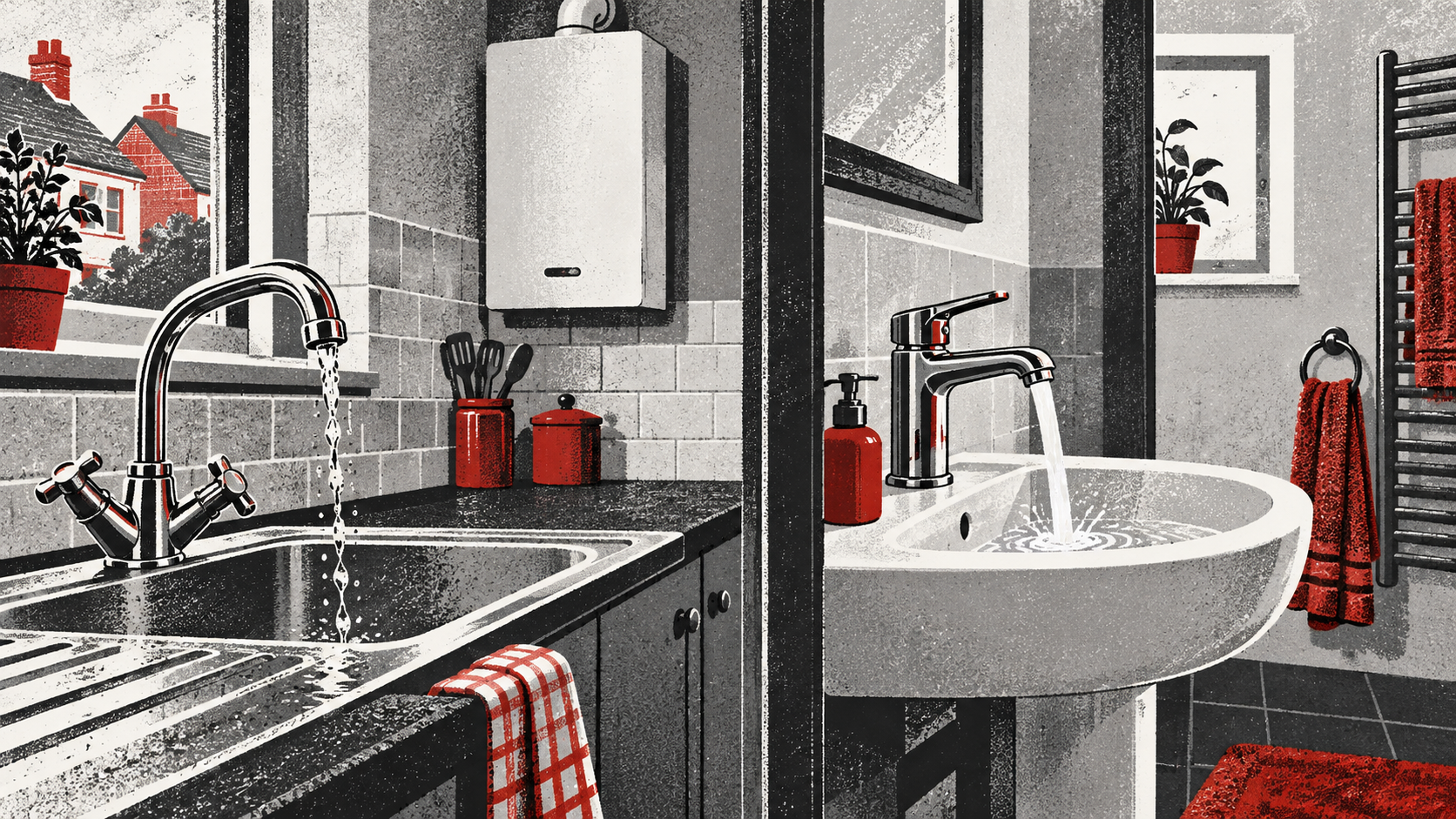
Can a boiler fault affect only one hot tap?
It is possible, but if every other hot tap works normally, the affected tap, its mixer, a flexible connector or the local pipe run is usually the first place to investigate. A combi-boiler fault more often affects hot water throughout the home. Compare outlets carefully before deciding where the problem starts.
Do not remove the boiler casing or adjust service valves beneath it. Use normal tap controls only, and take care with unexpectedly hot water.
First define what “not working” means
One tap may have no flow, weak flow, water that stays cold, temperature that surges, sputtering or a delay before it becomes hot. Each pattern points to a different part of the system.
Write down the exact symptom. “The bathroom hot tap is weak but gets hot” is more useful than “the boiler does not work upstairs”.
Compare at least two hot outlets
Run the affected tap at a normal washing flow, then compare a kitchen or basin hot tap after the pipework has cooled. Do not use a thermostatic shower as the only comparison because it has its own mixing and safety controls.
If the boiler responds normally and another hot tap reaches a steady temperature, the boiler is clearly capable of producing hot water at that moment.
One outlet can have its own restriction
Taps can contain aerators, flow restrictors, cartridges and small waterways. Flexible hoses beneath a basin can kink or deteriorate. Any of these can reduce flow at one outlet while the rest of the home remains normal.
Look for an obviously crushed hose or external leak without dismantling anything. Tap repair and isolation should be left to a competent plumber if you are not certain how the outlet is installed.
A mixer tap has separate hot and cold paths
A mixer can produce a strong stream even when its hot side is restricted because cold water is still flowing. Test the hot position on its own and compare the volume with the cold position.
A worn or obstructed cartridge may also blend too much cold water into one tap. That can make the water lukewarm even though genuinely hot water reaches other outlets.
Thermostatic showers are a special case
A thermostatic shower mixes hot and cold water and may limit the outlet if its filters, cartridge or temperature control are not working correctly. A shower-only problem does not prove a boiler fault.
Do not remove the shower valve or defeat its temperature stop. Compare an ordinary hot tap nearby and arrange a plumbing check if the shower remains the only affected outlet.
Flow matters to a combi boiler
A combi boiler detects hot-water demand when water flows through it. Worcester Bosch technical information shows that the minimum flow needed to start hot-water demand varies by model.
If one very low-flow tap sits close to that threshold, the boiler may not recognise the demand reliably. A different tap with a stronger flow may start it immediately. The cause can still be local to the slow outlet rather than an internal boiler fault.
Watch the boiler display from outside
Open the affected tap and note whether the boiler shows a hot-water or burner symbol. Repeat once with a known-good tap. Photograph any exact code or message.
If the boiler responds to the good tap but not the weak one, tell the engineer or plumber. Do not keep opening and closing taps to force repeated ignition attempts.
A long pipe run can create a delay
An upstairs bathroom or distant extension may contain more cooled water between the boiler and the tap. It can therefore take longer for hot water to arrive even when the final temperature is normal.
Time the delay once at an ordinary flow. A long but repeatable delay is different from water that never becomes hot or repeatedly changes temperature.
Other water use can affect one outlet more
Worcester Bosch advises that mains pressure and available flow are not the same thing. When another tap, toilet or appliance uses water, dynamic flow to a combi can fall.
A restricted or distant outlet may show the effect first. Repeat the comparison when no washing machine, dishwasher, toilet cistern or second tap is taking water.
Recent plumbing work is an important clue
If the problem began after a tap replacement, bathroom work or a water shut-off, mention it. A partly reopened isolation valve, disturbed debris, trapped air or a changed flow restrictor may affect only the altered branch.
Do not operate unfamiliar valves to experiment. Photograph their current position and ask the installer or a plumber to check the work.
When the boiler could still be involved
An internal hot-water fault can appear more clearly at one outlet because different taps demand different flow rates. A boiler that struggles at low demand may behave at a bath tap but cycle at a small basin tap.
If temperature changes occur at several outlets when tested under comparable conditions, or the boiler display cycles and shows a fault, the evidence points more strongly towards the appliance or shared supply.
Stored hot-water systems need a different comparison
If you have a cylinder, one cold or weak hot tap can relate to local pipework or a mixer, while a cylinder problem normally affects multiple outlets. Vented and unvented cylinders have different controls and safety devices.
Do not operate cylinder safety valves or dismantle fittings. Work on an unvented cylinder requires appropriate competence.
What to record before arranging help
List the affected outlet, whether its cold side is normal, the flow strength, the highest temperature reached, how long it takes and whether other water use changes the symptom.
Also record the boiler display, make and model, any recent plumbing work and which other hot taps work correctly. A short video of the flow and display can be useful.
When to stop using the outlet
Stop if the water becomes dangerously hot, the tap or pipework leaks, there is banging, discoloured water persists, or electrical fittings are getting wet. Isolate the outlet only if you know the normal user control for it.
If you smell gas or suspect carbon monoxide, follow emergency gas advice rather than continuing tap tests. Call the National Gas Emergency Service on 0800 111 999.
Who should investigate?
A plumber can assess the tap, local valves and pipework. If the evidence points to the boiler, work inside a gas appliance must be carried out by an appropriately qualified Gas Safe registered engineer.
Give them your outlet comparison so they can start with the most likely part of the system instead of trying to reproduce a vague intermittent symptom.
Common questions
Why is one hot tap cold but the others are hot?
A mixer cartridge, local restriction or very low flow may prevent that outlet receiving or requesting hot water correctly. Compare its hot-only flow and boiler response.
Can limescale affect only one tap?
Yes. Deposits or debris can restrict an aerator, cartridge or small local waterway, although the correct remedy depends on the outlet design.
Why does the bath work but the basin does not?
A bath tap usually has a higher flow. A combi may recognise that demand while a restricted basin tap falls near the boiler’s minimum start flow.
Should I turn up the boiler temperature?
Not to diagnose a single-outlet fault. If other taps are already hot, raising the boiler setting can increase scald risk without fixing the local problem.
Related guides: Hot taps sputter but cold taps are normal, Hot water reaches taps at different speeds and Hot water keeps going hot and cold.
One hot tap still misbehaving?
Have the outlet, flow and boiler response checked.