
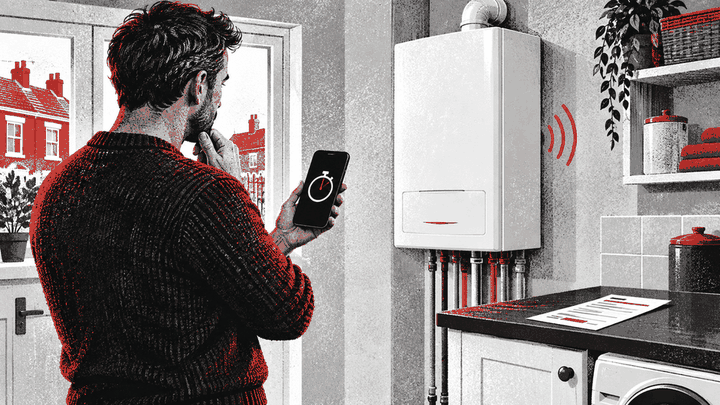
Can a boiler pump run for longer after a service?
Yes, a circulation pump can keep running after the burner has stopped. This is usually called pump overrun: it moves residual heat away from the boiler. The duration is not universal, though, and noticing a longer run after a service does not prove that the engineer changed anything. Compare like with like, check the service record and ask the servicing business if the new pattern is persistent.
A brief, repeatable period of pump noise after heating or hot-water demand ends can be normal. Manufacturer examples range from a few minutes to model-dependent settings and temperature-led operation. Record what demand had just ended, whether the burner symbol went out, how long the sound continued and whether the house heated normally. Do not open the boiler or alter installer settings.
What pump overrun is doing
When a boiler stops firing, heat remains in its heat exchanger and nearby water. Continuing circulation can carry that heat into the system rather than leaving it concentrated inside the appliance. The sound can be a low hum or gentle water movement after the flame or burner indicator has gone out.
This is an operating sequence, not automatically a fault. Worcester Bosch documentation for one Greenstar Ri model describes a three-minute pump overrun after demand ends. Its 4700iW documentation shows an installer-adjustable range on that model, while an older Worcester manual describes temperature-led overrun. Ideal documentation for a Logic+ Heat2 gives a four-minute example. These figures demonstrate variation; they are not targets for a different boiler.
Use the exact installation and user documentation for the appliance and controls in the property. Do not copy a number from another model or enter an installer menu to make the sound shorter.
Why it may seem longer just after a service
The most common explanation may simply be that you are paying closer attention. An annual service normally includes operational checks. The engineer may run the boiler, test controls and leave the system hot shortly before departing. A hotter appliance or a different final test can make an existing overrun more obvious.
There are other possibilities, but they should be checked against the written service record rather than guessed at:
- the heating or hot-water test finished under different conditions from your usual daily cycle;
- a user control, schedule or thermostat was left in a different mode;
- a model-specific setting was intentionally checked or changed;
- system water, a filter or another circulation-related item received documented attention; or
- the sound is not the pump at all, but a fan, valve, condensate movement or pipework cooling.
None of those can be confirmed from sound alone. Baxi’s service guidance says an annual service includes operational and safety checks and that the engineer should provide a service report. That report, and a direct question to the business, are better evidence than a theory based on timing.
Start by comparing the same kind of cycle
A boiler can behave differently after space heating, cylinder reheating and a short hot-water draw. Outdoor temperature, thermostat demand, flow temperature and how long the burner ran can also change what you hear.
Choose one ordinary heating cycle and record:
- the date and approximate room temperature;
- whether heating or hot water had been running;
- the time the thermostat or programmer ended demand;
- the time the burner indicator disappeared, if it is clearly identified in the user guide;
- the time the remaining hum or circulation stopped;
- whether radiators continued to warm and whether any fault code appeared; and
- whether the same sequence happened on the next comparable cycle.
Do not repeatedly force the boiler on and off to gather evidence. One or two normal cycles are more representative and avoid confusing the sequence with rapid control changes.
Make sure the sound really is the pump
A boiler and wet heating system produce several overlapping sounds. A fan can continue as part of a combustion or flue sequence. A motorised valve can move when demand changes. Condensate can trickle. Metal pipework can tick as it cools. Water can move through radiators even when the burner is no longer firing.
Keep the casing closed. Stand at a normal distance and note where the sound seems strongest, whether it is a steady hum or intermittent click, and whether visible radiator pipes remain warm. Do not touch hot pipes or remove covers to identify a component.
When longer running may still be normal
Model-specific control strategies can extend pump operation for reasons other than a simple fixed overrun. Some appliances and control arrangements use weather compensation or continuous-pump modes. Frost protection can run components when there is no normal room-heating demand. Some manufacturers also use a brief anti-seize movement after a period of inactivity.
These behaviours are appliance-specific. For example, Worcester’s information about a constantly running pump on certain Greenstar CDi arrangements lists weather compensation among the possible explanations, as well as faults that require diagnosis. It would be unsafe to use that page as a universal diagnosis for every boiler.
If the pump stops predictably, the home heats normally, no warning is displayed and there are no leaks, unusual heat, burning smells or electrical symptoms, record the pattern and check it with the servicing business. The engineer can say whether it matches the installed model and any work carried out.
When to contact the servicing business
Contact the business that performed the service if the behaviour changed immediately afterwards and remains noticeably different. Ask a precise question: “Was any pump, flow-temperature, control or weather-compensation setting changed, and is this run time expected for this model?”
Also arrange a check if:
- the pump appears to run continuously rather than for a defined period;
- the new run time becomes progressively longer;
- rooms overheat or fail to reach temperature;
- radiators stay cold despite an apparent heating demand;
- a new fault code, leak, harsh vibration or loud grinding sound appears;
- the boiler repeatedly cycles on and off; or
- the service record does not explain a change that the engineer says was intentional.
A registered engineer can compare the actual operating sequence with the manufacturer’s instructions and test circulation safely. A homeowner cannot establish pump condition, bypass operation or internal temperatures by listening alone.
What not to change yourself
- Do not open the boiler casing.
- Do not enter installer or service menus.
- Do not reduce a pump-overrun setting copied from another model.
- Do not isolate the boiler immediately after every demand just to silence it.
- Do not turn valves or adjust a bypass without model-specific professional advice.
- Do not assume that a quieter or shorter run is automatically more efficient.
HSE states that work on a gas appliance must be carried out by a competent Gas Safe registered engineer. User controls described in the appliance’s own user guide are different from internal gas, electrical and hydraulic work.
Safety signs override the timing question
If you smell gas, suspect fumes, see scorching or have a carbon-monoxide alarm, stop treating this as a pump-timing query. Follow the emergency advice for the property and contact the appropriate emergency service or a Gas Safe registered engineer. If anyone has symptoms that could be carbon-monoxide poisoning, move into fresh air and seek urgent medical advice.
A normal-looking display does not make a combustion or electrical warning safe. Do not restart or investigate a suspect appliance internally.
Questions homeowners often ask
How many minutes of pump overrun is normal?
There is no single figure. Current and historic manufacturer documents show fixed, adjustable and temperature-led approaches. Use the exact model documentation and ask the engineer who serviced it.
Did the engineer increase the run time?
Possibly, but sound alone cannot establish that. Check the service record and ask whether any control parameter was changed. Do not infer undocumented work.
Can the pump run when the burner is off?
Yes. That is the defining feature of overrun: circulation continues after heat demand or firing ends so residual heat can be moved through the system.
Does a longer run mean the pump is failing?
Not by itself. A failing component can produce noise or circulation problems, but duration alone is not a condition test. Persistent or abnormal behaviour needs model-specific diagnosis.
Should a landlord record it?
Yes. Record the service date, demand type, timing, sound and any display message, then pass that evidence to the landlord or managing agent. Do not ask a tenant to open or adjust the boiler.
The practical conclusion
A pump that runs after the burner stops can be doing exactly what the boiler was designed to do. What matters is whether the sequence is appropriate for the exact model, whether it stops predictably and whether heating performance remains normal.
Compare equivalent cycles, preserve the service record and ask the servicing business what was checked or changed. If the pump runs continuously, the behaviour worsens or another fault symptom appears, arrange a Gas Safe registered diagnosis rather than altering internal settings.
Unsure about a new post-service sound?
Have the boiler and circulation sequence checked against the manufacturer’s instructions.