
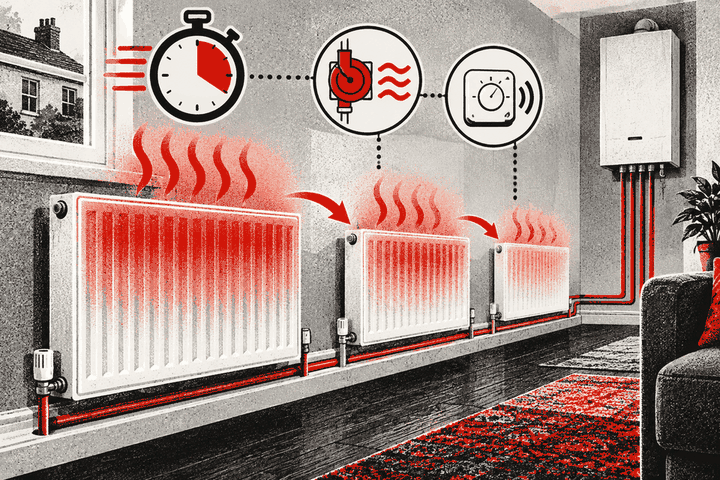
Can a boiler service change how quickly radiators warm up?
Yes, although a routine boiler service is not intended to transform the whole heating system. Radiators may warm differently if the engineer corrected system pressure, cleaned a serviceable filter, vented air, tested controls or changed an installer setting for a valid reason. Weather, thermostat demand and radiator valves can also make the timing look different even when nothing was altered.
Compare like with like: start from a similarly cold home, use the same programme and thermostat setting, open the usual radiator valves and note the outdoor conditions. Check which radiator warms first, whether they eventually heat evenly and whether pressure remains stable. If warm-up is markedly worse, rooms stay cold or the boiler faults, contact the servicing business.
Warm-up time is not one boiler measurement
The time a room takes to feel warm depends on water temperature, flow rate, radiator size, building heat loss, outdoor temperature and the starting temperature of the fabric and furniture. A boiler can reach its target quickly while a cold house still needs time.
Energy Saving Trust notes that homes take longer to warm in very cold weather and that raising a room thermostat does not make the home heat faster. Compare two similar days before deciding the service changed performance.
What a typical service may affect
A service includes safety and operating checks and may include checking controls, pressure, visible leaks and relevant filters. The engineer may run the heating while testing. If a restriction or control problem was corrected, circulation can improve; if settings were left different, warm-up can slow.
Ask for the service record and what was changed. Do not infer that every difference was caused by the visit, but the timing makes a clear explanation reasonable.
Pressure correction can change circulation
A sealed system with inadequate pressure may circulate poorly or show a fault. Restoring the manufacturer-specified cold pressure can make radiators warm more consistently. The correct value varies by boiler and installation, so use the user handbook.
If pressure falls again, record the reading and look for visible water without removing covers. Repeated topping-up is not a substitute for finding a leak or expansion problem.
Cleaning a filter may improve flow
Some systems have a serviceable magnetic or mechanical filter. Energy Saving Trust includes cleaning relevant filter systems among typical service work. Removing collected debris can reduce restriction, although the effect depends on the system and condition.
A boiler service is not automatically a full system flush. If radiators remain patchy or cold at the bottom, ask whether further diagnosis is needed. Our guide to radiators cold at the bottom explains the safe observations to make.
Air can change the first heating cycle
Work that disturbs water may release or introduce air. A radiator with trapped air often stays cooler at the top and may gurgle. The engineer should leave the system correctly vented, filled and tested.
If you bleed a radiator using an approved user procedure, check whether the sealed-system pressure then needs correction as described in the boiler manual. Persistent air or falling pressure needs an engineer, not repeated bleeding.
Flow temperature matters
The boiler flow temperature is the temperature of water sent towards the radiators. Lowering it can improve condensing efficiency, but Energy Saving Trust warns that setting it too low may stop radiators becoming hot enough to warm the home, especially in cold weather.
If the flow temperature was changed during the visit, ask why and what setting was left. Combi boilers often allow separate central-heating and hot-water controls; system and regular boilers serving a cylinder have different requirements. Do not copy a setting from another home.
Pump operation and system resistance
The circulating pump must move enough water through the system. Some modern pumps modulate with boiler load, while manufacturer service menus can define minimum and maximum operation. Incorrect adjustment can affect noise and how quickly distant radiators receive heat.
Pump parameters are installer settings. Homeowners should not change them. Report whether the nearest radiators warm quickly while distant ones remain cold, because that pattern helps diagnose circulation.
Balancing changes the order radiators warm
A balanced system distributes flow so radiators receive an appropriate share. Manufacturer installation guidance includes adjusting lockshield valves to achieve a design temperature drop. If valves were moved during testing or other work, the warm-up order may change.
Fast heat at one radiator is not necessarily better if it starves another. Judge the final comfort across the property, not which panel becomes hot first. Full balancing should be carried out by someone who understands the system design.
Thermostatic radiator valves affect flow
TRVs regulate water flow according to room temperature. Energy Saving Trust recommends setting each valve to the lowest level that keeps the room comfortable. A warm room or heat trapped around a covered valve can make it close early.
Check that valves moved for service testing were returned to their intended positions. Do not force a stuck head or remove valve components. Note whether a radiator stays cold with the room genuinely below the chosen setting.
Room thermostat and programme changes
If the thermostat setting, schedule or operating mode changed, the heating may start later or stop earlier. Make sure the programmer is in its intended Auto mode and the room thermostat is calling for heat during your comparison.
A higher thermostat setting does not make radiators heat faster; it simply keeps the demand active until a higher room temperature is reached. Restore agreed settings rather than using extremes as a test.
Boiler modulation can look slower
Modern boilers reduce burner output as demand changes. A gradual, controlled warm-up can be normal and efficient. The display flame or temperature may rise and fall rather than remaining at maximum.
Do not judge performance from one display number. Check room comfort, radiator pattern, fault history and whether the boiler cycles excessively. Product-specific behaviour belongs in the manufacturer guide.
Measure consistently
Choose a normal heating period after the system has been off long enough to cool. Record indoor and approximate outdoor temperature, thermostat setting and the time heat demand begins. Touch only the accessible radiator surface carefully and note when each becomes warm; surfaces can become hot.
Repeat on another comparable day. A phone infrared accessory or domestic thermometer can be misleading if used incorrectly, so a consistent simple log is often more useful than precise-looking numbers.
What counts as a meaningful deterioration?
- Radiators that previously heated now remain cold.
- One part of the home warms while another no longer does.
- The boiler repeatedly starts and stops without warming rooms.
- Pressure falls, rises sharply or a leak appears.
- New rushing, knocking or grinding accompanies slow circulation.
- A fault code, lockout or loss of hot water occurs.
These signs justify contacting the servicing business promptly. Give them the comparison notes and service record.
When faster warm-up still needs checking
Faster is not always proof of improvement. Extremely hot radiators, overshooting rooms, new pipe noise or very short boiler cycles can indicate that settings or flow distribution need review. Efficient operation balances comfort, control and suitable return temperature.
Do not reduce every lockshield or alter the boiler to compensate. Ask the engineer to verify commissioning values and the control sequence.
Keep safety boundaries clear
Homeowners can check schedules, thermostat and TRV positions, visible pressure, exposed pipe leaks and radiator heat patterns. Keep the boiler casing closed. Do not adjust pump settings, bypass valves, gas rates or combustion parameters.
A Gas Safe registered engineer must handle gas-boiler work. Fixed electrical control faults may require a qualified electrician. If there is a smell of gas, follow emergency gas guidance rather than continuing a warm-up test.
For landlords and tenants
Tenants should report a clear drop in heating performance with dates, rooms affected and photographs of accessible displays. Landlords should retain the service record, confirm what changed and arrange timely follow-up, especially in cold weather or where vulnerable occupants are involved.
Do not expect tenants to balance the system or alter boiler settings. Provide correct control instructions and record any temporary heating arrangements.
Ask the engineer these questions
- Was system pressure changed?
- Was a heating filter cleaned or isolated?
- Were any radiator, bypass or zone valves moved?
- Were flow temperature or pump parameters changed?
- Was trapped air found and was the system vented?
- Did the final test confirm circulation to every zone?
Clear answers usually resolve harmless differences quickly and focus any return visit on the right part of the system.
Common questions
Should all radiators warm at exactly the same rate?
No. Pipe routes, radiator size, valve position and room temperature differ. They should ultimately deliver the intended comfort without obvious starvation.
Can servicing make radiators hotter?
It can if pressure, flow or controls were corrected, but excessive heat or noise should be reviewed.
Does a slow radiator mean sludge?
Not always. Air, valves, balance, pump operation and demand can produce similar symptoms.
Should I turn the boiler temperature up?
Not before checking controls and asking what the engineer changed. Use model-specific guidance.
The practical conclusion
A service can indirectly change radiator warm-up by affecting pressure, air, filtration, controls or installer settings. Compare similar conditions, record the heat pattern and keep all internal adjustments with a competent professional. If performance is clearly worse or faults appear, ask the servicing business to return.
Radiators behaving differently after a service?
Have circulation, balancing and boiler controls checked together.