
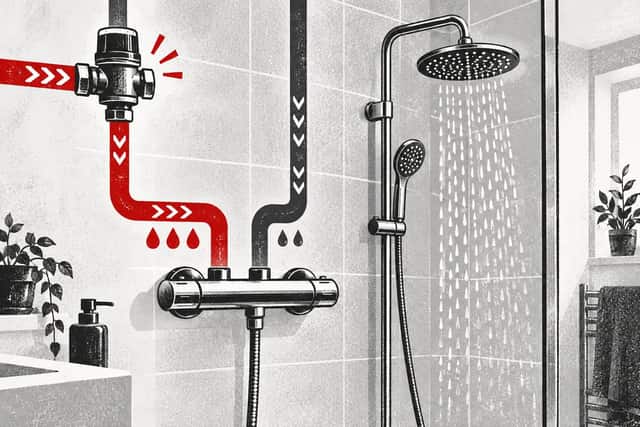
Can a pressure-reducing valve change mixer shower temperature?
Yes. A pressure-reducing valve, or PRV, changes the pressure available downstream. If it affects the hot and cold supplies differently, is set too low, is incorrectly sized or restricts flow under demand, a mixer shower may run at a different temperature or become less stable. A correctly specified thermostatic mixer should compensate within its stated operating limits, but it cannot correct every supply problem.
Do not adjust a PRV or remove shower parts by guesswork. Record whether the change followed installation or adjustment, whether every outlet is affected, and whether the shower changes when another tap or appliance runs. Stop using the shower if it becomes unexpectedly hot or fails to control temperature, especially where children or vulnerable people may use it.
What a pressure-reducing valve actually changes
A PRV takes a higher inlet pressure and regulates it to a lower downstream pressure. It protects pipework and fittings and can help other valves operate within their intended range. It does not directly choose the shower temperature.
A mixer shower chooses temperature by combining hot and cold water. The available pressure and flow on each side determine how much of each supply can reach the valve. Changing one supply can therefore change the mixture even when the temperature handle has not moved.
Reliance Valves says a PRV must be sized for the required flow at the agreed set pressure. An incorrectly sized or badly selected valve can create noise, pressure creep or inadequate performance.
Thermostatic does not mean independent of pressure
A thermostatic mixer senses mixed-water temperature and moves its internal element to rebalance hot and cold flow. Within the product’s operating range, that helps keep the outlet stable as conditions change.
WaterSafe explains that a TMV is intended to maintain a pre-set safe temperature when pressure fluctuates and to shut down if a supply fails. But every valve has minimum pressure, maximum pressure, pressure-ratio and minimum-flow limits.
Reliance’s Heatguard instructions, for example, specify operating pressure ranges and recommend dynamic pressures as close to equal as possible. They say a PRV may be fitted to the higher-pressure supply when the difference is outside the permitted ratio. Those figures are product-specific, not universal settings.
When a PRV can make the shower cooler
If the PRV reduces the hot supply more than the cold, less hot water may be available at the mixer. The thermostatic element can ask for more hot flow, but once it reaches its travel or the supply falls below the valve’s needs, the outlet may stay cooler.
A lower overall flow can also affect a combi boiler. Mira notes that if flow through a mixer shower is insufficient on a combination-boiler system, the boiler may cycle and the shower temperature may fluctuate.
The important observation is whether the temperature changes steadily, pulses hot and cold, or simply cannot reach the former maximum. Each pattern points to a different supply or product check.
When a PRV can make the shower feel hotter
If cold pressure is reduced while hot pressure is unaffected, the mixer may initially receive a greater proportion of hot water. A working thermostatic valve should react, but a sudden large change, incorrect commissioning or a fault may exceed its ability to compensate.
A shower that becomes unexpectedly hotter after PRV work should not be treated as a comfort issue alone. Turn it off, warn other users and arrange a competent check. Do not turn the temperature stop or PRV adjuster randomly to counteract it.
In England, Approved Document G requires the hot supply to a fixed bath in relevant new dwellings to be limited to 48°C. Shower and vulnerable-user settings have different requirements and risk controls, so that bath limit is not a universal DIY shower target.
Static pressure and working pressure are different
Static pressure is measured when no water is flowing. Dynamic pressure is what remains while water is being drawn. A gauge can look acceptable at rest while the pressure collapses when the shower and another outlet run.
A PRV setting therefore cannot be judged from a single no-flow number. The engineer needs the flow demand, pipe size, valve capacity, upstream conditions and downstream pressure while the relevant outlets operate.
Reliance’s commissioning checklist records both supply temperature and pressure, the pressure ratio, outlet flow and stability. That is more meaningful than turning an adjuster until the shower feels right.
One PRV may affect both supplies—or only one
A whole-house PRV near the incoming cold main can affect the cold supply directly and also the hot supply indirectly where the water heater is mains fed. That may keep the two sides broadly related.
A local PRV on just one branch changes only that route. Mixed systems, such as mains cold with gravity-fed hot, can already have a large pressure difference and may be unsuitable for some showers. Aqualisa warns that its thermostatic and digital products are not designed for certain mixed-supply arrangements.
Do not infer the pipe arrangement from the location of one visible valve. An installer should trace the supplies and identify the shower model and water system.
Why another outlet can reveal the problem
Toilets, washing machines, dishwashers and taps all create demand. Mira says using other outlets can reduce pressure to the shower and cause mixer temperature fluctuations.
Record what happens when the symptom occurs naturally: does flushing a toilet make the shower warmer or cooler, does a basin tap reduce flow, and does the change recover when that outlet closes? Do not stage a risky test with someone standing under the shower.
If the shower is already unstable, test only from outside the spray area and stop if the temperature rises unexpectedly.
A blocked head or hose can imitate a PRV problem
Restriction after the mixer reduces shower flow. Scale in the head, a kinked or collapsed hose, a clogged filter or an unsuitable flow regulator can change the operating point and may make a combi boiler cycle.
Mira’s troubleshooting guidance includes checking the showerhead and hose using the exact product instructions and warns that flow regulators are not appropriate in every application.
Clean only user-maintainable parts as directed. Do not dismantle the mixer body, strainers or thermostatic cartridge unless the manufacturer assigns that work to the user.
Did the change start immediately after PRV work?
Record the date, installer and reason for the work. Ask for the specified outlet setting, the pressure measurements under flow and confirmation that the valve size and direction match the installation.
Debris disturbed during plumbing work can reach filters and shower inlets. A newly fitted valve can also expose an existing imbalance that had previously been masked by excessive pressure.
Do not adjust the new PRV before the installer returns. Moving it removes the commissioned reference and can affect every downstream outlet.
A safe comparison without dismantling
- Run the shower from outside the spray and note the normal control position.
- Observe whether flow is strong, weak or pulsing.
- Use a suitable thermometer only if it can be done safely without contact with hot water.
- Record whether the temperature settles or continues changing.
- Note any natural simultaneous demand elsewhere in the property.
- Compare a nearby hot tap only if there is no scalding risk.
- Stop immediately if the shower becomes unexpectedly hot.
Do not use a hand or child’s bath thermometer as the only safety test for a suspected control fault. A competent person should measure and commission the valve according to its instructions.
Safety matters more than restoring the old feel
HSE explains that TMVs are used to reduce scalding risk and that vulnerable people need particular protection. In care settings, outlet temperatures and TMV performance must be monitored and maintained.
A shower that used to feel hotter is not automatically the correct benchmark. The earlier temperature may have been excessive. The objective is safe, stable operation within the shower and water-system specifications.
If anyone has been scalded, cool the burn with cool or lukewarm running water and seek appropriate medical help. Do not continue experimenting with the shower.
What not to do
- Do not turn the PRV adjuster without pressure measurements and product instructions.
- Do not remove or bypass a thermostatic cartridge.
- Do not defeat a maximum-temperature stop.
- Do not fit a random flow regulator.
- Do not assume high pressure means good shower performance.
- Do not test an unstable shower while standing beneath it.
- Do not alter a combi boiler internally to compensate for shower flow.
When to call a qualified plumber or engineer
Arrange help if temperature changed after PRV work, pressure falls sharply under demand, the shower becomes hot when another outlet opens, flow pulses, the maximum temperature cannot be controlled or the valve fails to shut down safely.
A WaterSafe-approved plumber can assess potable-water pressure controls and mixing valves. If a combi boiler cycles or shows a fault, a Gas Safe registered engineer qualified for that appliance should diagnose the boiler side.
For a related demand symptom, read whether a restricted shower valve can make a combi boiler cycle.
What to record for the visit
- Shower, PRV, boiler or cylinder make and model.
- Where the PRV sits and which outlets appear downstream.
- Whether the symptom began after installation or adjustment.
- Hot, cold and mixed behaviour at nearby outlets.
- Whether another outlet changes shower temperature or flow.
- Any gauge readings supplied by the installer.
- Whether the change is steady, delayed or alternating.
- Who may be at increased risk from scalding.
The practical conclusion
A pressure-reducing valve can change mixer shower temperature because it changes the pressure and flow available to the hot and cold sides. A correctly selected thermostatic mixer should compensate within its stated limits, but it cannot overcome an unsuitable supply arrangement, excessive imbalance, insufficient flow or a fault.
Record the timing and demand pattern, keep users away from unexpectedly hot water and have the PRV and mixer checked as one system. Do not chase the old temperature by adjusting safety controls without measurements.
Shower temperature changed after pressure work?
Keep the model details and demand pattern ready for the visit.