
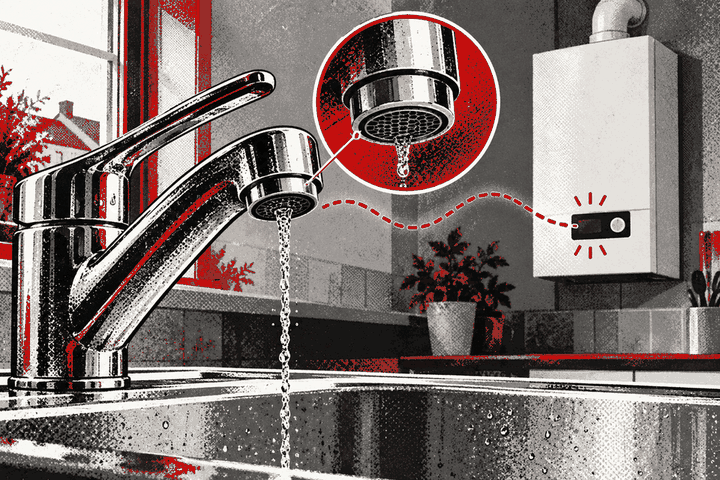
Can a tap aerator make a combi boiler fail to detect hot-water demand?
Yes. A tap aerator can deliberately limit flow, and scale or debris can restrict it further. If the hot-water flow from that outlet falls below the exact combi boiler’s activation threshold, the tap may run cold or lukewarm while a less restricted hot tap still starts the boiler normally. That makes the aerator a useful clue, but not an automatic diagnosis.
Compare the affected tap with another hot tap, one at a time, while watching only the boiler’s normal display. If another outlet produces steady hot water but the affected tap never shows a hot-water demand, a local restriction is plausible. Clean or remove the aerator only where the tap manufacturer’s user instructions permit it. Do not open the boiler, adjust an internal flow sensor or permanently remove a designed water-saving part.
Why a combi needs enough flow to recognise a tap
A combi boiler heats mains water when an outlet creates a domestic-hot-water demand. Its controls need a measurable flow before the appliance changes from standby to hot-water operation. The threshold is not the same for every boiler.
For example, current Worcester Bosch technical data for the Greenstar 8000 F Combi lists 1.9 litres a minute as the minimum required flow to activate a hot-water demand. Other models use different start and stop rates. Worcester Bosch also publishes a technical bulletin specifically about minimum flow rates on combi boilers. The correct figure must come from the manual for the boiler actually installed.
The figure at the boiler is not necessarily the same as what reaches the basin. Pipework, valves, the tap cartridge and the outlet fitting all add resistance. If one aerator limits the final outlet enough, the flow through the boiler can remain below its demand threshold even though water visibly leaves the spout.
What an aerator does
An aerator is the small fitting at the end of many tap spouts. It shapes the stream, reduces splashing and may mix air into the water. Some versions also contain a flow restrictor or pressure-compensating regulator designed to hold the flow near a specified number of litres per minute.
That reduction can save both water and the energy used to heat it. NEOPERL explains that water-saving aerators are offered at different flow rates and that regulated versions can keep the volume nearly constant despite pressure changes. A low-flow aerator is therefore not inherently blocked or defective.
The compatibility question is whether its actual hot-water flow remains suitable for the tap, plumbing system and boiler. A very low-flow setting that is comfortable on a stored hot-water system may sit too close to a particular combi’s activation point.
Designed restriction and accidental blockage are different
A designed restrictor limits flow in a controlled way. Accidental restriction develops when mineral scale, installation debris or small particles collect on the aerator’s screens and waterways. Both reduce flow, but the right response is different.
If the outlet has always delivered the same modest stream and the boiler behaviour began immediately after a new water-saving aerator was fitted, product compatibility is a reasonable question. If the tap worked normally for months and then weakened gradually, contamination or scale is more likely. A sudden change after plumbing work can also point towards disturbed debris.
Do not drill, cut or pull a flow regulator out of an aerator. If the intended flow category is wrong for the system, fit a compatible manufacturer-approved outlet component rather than modifying a safety- and performance-tested product.
The most useful comparison
- Make sure no washing machine, toilet, shower or other tap is drawing water.
- Run an unaffected hot tap at a normal useful flow and note whether the boiler shows a continuous hot-water demand.
- Close it and allow the boiler to return to standby.
- Run the affected tap fully in its hot position and observe the stream and the closed boiler display.
- Record whether the hot-water symbol never appears, appears only briefly or stays on.
- Repeat once at a similar time of day; do not keep cycling the appliance unnecessarily.
If the second tap starts the boiler but the affected one does not, the difference between the two outlet paths matters. That path includes more than the visible aerator: a partly closed service valve, kinked flexible connector, tap cartridge or local pipe restriction can produce a similar result.
If no hot outlet starts the boiler, stop treating the aerator as the main explanation. The incoming supply, boiler controls or another whole-system issue needs competent assessment.
Can I test the tap without the aerator?
Only where the tap’s own user or maintenance instructions show that the aerator is removable by the householder. Some are exposed and unscrew with a specified key; others are recessed, decorative, tamper-resistant or part of a specialist outlet. NEOPERL notes that some rectangular aerators are removable for cleaning while other versions are not removable without damage.
If removal is permitted, close the tap first, protect the finish and keep every washer and insert in the correct order. With the aerator removed, run the tap briefly into the basin while standing clear of possible hot water. A stronger stream that now keeps the boiler demand active strongly suggests a local outlet restriction.
This is a short diagnostic comparison, not a permanent configuration. Refit the cleaned, intact and compatible aerator as its instructions describe. Without it the tap may splash, use more water or deliver a harsher stream.
Cleaning must follow the tap instructions
Hansgrohe’s current maintenance guidance says a removable aerator can be soaked using a mild citric-acid-based cleaner and then rinsed thoroughly with clean water. That does not make the same method safe for every finish or every aerator. Some manufacturers prohibit particular acids, vinegar, abrasives or direct spraying.
Use the exact tap manual if available. Do not force a seized housing, grip a finished surface with bare pliers, poke metal objects through a mesh or mix cleaning products. If the aerator will not come out as described, leave it for a plumber or the tap manufacturer’s service agent.
After reassembly, check that the flow is even and that water does not leak around the housing. If the boiler now detects a steady demand, the cleaning result is useful evidence. Read why a tap can run better after its aerator is cleaned for the paired explanation.
What the result can and cannot prove
An improvement after aerator removal or cleaning shows that the outlet component affected the delivered flow. It does not prove that the boiler’s internal flow sensor is correctly calibrated, that the mains supply is adequate at all times or that the rest of the tap path is clear.
A healthy margin matters. If the boiler starts only when the tap is fully open and drops out with a small reduction, the system may be operating close to its threshold. An engineer can measure the flow at the outlet and compare it with the boiler’s model data rather than guessing from the appearance of the stream.
NEOPERL also warns that severe water reduction can contribute to temperature fluctuations depending on the mixer and system. A different approved flow category may be more suitable, but product selection should consider the tap, boiler and expected use together.
Pressure is not the same as flow
Householders often describe every weak stream as low pressure. Pressure is the force available in the supply; flow is the volume delivered over time. A blocked aerator can reduce the flow at one outlet even when the static mains pressure is unchanged.
Worcester Bosch explains that a combi needs adequate mains flow while other cold outlets are operating. A tap can therefore be affected by both a local restriction and changing whole-home demand. Compare outlets one at a time before testing shared use.
Do not use the sealed central-heating pressure gauge to judge tap flow. That gauge refers to the boiler’s closed heating circuit, not the litres per minute coming from the domestic hot tap.
Other causes when only one hot tap is affected
- A partly closed or failing local service valve.
- A kinked, twisted or internally restricted flexible connector.
- Debris or wear in the tap cartridge.
- An unsuitable replacement aerator or missing washer.
- Scale in the tap spout or nearby pipework.
- A hot-and-cold mixer interaction specific to that fitting.
If both hot and cold sides of the same tap are weak, the aerator becomes a particularly useful first clue because both supplies share the final outlet. If only the hot side is weak after the aerator is confirmed clear, look further upstream with a competent plumber.
When the boiler needs attention
Arrange a Gas Safe registered engineer when several hot outlets fail to create demand, the boiler drops in and out despite an adequate measured flow, a fault code appears, the appliance locks out or the behaviour remains after the outlet path is confirmed sound.
Do not remove the boiler casing to reach a flow switch, turbine, filter or sensor. Gas Safe Register explains that many appliance casings are integral to safe operation and should not be removed by a consumer. Internal diagnosis and repair belong with an appropriately qualified engineer.
Hot-water safety
Cleaning a restriction can produce a much stronger and potentially hotter stream. Keep children and vulnerable people away during the first test, start with the ordinary user temperature setting and stand clear until the temperature stabilises.
If anyone is scalded, NHS guidance says to cool the injury under cool running water for 20 minutes and seek the appropriate medical help. Do not apply ice, butter, creams or greasy substances.
Related questions
Why does opening a second hot tap make the first one heat up?
The additional draw may lift total boiler flow above its activation threshold. It is evidence of a flow-sensitive pattern, not an efficient or permanent workaround.
Should I fit the highest-flow aerator available?
No. Choose a flow rate compatible with the tap, system and task. Excess flow can waste water and energy, while excessive restriction may affect comfort or combi demand.
Can a new tap cause the same symptom?
Yes. The tap’s cartridge, flexible connections and supplied aerator may create a different resistance from the old fitting. Ask the installer to measure the hot flow and check product compatibility.
Does a bubbling stream mean the aerator is blocked?
No. An aerated stream deliberately contains air. Look for a new reduction, uneven jets, sideways spray or visible debris rather than judging by bubbles alone.
The practical conclusion
A tap aerator can stop one outlet creating enough flow for a combi to recognise hot-water demand. The most convincing pattern is simple: another hot tap starts the boiler steadily, the affected tap does not, and the flow improves when its manufacturer-approved aerator maintenance is carried out.
Keep the test outside the boiler, retain the correct water-saving parts and measure rather than guess. If the problem affects several outlets or remains at adequate flow, arrange a Gas Safe boiler check.
One tap not starting the combi?
Have the outlet flow and boiler hot-water response checked together.