
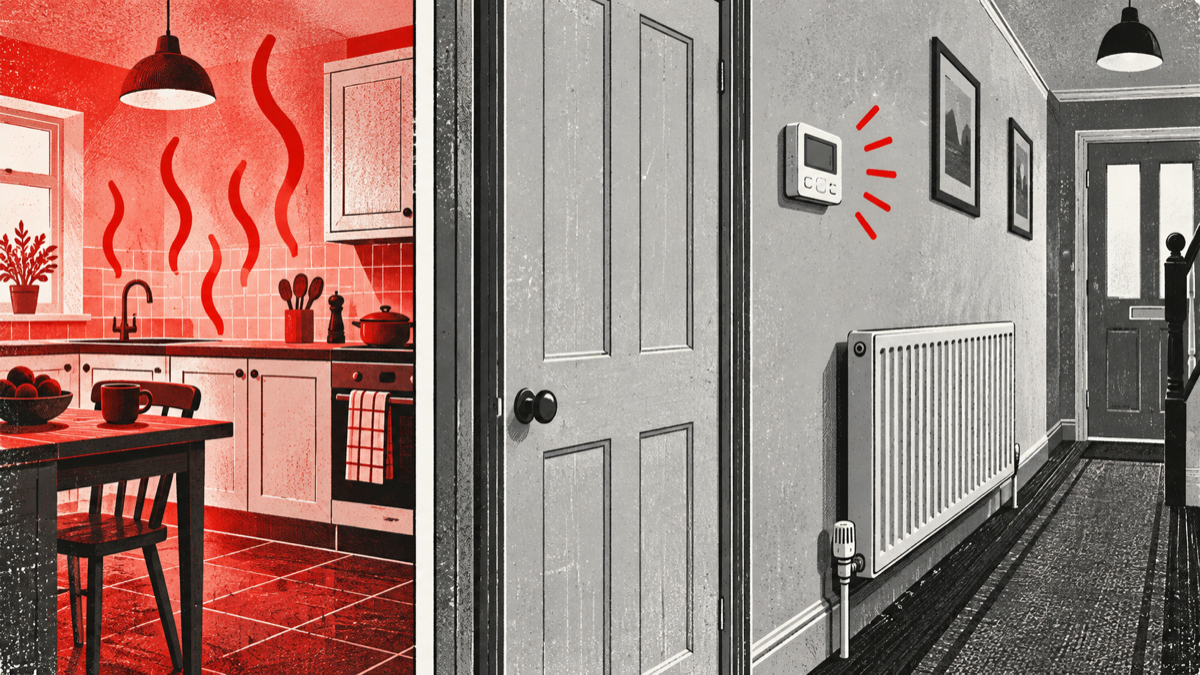
Can closing a kitchen door make the hallway thermostat run longer?
Yes. A room thermostat measures the air around itself. If an open kitchen door normally lets warm air from cooking, appliances or a kitchen radiator reach the hallway, closing that door can leave the hall cooler. The thermostat may then ask for heat for longer.
That can be a normal response to changed heat movement rather than a boiler fault. The important question is whether the rest of the home stays comfortable or becomes too warm while the hall is still trying to reach its target.
The short answer
Internal doors affect where heat moves. Energy Saving Trust notes that closing internal doors can reduce heat escaping into colder spaces such as a hall. The reverse is also true: if the kitchen was supplying useful incidental warmth to the hall, closing its door can remove that contribution.
A hallway thermostat cannot know why its location is cooler. It simply continues calling for heat until its own target is reached, the schedule ends or another control stops demand.
Why the kitchen can warm the hall
Kitchens gain heat from cooking, hot water, people, fridges, freezers and other appliances. A kitchen radiator may add central-heating warmth too. With the door open, some of that warmer air can mix with the hallway.
Closing the door keeps more heat in the kitchen and reduces air movement into the hall. The kitchen may become comfortable sooner while the hallway warms more slowly. If the main thermostat is in that hallway, the boiler or heating zone can run for longer.
The thermostat only knows its own location
A room thermostat is not an average thermometer for the whole house. Energy Saving Trust explains that it turns heating on until its chosen temperature is reached and then keeps it off until the room cools slightly.
Approved Document L uses the same basic principle in its heating-control guidance: a thermostat controls the room or zone it serves, with individual radiator controls elsewhere. Door position can change how representative that thermostat location is.
If the hallway is usually cooler than occupied rooms, the rest of the house may overheat before the thermostat is satisfied. If the hall radiator is undersized, turned down or blocked, the effect can be stronger.
Cooking can create a misleading comparison
A difference that appears only while the oven or hob is in use is likely to involve cooking heat. Compare a normal evening with cooking and a similar period without it, keeping the schedule and target unchanged.
Extractor fans can also move air through the home. A powerful cooker hood removes air from the kitchen and draws replacement air through intended vents and ordinary gaps. Door position can change that route, so note whether the extractor is running.
Do not block a vent or disable extraction to make the hallway warmer. Ventilation is needed to manage moisture and pollutants, and any ventilation serving a gas appliance must remain clear.
Check the hall radiator and nearby heat sources
Look at the accessible controls only. Is the hallway radiator warm when the thermostat is calling for heat? Is its thermostatic radiator valve, if fitted, set unusually low? Is a long curtain, large cabinet or cover trapping its warmth?
Some installations do not use a TRV on the radiator in the same room as the main thermostat, because the thermostat needs that room to warm in step with the heating demand. The exact arrangement depends on the system design.
Do not remove a valve head, turn service valves or adjust internal controls. Record what you can see and ask a heating professional if the thermostat room cannot warm properly.
A simple observation test
Choose two similar heating periods. On one, leave the kitchen door in its normal open position. On the other, close it as you usually would. Do not change the thermostat target between tests.
Record:
- the starting hallway temperature;
- the thermostat target and whether it shows heat demand;
- whether cooking and extraction are in use;
- when the hall radiator becomes warm;
- how long the heating demand lasts;
- whether other rooms become warmer than wanted.
One or two clear comparisons are enough. Do not keep running the heating solely to test the door.
What if closing the door makes other rooms hotter?
If the hall thermostat keeps calling for heat, radiators elsewhere may continue receiving hot water. Their TRVs should reduce flow as their rooms reach the selected level, but settings, valve condition and system balance affect the result.
A very warm kitchen with a cool hall can therefore coexist with hot bedrooms or living rooms. Raising the hallway target is unlikely to solve that imbalance and may increase overheating.
For the wider principle, read how closed internal doors affect a heating thermostat.
Could a draught be involved?
Closing the kitchen door may alter air movement from an outside door, letterbox, stairwell or extractor fan. A cold draught passing the thermostat can make it read lower than the centre of the hall.
Check from a normal standing position whether the effect follows a particular outside door or strong weather. Do not hold a flame, smoke source or hot object near the thermostat. Do not cover the control.
If the thermostat is beside a persistent draught, see why a draught near the thermostat can extend heating demand.
When the behaviour needs checking
Arrange help if the hallway never reaches a normal target, the heating runs far longer than before, the radiator stays cold during demand, the thermostat reading appears stuck, or other rooms repeatedly overheat.
A weak radiator flow, unsuitable thermostat position, stuck valve, communication problem or incorrectly configured zone can produce a similar symptom. A professional can check the controls and heat distribution without guessing at internal boiler parts.
What not to do
Do not move a wired thermostat, open its backplate, bridge a receiver or remove the boiler case. Do not set the thermostat much higher in an attempt to heat the hall faster; a higher target usually makes demand last longer rather than increasing the designed heating rate.
Do not leave a fire door wedged open for heating comfort. Door safety requirements take priority over heat movement.
For tenants and landlords
A tenant can report the door position, thermostat reading, schedule, cooking and extractor use, hall-radiator response and which rooms overheat or remain cold. That information is more useful than saying the boiler is always on.
A landlord should consider whether the control location and heat emitters work for the property’s normal use. A tenant should not have to keep a kitchen door open constantly to make the heating control behave sensibly.
The practical conclusion
Closing a kitchen door can make a hallway thermostat run the heating longer because warm kitchen air no longer reaches the hall. The thermostat is responding to its own cooler location, not directly to the kitchen or every room in the home.
Compare the pattern with the door open and closed, keep cooking and extractor use in mind, and watch whether other rooms overheat. If the hall cannot reach target or the controls no longer behave consistently, arrange a professional heating-controls check.
Hall thermostat keeping the heating on too long?
Keep the door-position and room-temperature notes ready for a controls check.