
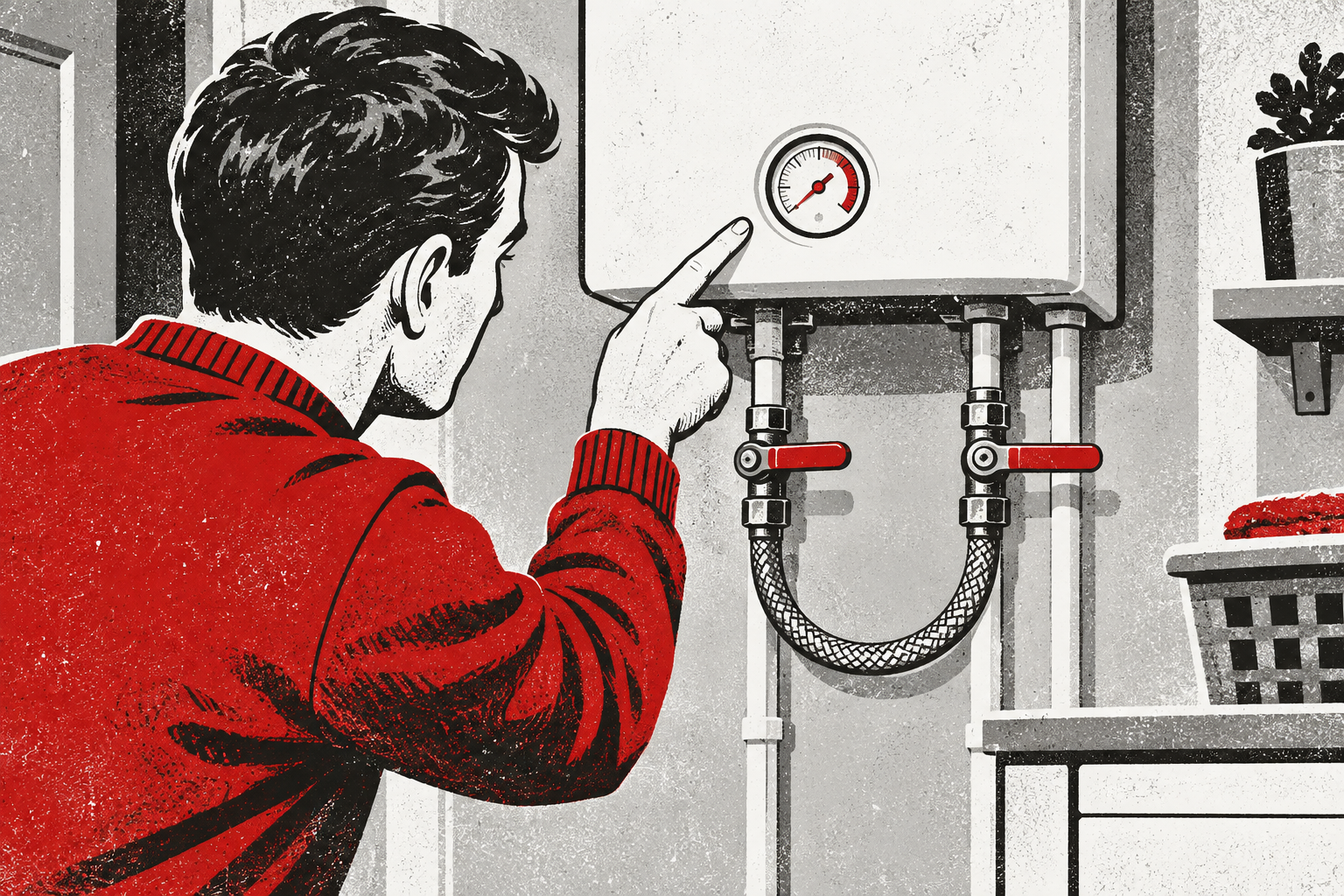
How can I tell if the boiler filling loop was left open?
The clearest sign is boiler pressure that keeps rising while the heating is off and the system is cool. You may also hear water passing through an external filling loop. But filling arrangements vary, and rising pressure can have other causes, so use the exact boiler instructions before touching any valve.
A filling loop temporarily connects the mains water supply to a sealed central-heating circuit so lost pressure can be restored. It should stop admitting water when filling is complete.
What a filling loop looks like
An external filling loop is often a short silver braided hose between two pipes, with a valve at each end. Some boilers instead have an internal keyed link, a lever underneath the appliance or an automatic filling device.
Do not assume every braided hose is a filling loop or every lever should point the same way. Valve designs and open positions differ. Find the boiler make, exact model and user manual, or ask the installer to identify the approved filling method.
The main clue: pressure rises when the system is cold
Heating water expands, so the gauge normally rises while radiators are hot. That does not mean the filling loop is open. The more telling pattern is pressure continuing to climb after heating has been off long enough for the system to cool.
Photograph the pressure when cold, make sure no one operates the filling controls, and check again later. If it rises steadily towards the high or red area, stop using the heating and arrange advice. Do not release water repeatedly to counteract a continuing inflow.
Listen, but do not dismantle
When a manual filling valve opens, mains water may make a hiss or rushing sound as it enters the heating circuit. Silence does not prove the valve is closed: a partly open or passing valve may be quiet.
Do not loosen the hose to test it, remove boiler panels or use tools on stiff valves. Water can escape, and unfamiliar controls may be part of a different service connection.
Check the stated closed position
If the user manual shows an external filling loop and identifies both homeowner controls, visually compare their positions with the closed diagram. Many lever valves are closed when the handle is across the pipe, but this is not safe as a universal assumption.
Some systems require both valves to be closed and the flexible hose disconnected after filling. Others have a built-in key that must be returned and removed, or a spring-loaded lever that should return when released. Follow only the procedure for the installed equipment.
What if both handles look closed?
A valve can look closed yet fail to seal internally. A key or lever may also be incorrectly positioned. If pressure still rises while cold, an engineer must determine whether mains water is passing through the filling assembly or entering by another route.
Do not force a handle beyond its stop. A seized or leaking valve needs repair, not extra leverage.
Other causes of rising pressure
If pressure rises mainly as the heating warms and falls again when cool, the expansion vessel or system expansion behaviour may be relevant. If it rises continuously even when cold, a passing filling link is one possibility; an internal cross-leak can be another on some boiler types.
The timing helps an engineer narrow the diagnosis, but it does not prove a component has failed. Do not buy a filling valve or internal heat exchanger based only on the gauge pattern.
What happens if water keeps entering?
The sealed heating circuit can become overfilled. As pressure approaches the appliance limit, a safety relief valve may discharge water through a pipe outside. After the cause is corrected, that valve may continue dripping if debris or damage prevents it resealing.
Never cap, block or plug a discharge pipe. It is a safety route. If water is discharging, switch the heating off with its normal control and arrange prompt professional attention.
Should I bleed a radiator to reduce pressure?
Bleeding can release some water and lower pressure, but it does not fix water continuing to enter. Repeating it can introduce air and create more confusion. If overfilling was a one-off mistake and the manual permits a homeowner correction, follow that guidance; otherwise call an engineer.
Protect floors and allow radiators to cool before any permitted user action. Never use a boiler drain point or internal valve as a DIY pressure-control method.
Automatic filling systems are different
Some installations have an automatic filling device programmed to maintain pressure. A rise after a pressure loss may therefore be intended. Its settings, isolation and fault behaviour should have been explained by the installer.
Do not disable or reprogramme an unfamiliar automatic unit. Record the pressure pattern and any message, then contact the installer or a competent engineer.
Safe steps if you suspect it was left open
Turn the heating off at its normal control and let it cool. Photograph the gauge and the visible filling arrangement. Check the exact user manual for the closed position. If the identified controls can be returned to closed easily and the manual treats this as a user task, do so without tools.
Monitor the cold reading. If it stops rising but is already outside the stated range, seek advice before operating the boiler. If it continues rising, a valve may be passing or another fault may be involved.
When to stop and call an engineer
Arrange help if you cannot positively identify the filling controls, a valve is stuck or leaking, the pressure keeps rising, water is discharged outside, the boiler locks out, or you have repeatedly had to correct pressure.
Do not remove the boiler casing. Any work on the gas appliance must be completed by a Gas Safe registered engineer with the right competence, even when the visible symptom concerns heating water rather than gas.
What to record before the visit
Take clear photographs of the cold pressure, the visible filling arrangement and any fault code. Note the time the heating was switched off, how quickly the reading rose and whether water appeared at a radiator valve, beneath the boiler or from the outside discharge pipe.
Tell the engineer when the system was last topped up and who operated it. Do not change several controls before the visit, because that can hide the pattern. If you already returned an identified user valve to its documented closed position, say exactly what you changed.
Advice for tenants and landlords
A tenant should report continuing pressure rise promptly and send the photographs rather than repeatedly bleeding radiators. A landlord or agent should arrange competent inspection when the filling controls are unclear, damaged or not stopping the rise.
In a shared property, tell other occupants not to top up the boiler while the issue is being investigated. More than one person operating the loop can create repeated overfilling and make the history difficult to understand.
Common questions
Can an open loop make pressure rise quickly?
Yes. Mains water is normally at a higher pressure than the sealed heating circuit, so an open path can raise the gauge. The speed depends on the valve opening and supply.
Why did pressure rise after topping up and heating?
You may have added too much water, or the normal heat expansion may have taken an already-high cold reading higher. Let the system cool and compare with the manual.
Can I remove the hose?
Only if the exact manufacturer or installer instructions describe disconnection as a user task and both identified valves are securely closed. If uncertain, leave it alone and ask an engineer.
Related guides: Why is my boiler pressure too high? and Why does my boiler keep losing pressure?
Pressure keeps rising while cold?
Have the filling arrangement and sealed system checked promptly.