

If the pressure on your Baxi, Main or Potterton boiler is below its normal range, you may be able to top it up using the filling link fitted to the heating system. The common arrangements include Baxi’s spring-loaded Easy-Fill lever, a rigid link beneath the boiler, or a conventional external braided-hose loop.
Boilers and installations differ. Before touching a valve, find the exact model’s user guide and match the filling arrangement to its diagram. If you cannot confidently identify it, stop and ask a Gas Safe registered heating engineer.
Quick answer: what pressure should it be?
Baxi’s current homeowner guidance says normal boiler and central-heating pressure is generally between 1 and 2 bar. Many Baxi user guides tell homeowners to restore a cool system to around 1 to 1.5 bar, or the green section of the gauge.
Read the pressure when the heating is off and cool. Pressure normally rises as the system heats, so topping up a hot boiler to the cold target can result in excessive pressure later. Your model manual takes priority over a generic figure.
Before topping up
- Turn the heating off and let the boiler and radiators cool.
- Check the gauge or pressure display and note the reading.
- Find the make, exact model and user instructions.
- Identify the filling device from the manual or installer’s handover information.
- Look for visible water, corrosion or staining without removing the boiler case.
- Do not continue if the pressure is already within the stated range.
Keep watching the gauge throughout filling. The pressure can rise quickly, and every filling control must be fully closed afterwards.
Method 1: Baxi Easy-Fill permanent filling link
Baxi’s Easy-Fill arrangement uses a spring-loaded green lever beneath compatible boilers. Although the lever is normally easy to recognise, confirm it in the user guide because other nearby valves may isolate gas or water and must not be used for topping up.
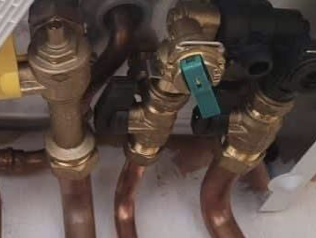
- Operate and hold the spring-loaded green lever in the filling direction shown.
- Listen for water entering and watch the pressure gauge continuously.
- Release the lever when the pressure reaches the manual’s target—commonly between 1 and 1.5 bar on a cool system.
- Check that the lever returns fully and the pressure stops rising.
Baxi’s user information for Easy-Fill models says no part of the permanent link needs to be removed. If the lever sticks, the gauge does not move or water leaks from the link, release it and arrange professional help rather than forcing it.
Which Baxi boilers may have Easy-Fill?
Easy-Fill or Easy-Fill 2 is available on several Baxi ranges, including current Baxi 600 and 800 Combi 2 products and some system models, but installation details and accessories vary. Older Baxi 600/800 and Platinum-family appliances may also use a spring-loaded Easy-Fill link.
Do not assume a boiler has Easy-Fill because an online photograph of the same model shows one. Installers may use an alternative filling arrangement in some properties. The actual controls beneath your boiler and its documentation decide which method applies.
Method 2: rigid filling link
Some Baxi, Main and Potterton installations use a short rigid metal link beneath or close to the boiler. It bridges the cold-water supply and heating circuit and may have one or two small quarter-turn valves. The Main Eco Compact Combi, for example, is listed with a temporary rigid filling link, while Baxi also lists rigid filling links for parts of its combi range.
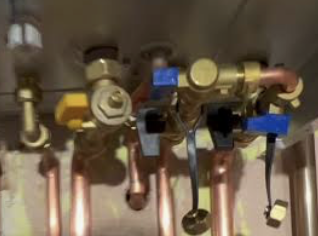
- Confirm both are the filling-link valves—not gas or isolation controls.
- Open the first valve slowly as directed.
- Open the second valve slowly until you hear water entering.
- Watch the gauge and close the second valve at the stated cold pressure.
- Close the first valve and confirm the pressure stops rising.
On some temporary links the connector is meant to be disconnected after filling; on permanent arrangements it remains fitted. Follow the supplied instructions. Do not loosen a rigid connector under pressure or use pliers on a stiff valve.
Method 3: external braided-hose filling loop
A conventional external filling loop is normally a short silver braided hose connecting the mains-water pipe to the sealed heating circuit. It may sit beneath the boiler, inside a nearby cupboard or by the hot-water cylinder. It usually has a valve at each end.
-

. Match the hose and both valves to the installer or boiler instructions.
- If the approved hose is stored disconnected, attach it securely as instructed. Never improvise a connector.
- Open the first filling valve slowly.
- Open the second slowly until water can be heard entering the heating system.
- Close the second valve when the cool pressure reaches the model’s target, then close the first.
- Confirm both valves are fully shut. Remove the hose only if the approved instructions require it, with a cloth ready for residual water.
Valve handles may be levers, small plastic taps or screwdriver slots. If several valves are clustered together and you are not certain which two form the filling loop, do not experiment.
Main and Potterton boiler filling arrangements
Main and Potterton boilers share parts of their heritage and product support with Baxi Heating, but model layouts are not interchangeable. A Main Eco Compact may use a temporary rigid link, while older Main or Potterton sealed systems may have a separate two-tap filling loop elsewhere on the installation.
Search the official literature library using the complete model name from the boiler. If the original user guide says the filling device was installer-positioned, its location cannot be reliably guessed from the boiler fascia.
When is topping up normal?
A small one-off pressure correction can be needed after radiators have been bled, after heating work, or as residual air leaves a recently filled system. Baxi notes that occasional repressurising can be a normal homeowner task.
It should not become a weekly or monthly routine. Repeated loss can indicate a visible or hidden leak, a pressure-relief valve passing water, an expansion-vessel fault or another problem. Continually adding fresh water does not repair the cause and can encourage internal corrosion.
What if the pressure keeps dropping?
With the system cool and without opening the boiler, look for:
- damp or stained radiator valves and pipe joints;
- water marks beneath the boiler;
- rust or corrosion around accessible heating pipework;
- a dripping copper discharge pipe outside;
- pressure that rises sharply when hot and falls low again when cool;
- recent radiator bleeding or system work.
Baxi identifies leaks, expansion-vessel problems and debris affecting the pressure-relief valve among possible causes of low pressure. Expansion-vessel and internal safety-valve work is for a Gas Safe registered engineer. Never remove the casing or block a discharge pipe.
What if the pressure is too high?
Stop filling immediately and check that every filling valve or Easy-Fill lever has fully closed. Baxi says pressure should stay in the gauge’s normal area and notes that very high pressure may make the safety valve discharge water.
If you have simply overfilled a cool system, Baxi’s guidance describes bleeding a cool radiator to reduce pressure. Only do that if you already know the safe homeowner procedure: protect the floor, open the bleed point gradually and close it as soon as water appears. If pressure continues to rise or remains high, call an engineer.
What if the gauge does not rise?
Close the identified filling controls if water is not entering or the gauge remains unchanged. Do not force a lever or turn other valves in search of the correct one. The supply may be isolated, the filling device may be faulty or the gauge may not be responding.
Tell the engineer the exact Baxi, Main or Potterton model, starting pressure, filling-link type and whether you heard water. That is more useful than continuing until another fault is created.
Will the boiler restart automatically?
Some Baxi Easy-Fill model instructions state that the boiler resets automatically when correct pressure is restored. Other models may continue to display a code or require the normal user reset procedure. Follow the specific manual.
Do not keep resetting a boiler if pressure immediately drops again or the same code returns. Record the complete code because Baxi, Main and Potterton meanings are model-specific.
Common topping-up mistakes
- Using the boiler while hot: the reading will rise further as the water expands.
- Opening the wrong coloured handle: colour alone does not identify the filling link.
- Leaving one valve open: pressure may continue rising after you walk away.
- Forcing a stiff control: filling valves and links can be damaged.
- Filling beyond the manual’s range: more pressure does not improve heating.
- Repeatedly masking a leak: frequent topping-up needs diagnosis.
- Following a different model’s video: even similar boiler casings can have different controls.
Frequently asked questions
Should my Baxi boiler be at 1 bar or 1.5 bar?
Baxi’s general operating range is 1 to 2 bar, while many user instructions use 1 to 1.5 bar as the cool refill target. Aim for the green area or exact range in your model manual.
Where is the Baxi green filling lever?
On compatible Easy-Fill installations it is beneath the boiler. Not every Baxi, Main or Potterton boiler has one; some use a rigid link or an external loop.
Do I pull the Easy-Fill lever down?
Operate the spring-loaded lever in the direction shown in the exact user guide and release it at the stated pressure. Videos and manuals for common Easy-Fill models show the lever being operated to admit water, but access and orientation can differ.
Why has my Baxi pressure fallen after bleeding radiators?
Releasing air reduces system pressure, so a small top-up may be necessary afterwards. If pressure continues falling, investigate for a leak or fault.
Can I repair a filling link myself?
No internal boiler or filling-link repair is described here. If it leaks, sticks or will not close, stop using it and arrange professional repair.
Related boiler-help guides
- Why does my boiler keep losing pressure?
- How to bleed a radiator safely
- Baxi boiler fault codes explained
Does your Baxi or Main pressure keep falling?
Repeated topping-up is a symptom, not a repair. Book a fixed-price Incredaboil visit so the pressure loss can be diagnosed safely.