
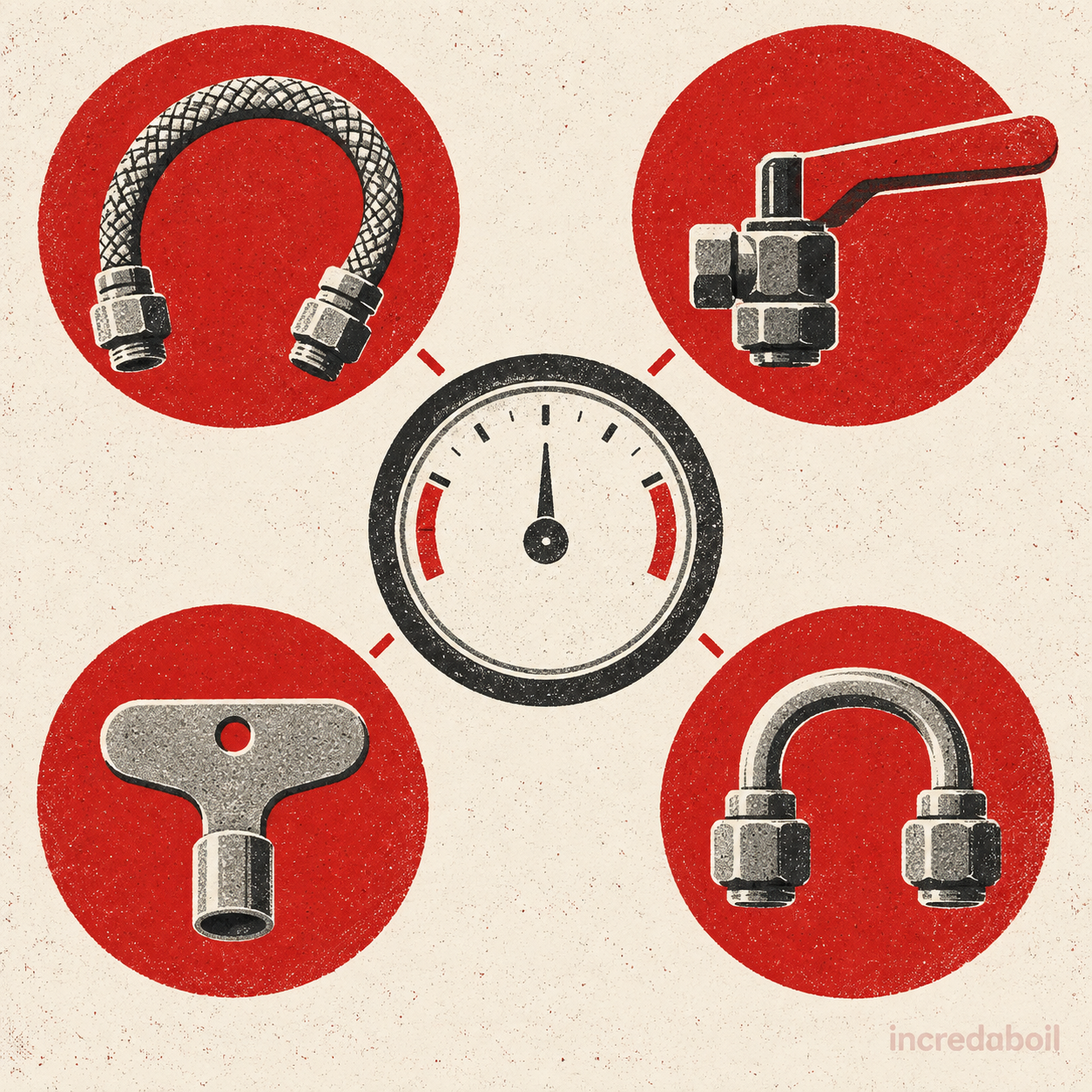
If your boiler pressure is below its normal cold range, you may be able to restore it by letting a small amount of mains water into the sealed heating circuit. The safe method depends on the filling arrangement fitted to your boiler: a braided hose, spring-loaded lever, removable key, rigid link or detachable loop.
Never copy a valve sequence simply because another boiler looks similar. Check the exact model and user instructions first, keep the pressure display in sight and stop if anything leaks or fails to respond.
Quick answer: what pressure should a boiler be?
Many domestic sealed heating systems should sit at roughly 1 to 1.5 bar when cold. Some manufacturer manuals allow a broader cold range, such as 1 to 2 bar, while taller homes may need a different setting.
The exact boiler manual and the pressure specified by the installer take priority. Pressure normally rises as the heating water becomes hot, so turn the heating off and let the system cool before deciding whether it needs topping up.
Before you touch the filling loop
- Turn the heating off and allow the boiler and radiators to cool.
- Read the current pressure and photograph the gauge if useful.
- Find the full make and model—not just the manufacturer name.
- Match the filling device to the official user guide.
- Check accessible radiators, valves and pipework for visible leaks.
Do not top up a system with an active leak. Do not remove the combustion case or operate internal boiler parts. If the homeowner controls cannot be positively identified, ask a Gas Safe registered engineer to show you the filling arrangement.
1. External braided filling loop
Start here because the flexible silver hose is one of the most common arrangements across boiler brands. It joins the cold mains supply to the sealed heating circuit, usually beneath the boiler or close to other heating pipework. Some loops stay connected; others must be fitted only while topping up.
A typical loop has a control at each end. Depending on the installation, these may be small levers, taps or a screwdriver-slot isolation valve.
- Confirm both controls are closed and the correct hose is securely connected.
- Make sure you can watch the pressure gauge throughout.
- Open the first control slowly, then the second. You should hear water entering.
- Stop at the cold pressure stated in the manual—often around 1 to 1.5 bar.
- Close both controls fully and confirm the gauge has stopped rising.
- If the loop is designed to be removed, disconnect it as instructed and use a towel for the small amount of water held in the hose.
Lever positions vary, so use the installation’s diagram. Never force a stiff valve, and never leave a filling loop open.
2. Baxi Easy-Fill spring-loaded lever
Several Baxi, Main and Potterton boilers use the Baxi Easy-Fill link. Baxi’s homeowner guidance identifies it as a green lever beneath compatible boilers. Unlike a normal quarter-turn valve, the lever is spring loaded: the user pulls it to admit water and releases it to stop.
- Confirm that your boiler has the Easy-Fill link shown in its instructions.
- With the system cool, pull the lever gently and listen for water flow.
- Watch the gauge continuously.
- Release the lever at the model’s target pressure or the centre of its normal gauge area.
- Check that the pressure stops rising after release.
Baxi states that normal operating pressure is commonly between 1 and 2 bar and that pressure below 1 bar requires attention. Read the full Baxi and Main boiler pressure guide for Easy-Fill, rigid links and external loops.
3. Worcester Bosch keyless filling link
Many Worcester Bosch boilers use a keyless filling link with a lever beneath the appliance. Worcester’s guidance tells the user to pull down the identified lever, watch the pressure rise and release it when the display reaches the normal zone—commonly between 1 and 1.5 bar.
The lever should return and stop the flow. If the pressure continues rising, switch the boiler off and arrange help. Do not confuse the filling lever with neighbouring isolation controls.
See the Worcester boiler pressure guide for the keyless link, internal filling key and external hose arrangements.
4. Worcester Bosch internal filling key
Older and some compatible Worcester boilers use a removable white filling key. The key bridges the filling link; a separate white control then admits water.
- Insert the correct key with its arrow aligned to the open-padlock symbol.
- Turn it to the locked position described in the model manual.
- Open the separate filling control slowly.
- Close it when pressure reaches the normal cold band.
- Return the key to the unlocked position, remove it and store it safely.
A few drips on removal may be water trapped in the link. Continued dripping means the filling valve may not be closed or sealed properly. Do not substitute a key from another appliance.
5. Ideal detachable filling loop
Several Ideal Logic and Logic MAX combis use a short detachable hose beneath the boiler. The current Logic MAX Combi2 guide shows the hose connecting between the domestic-hot-water inlet and a dedicated filling-loop connection. The two specified handles are opened in sequence, then both are closed at 1 to 1.5 bar before the hose is removed and its cap and plug replaced.
Nearby handles are not interchangeable. On the manual’s diagram, the yellow gas isolation handle and black central-heating return handle are not the routine homeowner filling controls. Do not move them when topping up.
Use the detailed Ideal boiler pressure guide to identify the detachable loop and external-loop alternatives.
6. Rigid filling links and two-control assemblies
Some Baxi-family, Ideal and other boilers use a small rigid metal link rather than a braided hose. It may have two taps or levers which must both be opened for water to pass. The safe principle is the same: identify both controls from the exact instructions, open slowly, watch the gauge and close both fully.
Do not rely on colour alone. Boiler generations and installations differ, and a gas isolation handle or heating service valve may sit close to the filling link.
7. Vaillant filling devices
Vaillant installations may use an external braided loop, a filling cock elsewhere on the system, a filling key or another model-specific filling device. Current ecoTEC plus instructions deliberately tell users to have the individual arrangement explained by the competent person.
Many Vaillant systems operate within a 1 to 2 bar cold band, with roughly 1 to 1.5 bar a common homeowner top-up target. Use the Vaillant boiler pressure guide for the different arrangements and F.22 context.
8. Viessmann filling loops
Viessmann’s homeowner guidance covers detachable external hoses, permanently connected loops and built-in filling controls. A removable loop is attached at both ends, both valves are opened slowly and the loop is removed again after the correct pressure is reached. A built-in arrangement uses its accessible filling control without attaching a separate hose.
Do not enter the Vitodens commissioning filling programme: it is an installer function, not the normal homeowner pressure top-up. Read the Viessmann boiler pressure guide for the user-accessible options.
What if the gauge does not rise?
Close the filling controls straight away. Do not leave them open while waiting for the display to react. You may have selected the wrong valve, the cold supply may be isolated, the filling device may be blocked or faulty, or the pressure sensor or gauge may not be responding.
Do not dismantle the filling link or remove the boiler case. Arrange a professional check.
What if you add too much water?
Close every filling control and allow the boiler to cool before judging the final pressure. If you already know how to bleed a radiator safely, releasing a small amount of water at a radiator may reduce the pressure. Protect the floor and stop once the correct cold reading is restored.
Do not operate the boiler pressure-relief valve or a drain point. If pressure remains high, climbs sharply when the heating runs or water discharges outside, call an engineer.
Why does the pressure keep dropping?
A single top-up after radiator bleeding can be expected. Repeated loss over days or weeks means water is escaping or the sealed system has a fault. Look only at accessible parts for:
- damp or corrosion around radiator valves;
- marks near accessible pipes and fittings;
- drips at the filling loop;
- water from the copper relief pipe outside;
- a large difference between cold and hot pressure.
Do not keep topping up every few days. Record the cold and hot readings and how quickly they change, then arrange diagnosis. Repressurising replaces missing water; it does not repair the leak, pressure-relief valve or expansion problem causing the loss.
Common mistakes to avoid
- Following instructions for the wrong make or model.
- Filling while the system is hot.
- Opening valves fully instead of controlling the flow.
- Looking away from the pressure gauge.
- Leaving one filling control partly open.
- Moving a gas or heating isolation valve by mistake.
- Repeatedly masking a leak with fresh water.
Frequently asked questions
Are all boiler filling loops underneath the boiler?
No. The loop may be built into the boiler, attached beneath it, fitted remotely in an airing cupboard or stored separately until needed.
Do both filling-loop valves need opening?
A conventional braided loop usually requires both controls to be open, while a spring-loaded or keyless link may use one lever. Follow the exact manual.
Should I reset the boiler after topping up?
Some low-pressure warnings clear automatically; others may require the reset procedure in the user guide. If the fault returns, do not repeatedly reset it.
Can I top up a boiler every week?
No. That frequency strongly suggests a leak or system fault and needs investigation.
Who should investigate recurring pressure loss?
Use a Gas Safe registered engineer for work involving a gas boiler. Check the engineer or business on the official register.
Related boiler-help guides
- Why does my boiler keep losing pressure?
- How to bleed a radiator safely
- Why is my boiler pressure too high?
Does your boiler pressure keep falling?
Stop repeatedly topping it up and book a clear, fixed-price Incredaboil repair visit for an eligible Baxi, Worcester Bosch or Ideal boiler.