
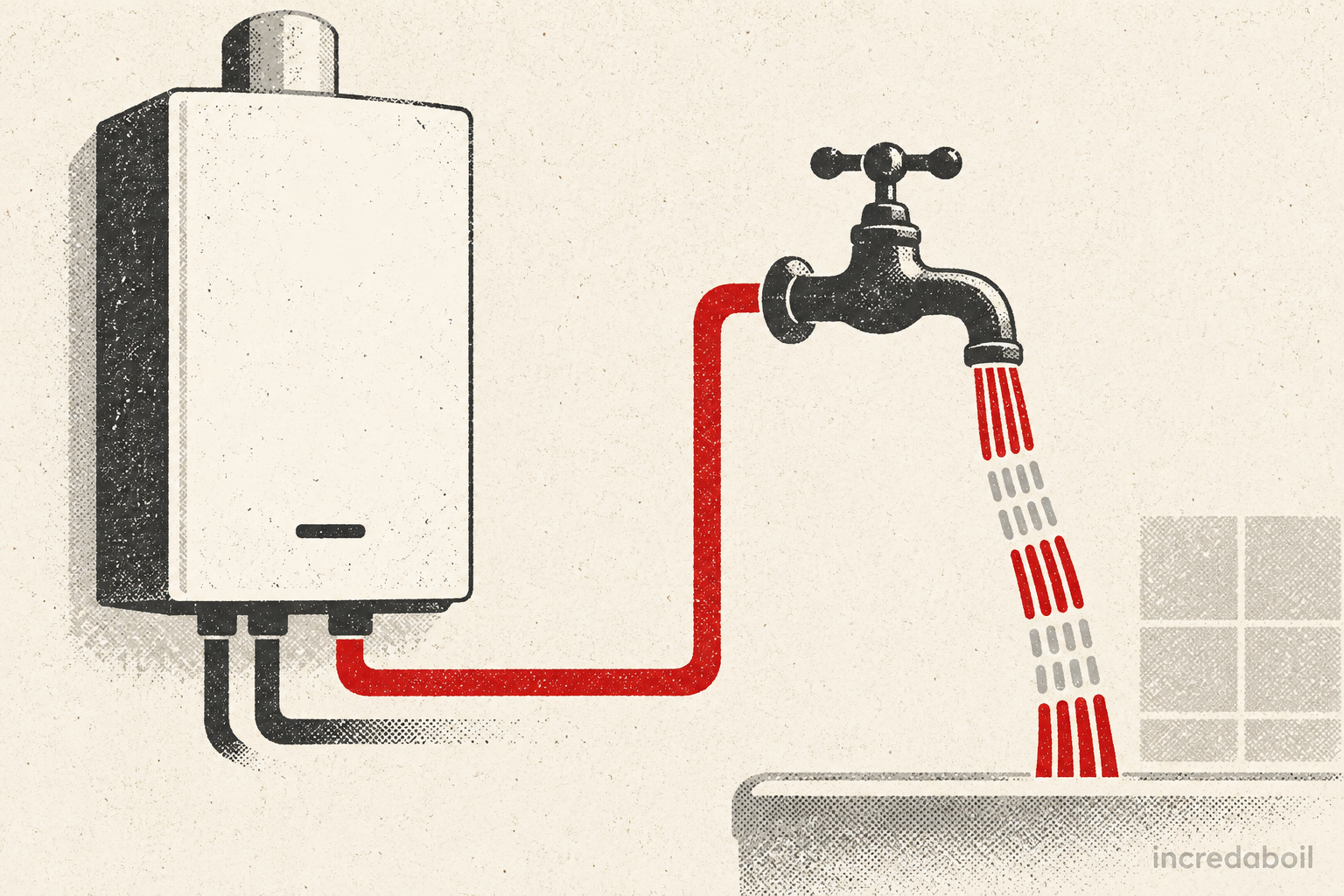
Intermittent hot water from an Ideal boiler can mean different things: a combi may run hot, then cold, then hot again at the tap; a system or heat-only boiler may be working correctly while a cylinder control or zone valve causes the problem. Start by identifying the boiler type, checking the display and comparing more than one outlet. Internal water, gas and combustion checks belong to a qualified engineer.
Ideal’s own homeowner guidance says combi users can check the hot-water setting and confirm that the accessible cold-mains isolation valve below the boiler is open. If those basic checks do not resolve the problem, the appliance needs professional investigation.
What counts as intermittent hot water?
The useful question is not simply “Is there hot water?” but exactly how it changes. Water may start hot and gradually cool, switch sharply between hot and cold, stay warm rather than hot, or fail only when another tap opens. Each pattern gives an engineer different evidence.
Record how long the water stays hot, which outlets are affected and whether the boiler display shows a hot-water demand throughout. Do not repeatedly run water just to force the fault.
First identify your Ideal boiler type
An Ideal combi heats mains water as it is drawn, without a separate hot-water cylinder. Ideal’s Logic MAX Combi2 literature explains that a domestic-hot-water demand directs the boiler’s output through a plate heat exchanger. Flow rate and incoming-water temperature therefore affect the temperature available at the tap.
An Ideal system or heat-only boiler usually heats water stored in a cylinder. If radiators work but stored hot water is intermittent, the cylinder thermostat, programmer, motorised valve, pump or wider system controls may be involved. The correct diagnostic route depends on the installation.
Check the hot-water setting
On an Ideal combi, look at the user hot-water temperature control and make sure it has not been turned down. Use only the normal front-panel controls described in the user guide. A lower setting can make water feel inadequate, especially when the incoming mains water is colder.
Do not enter installer menus or change service parameters. If the setting changes by itself, the control behaves erratically or the display shows a fault, record it and arrange a repair.
Does the problem affect every tap?
Compare two outlets safely. If one shower or mixer tap fluctuates while a simple hot tap remains steady, the outlet, thermostatic cartridge or local plumbing may be the better starting point. If every hot outlet changes temperature, the boiler, supply or shared hot-water system becomes more likely.
Keep the comparison brief and avoid scalding temperatures. A plumber may be appropriate for one faulty outlet; a Gas Safe registered engineer is needed for internal boiler and combustion work.
Does opening a second tap trigger the problem?
A combi has a finite hot-water output. Ideal publishes different nominal flow rates for different outputs, measured at a specified temperature rise. The cited Logic MAX Combi2 figures are 9.9, 12.4 and 14.5 litres per minute at a 35°C rise for the 24, 30 and 35 models respectively.
Those figures are not a promise that every installation delivers the same result. Ideal notes that seasonal inlet temperature and system variation affect flow and temperature rise. If two showers or taps exceed the boiler’s capacity, each may become cooler even when the appliance is operating normally.
Try a steady, sensible flow
Very high flow can exceed the boiler’s ability to deliver the requested temperature rise. An extremely low flow can also be difficult for a combi to recognise consistently. Test one ordinary hot tap at a steady middle position and note whether the boiler keeps showing a domestic-hot-water demand.
Do not throttle hidden service valves or alter internal flow regulators. The purpose is only to describe the symptom, not to tune the appliance.
Check the accessible cold-mains valve
Ideal advises combi users to check that the cold-mains isolation valve beneath the boiler is open. Only do this if the valve is clearly identified in the user documentation, accessible and designed for normal operation. On many lever valves, being in line with the pipe indicates open, but follow the actual fitting and appliance instructions.
Do not force a stiff valve, loosen a nut or guess between gas and water controls. If the pipework is unclear, leave it alone and tell the engineer.
Watch the boiler display during the fault
Applicable Ideal displays show a domestic-hot-water status when the boiler recognises a tap demand. A fault code, a demand that repeatedly disappears, or rapid cycling can help narrow the professional checks.
Photograph the full display and exact model. Do not remove the fascia or use diagnostic menus. A video showing the display while another person safely operates the tap can be useful.
Could low mains pressure or changing flow be involved?
A combi depends on the incoming cold-water supply. If cold taps also weaken when another appliance runs, or pressure varies at busy times, the water supply or property plumbing may contribute. Ask neighbours or the water company about a known interruption when appropriate.
Do not adjust a pressure-reducing valve or dismantle a meter arrangement yourself. Tell the engineer whether the cold flow changes at the same time as the hot temperature.
Could limescale restrict hot water?
In hard-water areas, scale can reduce heat transfer or restrict domestic-water paths over time. Ideal’s commissioning records specifically ask whether the installation is in a hard-water area and whether a scale-reduction device is fitted.
Intermittent temperature alone does not prove scale. An engineer needs to compare flow, temperature and appliance operation before recommending treatment or component work. Do not pour descaler into the boiler or dismantle the plate heat exchanger.
Could the diverter valve be involved?
On applicable Ideal combis, a diverter valve directs heat towards the domestic-hot-water plate heat exchanger when a tap demand occurs. If the flow is not directed correctly, hot-water performance can be affected, sometimes alongside unexpected radiator warming.
That symptom does not confirm a faulty valve. Controls, sensors, flow detection and heat-transfer conditions can produce overlapping effects. The valve is inside the appliance and is not a homeowner adjustment.
Could a sensor or flow detector be responsible?
The boiler needs to detect water flow and control temperature. Ideal’s fault menus include a domestic-hot-water thermistor fault on applicable Logic models, while professional no-hot-water routes examine whether the appliance recognises demand.
A fluctuating temperature without a code can still need those areas checked, but the symptom does not identify one part. Avoid buying a thermistor, turbine or control board based on an online guess.
What if heating works but hot water does not?
On a combi, that comparison tells the engineer that the appliance can respond to central-heating demand but has a problem specific to hot-water demand or heat transfer. On a system or heat-only installation, it may point towards the cylinder controls or zone arrangement rather than the boiler itself.
Record whether the radiators become warm when only a hot tap is running, and whether the cylinder programme is on. Do not remove control covers or manually move motorised valves.
Safe checks a homeowner can make
- Identify whether the boiler is combi, system or heat-only.
- Record the full model and any code.
- Check the normal hot-water temperature setting.
- Compare two outlets briefly.
- Test one tap at a steady moderate flow.
- Note what happens when another tap opens.
- Check the accessible cold-mains valve only if clearly identified.
- Record the display during a hot-water demand.
- Note whether radiators warm unexpectedly.
What not to do
- Do not remove the boiler case.
- Do not adjust the gas valve or combustion settings.
- Do not dismantle the plate heat exchanger.
- Do not force or guess at service valves.
- Do not bridge sensors or flow switches.
- Do not repeatedly reset a boiler that locks out.
- Do not use boiling water to “flush” an outlet or component.
What an engineer may investigate
An engineer can reproduce the fault at a measured flow, check whether the boiler consistently recognises domestic-hot-water demand, compare inlet and outlet temperatures, assess the hot-water thermistor and flow detection, and inspect the diverter valve and plate heat exchanger where applicable.
They can also check gas rate and combustion safely if the appliance is failing to maintain output. The final checks depend on the exact model and evidence; the goal is stable safe operation, not simply changing a likely part.
When is intermittent hot water urgent?
Arrange prompt repair if the water becomes unpredictably scalding, the boiler repeatedly locks out, there is a leak, electrical controls behave erratically or vulnerable occupants cannot obtain reliable hot water.
If you smell gas, do not operate electrical switches or reset the appliance. Leave the affected area and call the National Gas Emergency Service on 0800 111 999 from a safe place. Follow carbon monoxide alarm instructions immediately.
What to tell the booking team
- the complete Ideal model and boiler type;
- whether every outlet is affected;
- whether the water goes cold gradually or suddenly;
- the approximate time before temperature changes;
- whether a second outlet triggers it;
- what the display shows during demand;
- whether radiators warm at the same time; and
- any code, leak, noise or recent plumbing work.
Frequently asked questions
Why does my Ideal combi go hot, cold, then hot?
The pattern can involve changing flow, demand detection, temperature sensing, heat transfer or an internal control component. The exact model and live measurements are needed to diagnose it.
Why is the shower affected but taps are fine?
A shower mixer, thermostatic cartridge or local flow restriction may be responsible. Compare another outlet before assuming the boiler is at fault.
Can too much water flow make it cooler?
Yes. A combi has a model-specific output and temperature rise. Opening multiple outlets can reduce the temperature available from each.
Should I keep resetting the boiler?
No. If it locks out, follow one model-approved restart at most. A returning fault needs diagnosis.
Related boiler-help guides
- Why does hot water go cold?
- Ideal boiler with no hot water
- Boiler hot-water temperature fluctuates
- Combi boiler flow rate explained
Does your Ideal hot water keep changing temperature?
Book a fixed-price Incredaboil repair so the demand, flow and hot-water controls can be checked safely.