
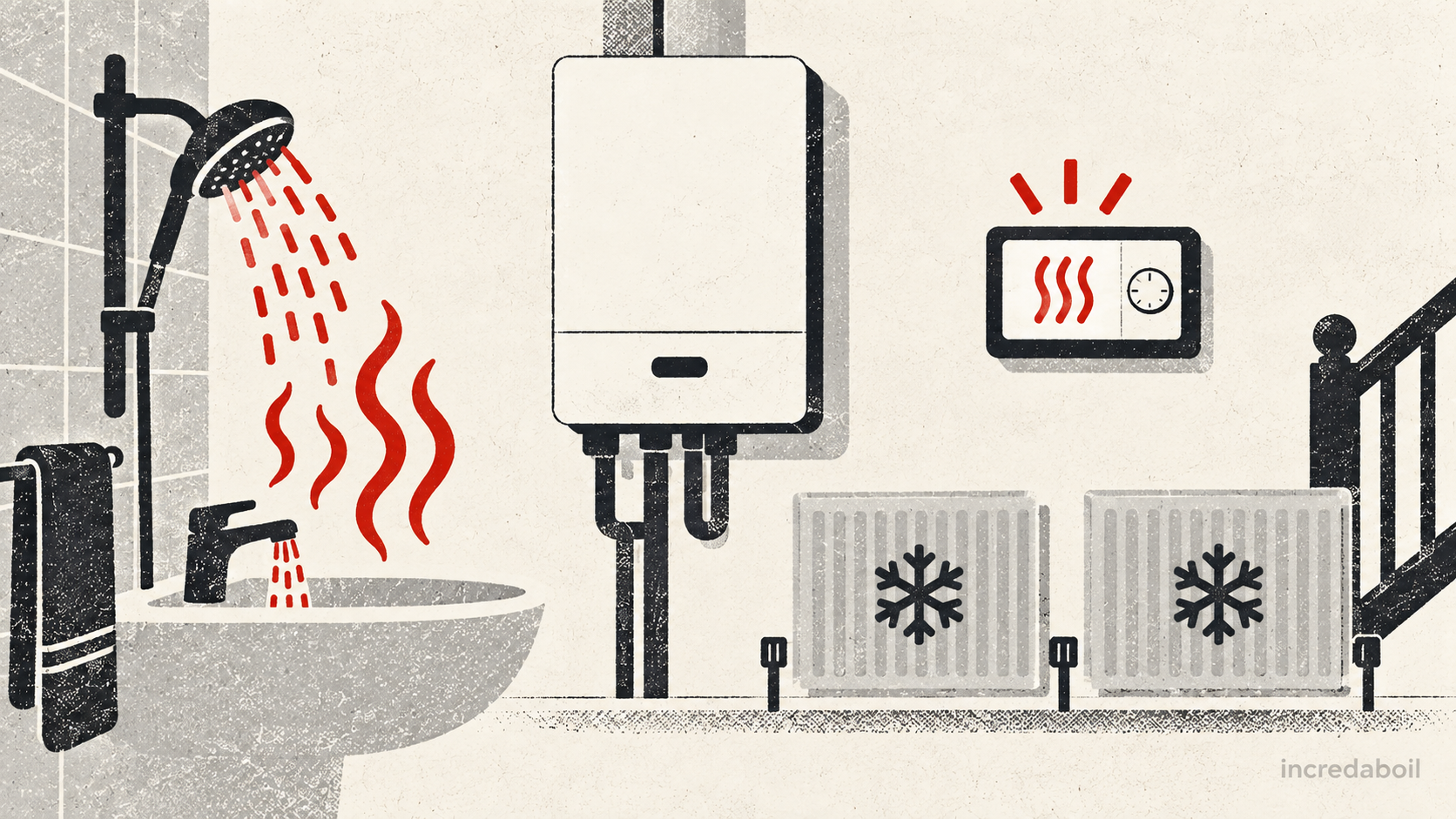
Ideal boiler hot water works but heating does not
If an Ideal combi supplies normal hot water but the radiators stay cold, the boiler can produce heat in at least one mode. The next checks are the heating mode, room thermostat, programmer, system pressure and whether the boiler actually receives a central-heating demand.
Working hot water narrows the fault, but it does not identify a failed internal part. Controls, circulation, sensors and the way heat is directed can create similar symptoms. Keep the casing closed and use the user guide for the exact Ideal model.
Confirm the hot water is genuinely normal
Run one hot tap and let its temperature settle. Note whether the burner indicator appears, whether water becomes properly hot and whether it stays stable. Briefly warm or fluctuating water means both services may be affected and should be reported as a wider fault.
If the property has a hot-water cylinder, stored hot water may remain available even while the boiler is not responding. Identify whether the boiler is a combi, system or heat-only model before assuming its hot-water mode is currently working.
Check winter and summer mode
Current Ideal Logic MAX Combi2 instructions use separate tap and radiator symbols. In winter mode both services are available; in summer mode the tap remains on while the radiator is off. A boiler left in summer mode will provide hot water exactly as intended but will not heat radiators.
Use the Mode button or ordinary control described in the model guide until heating is enabled. Do not copy button sequences from another Ideal range, because displays and controls differ.
Make a clear thermostat demand
Set the room thermostat a few degrees above the measured room temperature and wait several minutes. If it is wireless, check its display and replace batteries only as its instructions describe. Confirm the programmer is in an active heating period or temporary manual-on mode.
A thermostat screen saying “heating” proves that the control has requested heat, not that its receiver or the boiler has accepted the request. Note the receiver’s ordinary status lights without opening it or touching wiring.
Watch the boiler display
Ideal’s current user guides distinguish “no heat demand” from an active central-heating demand. Photograph the full screen before resetting. Does a radiator or demand message appear when the thermostat is raised? Does the burner symbol illuminate? Does a fault message follow?
No demand at the boiler points first towards mode, schedule, thermostat, receiver or another external control. A recognised demand followed by no heating needs professional testing of a different part of the sequence.
Check central-heating temperature
The heating and domestic-hot-water temperature controls are separate on many Ideal combis. Make sure the central-heating target has not been turned off or set unusually low. Do not change the hot-water control in an attempt to warm radiators.
Weather-compensated or load-compensated systems can choose a lower flow temperature in mild conditions. A lower target is not automatically a fault, but completely cold radiators in a cool home with a sustained demand need checking.
Check system pressure
Sealed Ideal systems need pressure within the range in their own user guide. Current Logic MAX Combi2 guidance uses a normal cold filling range of roughly 1 to 1.5 bar. Other models can differ.
If pressure is already normal, do not add water. If it is low, follow only the exact model’s documented user procedure and stop when the stated cold pressure is reached. Repeated pressure loss needs investigation, not continual topping up.
Check radiator valves and zones
Open at least one radiator valve and make sure the room containing the main thermostat does not have every radiator shut. If some radiators heat but others do not, the pattern points more towards individual valves, trapped air or system balance than a total boiler heating failure.
In a zoned property, test each thermostat separately and record which zone causes a demand at the boiler. Do not remove motorised-valve covers or bridge control wires.
If the boiler shows a heating demand but radiators stay cold
Note whether the burner starts, how long it runs and whether nearby heating pipes begin to warm. Do not touch pipes that may be hot. A boiler that fires briefly then stops is a different pattern from one that never lights or one that runs while no radiators receive heat.
Possible professional diagnostic areas include circulation, external valves, sensors, control communication and the boiler’s changeover mechanism. Sound and display observations help, but they cannot safely confirm a component.
Also note whether the boiler temperature rises while the radiators remain cold. That detail can help distinguish heat being produced without effective circulation from a burner that never starts, but it still requires measured diagnosis.
Hot-water priority can pause heating
On a combi, opening a hot tap normally gives domestic hot water priority. Ideal’s technical description says the boiler directs its output to hot water while a tap is running, then returns to central heating when the draw stops.
A short heating pause during a shower is normal. Heating that never resumes after every tap is closed is not the same thing. Close hot outlets, wait several minutes and record the display.
Could preheat be confusing the observation?
Some Ideal combis periodically fire to keep their hot-water heat exchanger ready when preheat is enabled. That brief operation does not mean there is a central-heating demand and may not warm radiators.
Check the display message and symbols rather than judging by burner sound alone. Use only the normal preheat setting described in the model guide.
If there is a hot-water cylinder
On a system or heat-only installation, normal hot water can come from stored heat or an immersion heater. Check whether the boiler responds to the hot-water schedule later and whether the central-heating channel creates a separate demand.
External zone valves, cylinder controls and pumps may be involved. Tell the engineer whether an immersion heater was used and which programmer lights appear. Do not remove electrical covers or force valve levers.
One restart only when instructed
If the exact Ideal user guide tells the user to restart for the displayed message, perform one controlled restart and observe the result. Give the boiler time to finish its sequence.
If the message returns or heating remains unavailable, stop resetting. Repeated restarts do not repair a control, circulation or safety fault and can obscure the pattern.
What not to do
- Do not remove the boiler casing.
- Do not bridge a thermostat or receiver.
- Do not force a valve or attempt to free an internal pump.
- Do not refill when pressure is normal.
- Do not repeatedly restart a returning fault.
- Do not assume working hot water proves the entire appliance is safe.
When to arrange a repair
Book professional diagnosis if a clear heating demand reaches the boiler but every radiator remains cold, a fault message returns, pressure repeatedly falls, the boiler starts and stops abnormally, or the problem followed electrical, control or plumbing work.
HSE says work on a domestic gas appliance must be completed by a competent Gas Safe registered engineer. An engineer can test the control signal, circulation and model-specific sequence without guessing.
Gas and carbon monoxide safety
If you smell gas, open doors and windows, avoid flames and electrical switches, turn off the supply at the meter only if you know how, leave if necessary and call the National Gas Emergency Service on 0800 111 999.
If a carbon monoxide alarm sounds or anyone develops headache, dizziness, nausea, weakness or confusion, go outside and seek urgent medical advice. Do not continue testing the appliance.
What to tell the engineer
- the complete Ideal model name;
- whether it is a combi or cylinder system;
- whether hot water is fully normal;
- whether the boiler shows a heating demand;
- the exact display message and pressure;
- whether any radiator or zone heats; and
- recent power, control or plumbing changes.
Frequently asked questions
Why does the tap work but the radiator symbol says off?
The boiler may be in summer mode or receiving no heating demand. Enable heating using the exact model guide and check the external controls.
Can low pressure affect heating while hot water works?
Yes, depending on the model and condition. Check the stated cold range, but do not add water to a normal system.
Is the diverter valve definitely faulty?
No. It is one possible professional diagnostic area on a relevant combi, but controls, circulation and sensing can create the same symptom.
Why does heating pause when a tap opens?
A combi normally gives hot water priority. Heating should resume after the draw ends; a short pause alone is not a fault.
Will a reset restore heating?
It may clear a temporary condition when the model guide instructs it. A returning message or persistent failure needs diagnosis.
Related boiler help
- Hot water works but heating does not
- Boiler not responding to the thermostat
- Ideal display switches on and off
Does hot water work while the heating remains off?
Book a fixed price repair