
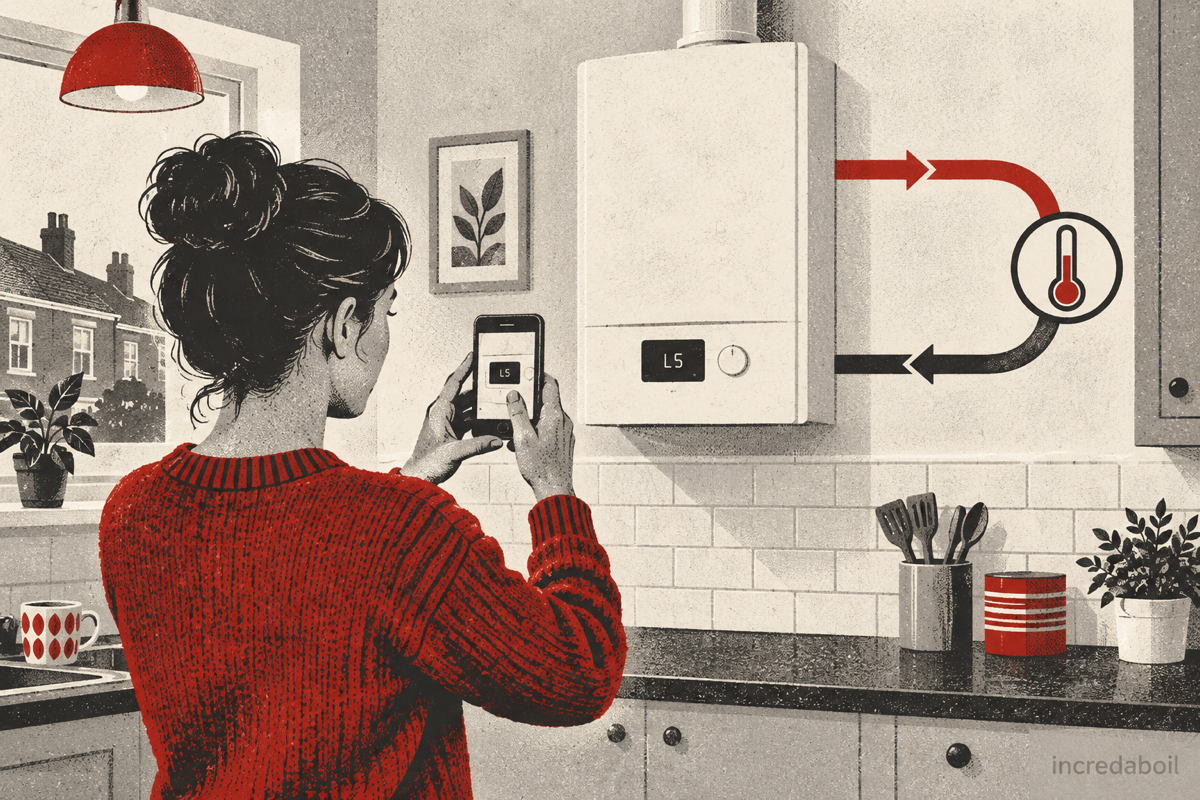
Ideal boiler L5 fault code explained
On several Ideal Logic-family boilers, L5 or F5 means a return thermistor fault. The return thermistor is a temperature sensor associated with water coming back from the heating circuit. The code does not tell you whether the sensor, its wiring or the control electronics are responsible, so keep the casing closed and arrange proper testing if a manual-approved restart does not clear it.
Check the full model and display because codes vary. The Ideal Logic Code Combi ESP1 user guide labels L5 as a return thermistor fault and permits a restart. If the code remains or returns, do not access the sensor or wiring. A qualified engineer needs to test the sensor circuit.
What does Ideal L5 mean?
A thermistor is a temperature-sensitive electrical component. The boiler control uses readings from flow and return thermistors to understand how the heating water is changing temperature.
Ideal’s professional Logic-family manuals identify L5 or F5 as a return thermistor fault. The return side is the water coming back to the boiler after travelling through the heating system. The display means the control has detected a problem with the return-temperature sensing circuit.
It does not automatically mean the water is too hot, that the pump has failed or that the thermistor alone must be replaced. Wiring continuity and the control board form part of the professional fault path.
Is L5 the same on every Ideal boiler?
No code should be interpreted without the exact model. Several Logic, Instinct and Esprit manuals use L5 or F5 for the return thermistor, but newer displays may add spacing, leading zeroes or extra messages.
Photograph the whole screen and the model label visible without removing the case. Use Ideal’s guide for that appliance rather than a generic code list.
What is the return thermistor for?
The boiler compares water temperatures as part of controlling the burner and checking that heat moves through the system. A plausible return reading helps the appliance modulate safely and recognise unusual temperature differences.
If the sensor reading is missing, outside the expected electrical range or inconsistent with the circuit, the boiler cannot rely on it. Locking out is safer than continuing with uncertain temperature information.
What can cause an L5 or F5 code?
Ideal’s professional fault flowchart checks the resistance of the return thermistor, the wiring between the sensor and printed circuit board, and the board if the sensor and wiring test correctly. That creates three broad diagnostic areas:
- the return thermistor itself;
- its connector or wiring; and
- the control electronics that interpret the signal.
Moisture, a loose connection, damaged wiring or an electrical component fault may all need consideration, but L5 alone cannot distinguish them. Do not buy a part until the circuit has been tested.
Safe checks you can make
Keep every check outside the closed casing:
- photograph the complete display;
- record whether it shows L5, F5 or another code as well;
- note whether heating, hot water or both stopped;
- check the ordinary controls and electrical supply are on;
- read the system pressure when cold; and
- look for an obvious leak without touching internal components.
Pressure is useful context but L5 is not the low-water-pressure code on the cited Logic guide. Do not add water when the cold reading is already in the correct model range.
Should you restart an Ideal boiler showing L5?
The Logic Code Combi ESP1 user guide tells the householder to restart the appliance for a return thermistor fault. Follow only the restart procedure in the exact user guide for your model.
If the boiler does not operate, or L5 returns, stop. Repeated restarts cannot repair a sensor circuit. Ideal documents an LC condition after five resets within 15 minutes on the cited range, so repeated button pressing is particularly unhelpful.
Do not power-cycle the boiler repeatedly or hold controls longer than instructed.
Why the fault might be intermittent
An electrical connection can fail only as the appliance warms, cools or vibrates. A marginal thermistor may also produce plausible readings at one temperature and implausible readings at another.
Record how long the boiler runs, whether the code appears from cold or after heating, and whether it clears temporarily when the system cools. Do not tap the casing, move wiring or deliberately force repeated cycles.
What an engineer may test
Ideal’s professional instructions specify resistance checks at known temperatures and continuity between the thermistor and the printed circuit board. An engineer may therefore:
- confirm that the exact model uses L5 or F5 for the return thermistor;
- inspect the sensor and connectors safely;
- measure thermistor resistance and compare it with official values;
- check wiring continuity and signs of damage or moisture;
- compare flow and return temperature behaviour; and
- assess the control board only after the sensor and wiring are verified.
These are internal electrical checks. Do not try to copy them with a household multimeter while the boiler is assembled or powered.
Does L5 mean the boiler is overheating?
Not by itself. On the cited Ideal manuals, L1 is the flow-temperature overheat lockout, while L5 or F5 identifies the return thermistor circuit. A bad sensor signal can affect temperature control, but the code is not proof of a real overheat.
If the boiler or pipes are abnormally hot, there is loud boiling or banging, or a second overheat code appears, turn the appliance off using its normal control and seek prompt help.
Does L5 affect heating and hot water?
It can stop normal boiler operation, so both services may be affected on a combi. The exact behaviour depends on the model, the fault state and whether the code is intermittent.
Tell the engineer whether hot water stopped, radiators cooled, or the code appeared only during one type of demand. That pattern does not replace testing, but it helps reproduce the issue.
Could low pressure cause L5?
Low pressure is a separate fault category on the cited Logic guide, normally F1. Check pressure because the heating system should be correctly filled, but do not assume topping up will fix a return thermistor code.
If the gauge is low, use only the exact model’s filling instructions. If pressure falls again, arrange diagnosis rather than repeatedly adding water.
Can you replace the thermistor yourself?
No. The professional procedure involves removing the return thermistor from the heating return pipe, disconnecting wiring and testing the circuit. That requires internal boiler access and competent electrical and appliance-safety checks.
Gas Safe Register advises that consumers should only perform tasks intended for them in the manufacturer’s user instructions. Removing the combustion case or disturbing parts that affect safe operation is not a homeowner task.
When to switch the boiler off
Turn the boiler off using its normal control and arrange urgent attention if water is leaking near electrics, the casing or pipes are abnormally hot, the code is accompanied by burning smells or unusual noise, or the fault returns immediately.
If you smell gas, avoid electrical switches and flames. Open doors and windows if safe, leave the area and call the National Gas Emergency Service on 0800 111 999.
Carbon monoxide is odourless. If an alarm sounds or anyone has symptoms such as headache, dizziness, sickness, weakness, confusion, chest pain or breathlessness, stop using the suspected appliance, go outside and seek urgent help. Call 999 for severe symptoms.
Information to give the engineer
- The complete Ideal model name.
- A photograph of L5, F5 or any alternating message.
- Whether heating, hot water or both stopped.
- Whether the code appeared when the boiler was cold or already warm.
- The cold system pressure.
- Whether the fault clears temporarily after cooling.
- Any recent service, wiring, thermostat or plumbing work.
- Any leak, unusual heat, noise or smell.
Frequently asked questions
Is Ideal L5 a return sensor fault?
Yes on the Ideal manuals cited here. Check the exact model because display formats and meanings can differ.
Will a restart fix L5?
A model-approved restart may clear a temporary condition, but a returning code needs testing of the sensor, wiring and control circuit.
Is the return thermistor outside the boiler?
On the cited professional documents it is associated with the central-heating return pipe within the appliance. Do not remove the casing to find it.
Can I test the thermistor with a multimeter?
No. The official values are for professional fault finding after safe isolation and access. Household probing risks shock, damage and unsafe reassembly.
Does L5 mean I need a new boiler?
No. The code identifies a sensor-circuit fault path, not the repair outcome. Proper diagnosis determines what is actually needed.
Why might L5 appear after other work?
If the code began after a service, electrical interruption or heating-system repair, record the timing and tell the engineer. That history may help locate a disturbed connector or separate system change, but it does not prove that the previous work caused the fault. Avoid moving cables or controls yourself.
Related boiler-help guides
- Ideal boiler L9 fault code explained
- Ideal boiler F2 fault code explained
- Ideal boiler locks out after reset
- Ideal boiler display is blank
Is an L5 sensor fault stopping your boiler?
Book a fixed-price boiler repair for a safe test of the return-temperature circuit.