
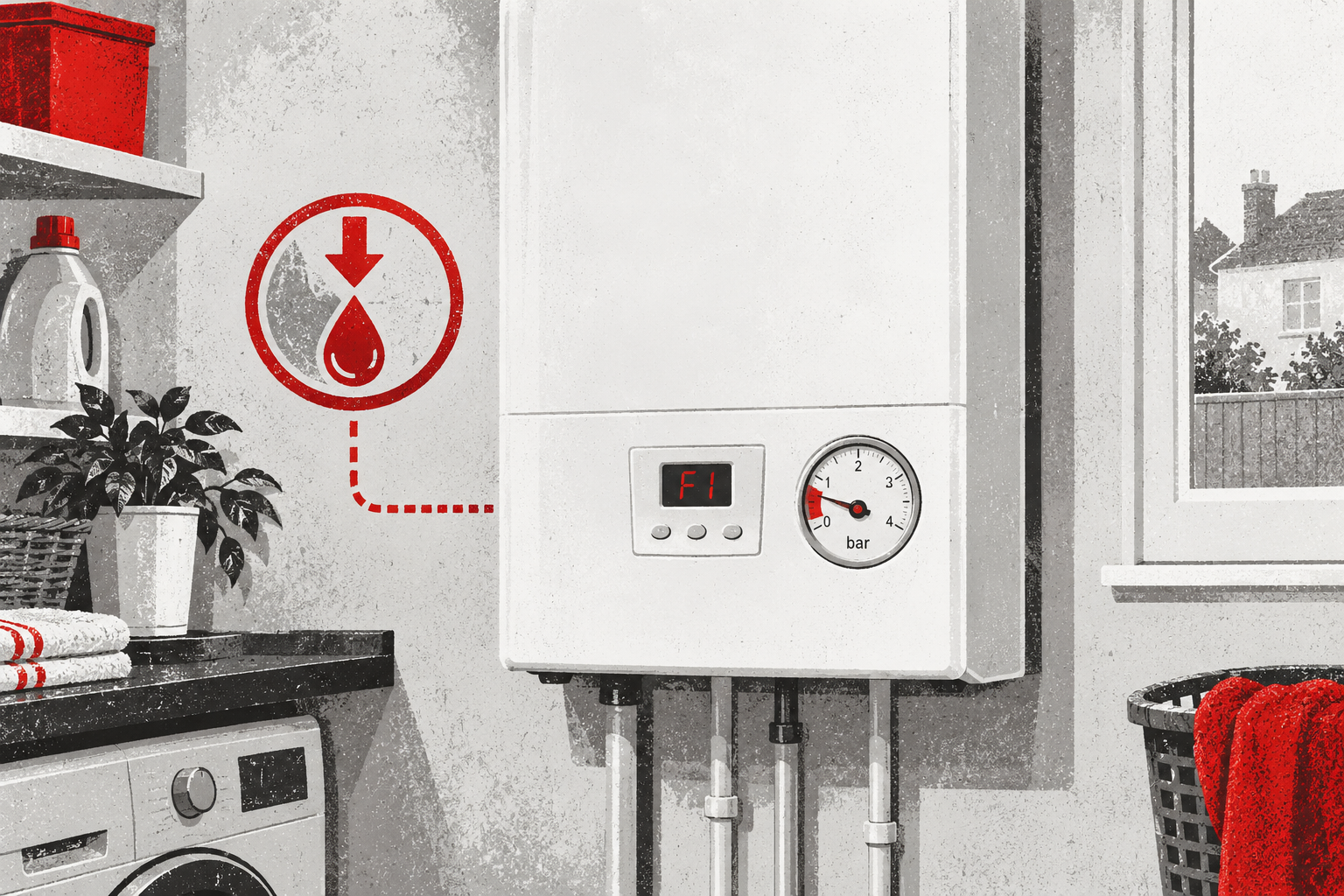
Ideal F1 fault code explained
An Ideal boiler showing F1 is reporting low water pressure in the central-heating system. On Ideal models whose instructions use this code, the boiler may stop providing heating or hot water because there is not enough system pressure for normal operation.
F1 is useful information, but it does not explain why the pressure became low. A one-off pressure drop after radiator work is different from a boiler that needs topping up repeatedly. This guide explains what an ordinary homeowner can safely check, when the instructions may allow repressurising, and when the fault needs a professional repair.
What does the Ideal F1 fault code mean?
Ideal describes F1 as low water pressure. The figure on the pressure gauge or digital display is the important clue. Ideal’s Logic Code Combi instructions say the system pressure should normally be between 1 and 1.5 bar when checked for this fault.
The water in a sealed heating system needs enough pressure to circulate around the boiler, radiators and pipework. If that pressure falls too far, the boiler protects itself by displaying a fault rather than continuing as though conditions were normal.
F1 is therefore a pressure warning, not a diagnosis of a particular component. It does not prove that the pressure sensor, expansion vessel or any other single part has failed.
Which Ideal boilers use F1?
F1 appears in several Ideal Logic-family instructions, including the Logic Code Combi ESP1 documentation. Some related Ideal controls and boiler generations also describe F1 as low water pressure, while newer displays may use plain-English messages instead.
Always use the model name and user guide for the boiler in front of you. Do not assume that every Ideal appliance uses identical codes, controls or repressurising arrangements.
What might you notice at home?
The boiler may stop firing, so both heating and hot water can be affected on a combi boiler. On other system types, the effect can depend on the controls and how the installation is arranged. The display may show F1 continuously or return to it after an attempted restart.
You may also see a pressure gauge reading below its usual position. Record the displayed code and pressure before changing anything. It is useful to note whether the fault appeared after radiator bleeding, building work, a recent service or a visible leak.
Safe checks before arranging a repair
- Check the exact display and write down F1 rather than relying on memory.
- Read the system pressure from the boiler’s normal external gauge or display.
- Look around visible radiators, valves and accessible pipework for obvious water marks or dripping.
- Note whether heating, hot water or both have stopped.
- Check whether any radiator or heating work happened shortly before the pressure fell.
These observations help an engineer understand the pattern. Keep the boiler casing closed and do not inspect internal pipework, wiring or sensors.
Can you repressurise an Ideal boiler showing F1?
Some Ideal user guides give a homeowner procedure for restoring pressure. The Logic Code Combi guide, for example, directs the user to check for 1 to 1.5 bar and follow that model’s repressurising section. Only do this if you can positively identify your boiler and follow its own instructions using the fitted user controls.
Stop if the controls do not match the guide, a valve is stiff, water appears, or you are unsure which parts are intended for the user. Do not improvise with tools or copy a video for a different Ideal model.
If the pressure is restored once and remains stable, the boiler may return to normal. If F1 comes back, the pressure drops again, or repressurising does not clear the fault, book a repair instead of repeatedly adding water.
Why might the pressure keep falling?
Repeated pressure loss means the system is not maintaining its normal sealed pressure. There can be several possible reasons, including water escaping somewhere in the heating system or a problem within the boiler. The F1 code alone cannot distinguish between them.
A tiny visible drip can matter over time, but the absence of an obvious leak does not rule out a fault. Avoid adding water every few days. Repeated topping-up masks the pattern and introduces fresh oxygenated water into the system.
For more context, see why a boiler keeps losing pressure and the guide to normal boiler pressure.
What will an engineer need to establish?
A Gas Safe registered engineer can confirm whether the displayed pressure matches the boiler’s actual condition and assess the heating system safely. They may consider the pressure history, visible leakage and how the appliance behaves, then test the relevant parts using the correct manufacturer information.
This is not something to diagnose by removing the casing. The repair depends on evidence from the particular boiler and installation, not on the code alone.
What should you avoid doing?
- Do not remove the boiler casing.
- Do not keep resetting or topping up the boiler whenever F1 returns.
- Do not exceed the pressure stated in the model’s user guide.
- Do not tighten internal fittings or disturb safety components.
- Do not order a pressure sensor or other part from the code alone.
When should you book a repair?
Arrange a repair if F1 remains after the permitted user action, the pressure will not rise, the reading drops again, water is visible, or you cannot identify the correct repressurising procedure. Switch the boiler off and seek prompt advice if water is reaching electrical equipment.
Get dependable heating and hot water back
Book a fixed-price boiler repair that aims to fix the Ideal F1 fault, with the cost agreed before the engineer visits.
Quick Answers
What does F1 mean on an Ideal boiler?
On the applicable Ideal models, F1 means the central-heating system water pressure is too low.
What pressure should an Ideal boiler show?
The Logic Code Combi user guide specifies 1 to 1.5 bar for the F1 check. Use the range stated in your exact model’s guide.
Can I reset an Ideal F1 fault?
Pressure must be correct first. A reset will not solve continuing pressure loss, so follow only the user guide and avoid repeated resets.
Is F1 always caused by a leak?
No. A leak is one possibility, but F1 does not identify the cause. An engineer should assess a recurring fault.
When does Ideal F1 need repair?
Book repair when the pressure cannot be restored safely, the code remains, or the pressure drops again after topping up.