
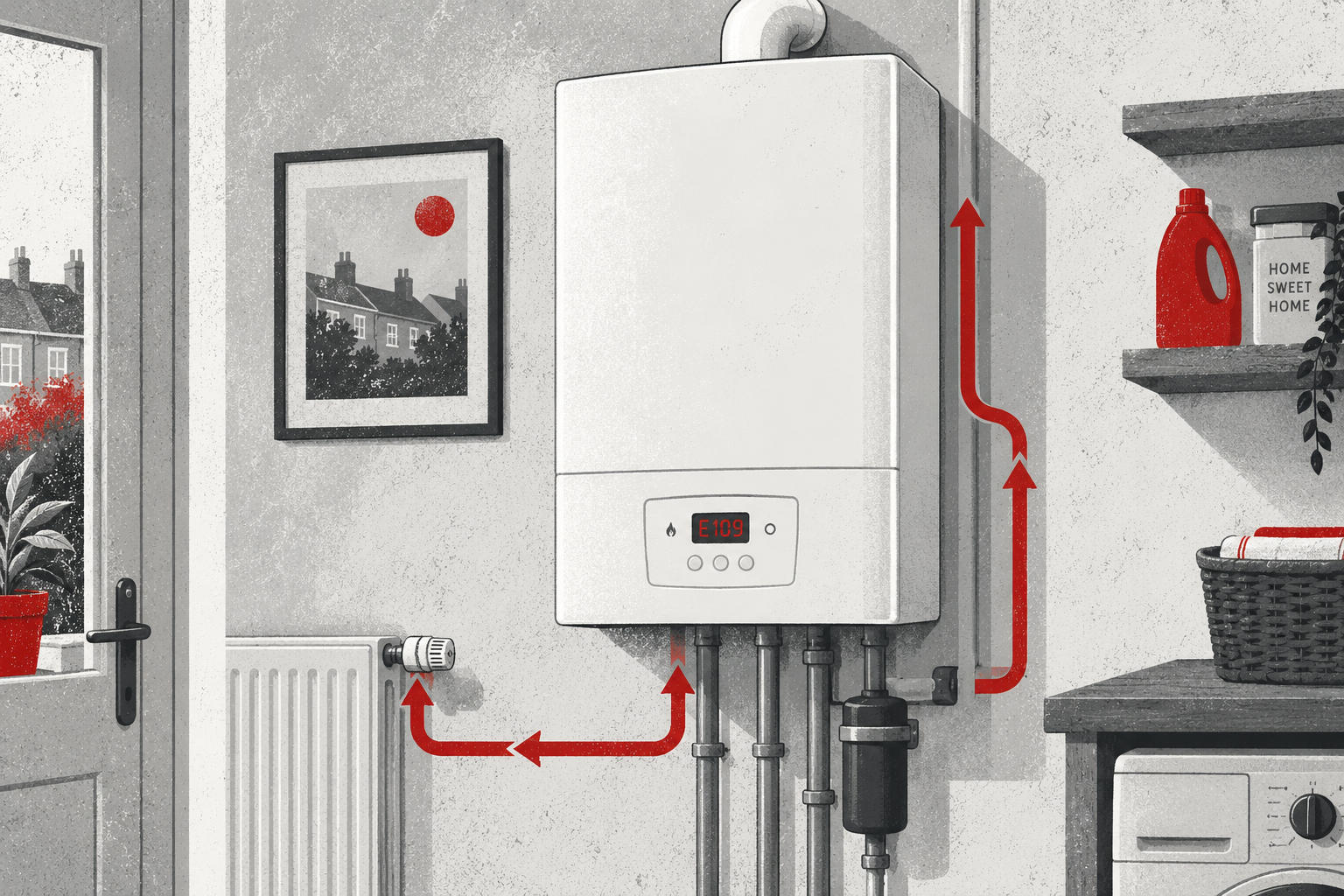
Main Eco Compact E109 fault code: precirculation alarm
The Main Eco Compact E109 fault code means “Precirculation alarm” in Baxi’s current error-code table. The Main Eco Compact user guide describes it as a “Pre-circulation fault”. The current manufacturer table places E109 in the model group that includes Main Eco Compact Combi and Main Eco Compact System boilers.
The wording tells you that the boiler has detected a problem during a circulation stage before normal operation continues. It does not identify a failed part, and it does not mean a homeowner should try to adjust the pump, valves or internal water circuit.
What does “pre-circulation” mean?
Before or around the firing sequence, the boiler controls water movement through its primary heating circuit. “Pre-circulation” is the name used for the stage that takes place before normal firing and heat delivery continue.
E109 means the boiler’s control sequence did not see the expected result during that stage. Baxi’s public error-code table does not give a single component cause for E109. It would therefore be misleading to say the code proves a pump, sensor, valve, air pocket or control board has failed.
An engineer needs to compare the fault history with actual circulation, temperature and control readings. The code is the starting point for that assessment, not a parts list.
What you may notice when E109 appears
The household symptoms can vary. You may notice:
- the boiler tries to start but does not continue into normal operation;
- the heating does not come on even though the thermostat is asking for heat;
- radiators remain cold or only begin to warm;
- hot water is interrupted on a combi model;
- the display returns to E109 after another start attempt;
- a different fault code appears before or after E109; or
- the problem began after work on a radiator or the heating system.
These observations do not reveal the cause, but they help establish when the sequence fails. If the boiler does not fire at all, [safe checks for a boiler that is not firing](/boiler-help-boiler-not-firing-up/) may help you describe the wider symptoms. If the boiler appears active but radiators stay cold, see [boiler running but radiators not heating](/boiler-help-heating-on-no-radiators/) for safe external observations.
Does E109 apply to every Main boiler?
No. Boiler fault codes are range-specific. The current Baxi table groups E109 with several products, including Main Eco Compact Combi and Main Eco Compact System. Do not assume the same code has an identical meaning on every older Main appliance.
Confirm the full model name on the front of the boiler or in its paperwork. Record the code exactly as displayed. Do not shorten E109 to E10 or E19, because those are different messages.
A Combi boiler provides hot water directly, while a System boiler normally works with a separate cylinder. That may change what you notice in the home, but both models appear in the manufacturer group for this code.
Safe observations to make
Keep the boiler casing closed. You can gather useful information without touching internal parts:
- Record the model and code. A photograph of the display can preserve the exact message.
- Note the demand. Was the thermostat calling for heating, was a hot tap running, or did the code appear with no obvious demand?
- Watch the timing. Does E109 appear immediately, after a short starting sequence or only after the boiler has been running?
- Check the visible pressure. Write down the reading but do not add water simply because E109 is shown.
- Observe the radiators. Note whether none, some or all of them begin to warm.
- Listen from a normal distance. Record any new sound, but do not remove panels to locate it.
- Remember recent work. Tell the engineer about radiator bleeding, draining, valve work or other heating changes.
- Keep the code sequence. If another message appears, write down the order instead of repeatedly clearing it.
This information can shorten the route to a proper repair because it shows which demand and stage are associated with the alarm.
What not to do
Do not treat “pre-circulation” as an instruction to work on circulation components. Avoid:
- removing the boiler casing;
- trying to turn, free or bleed the pump;
- opening internal vents;
- changing bypass or hidden valve settings;
- forcing valves that do not move normally;
- draining or refilling the system as an experiment;
- testing sensors, wiring, connectors or a circuit board;
- entering installer menus or changing parameters; or
- repeatedly switching or resetting the boiler.
These steps can introduce another fault, obscure the original evidence or involve gas-appliance components that require the correct competence and test equipment.
Should I change the boiler pressure?
E109 is not the manufacturer’s low-water-pressure code. The visible pressure reading is worth recording, but it should not be altered solely to clear a pre-circulation alarm.
If the display also shows a pressure-related message, follow the exact instructions for that separate code and the exact model guide. Do not improvise a filling method or copy controls from a different boiler.
Can I reset E109?
Use the symbols and instructions in the user guide for your exact Main Eco Compact. The guide distinguishes faults marked with an R, which can be reset by the user, from faults marked with a spanner, which cannot and require support.
Do not assume E109 is resettable merely because the boiler has a reset button. If the exact display and guide permit a user reset, try it once. If there is no R symbol, the code returns, or the boiler does not restart normally, stop and arrange a repair. Repeated resets are not a repair and can erase useful timing information.
When to arrange professional repair
Book a repair when:
- E109 remains on the display;
- it returns after one permitted reset;
- heating or hot water is unavailable;
- the boiler repeatedly starts and stops;
- radiators remain cold or heat unevenly;
- the code followed heating-system work; or
- another fault code is also present.
An engineer can assess the primary circulation and control sequence safely. That is more reliable than replacing a part based on the word “circulation”.
Important safety warning
If you smell gas, avoid electrical switches and naked flames, leave the property and call the National Gas Emergency Service on 0800 111 999 from a safe place. If a carbon-monoxide alarm sounds or anyone feels unwell, move into fresh air, seek medical help and do not use the boiler until it has been checked by a Gas Safe registered engineer.
Choose a straightforward booking route that aims to fix the E109 fault and restore reliable boiler operation.
Quick Answers
What does Main Eco Compact E109 mean?
Baxi’s current table calls it a precirculation alarm, while the user guide calls it a pre-circulation fault.
Does E109 mean the pump has failed?
No. The public manufacturer wording does not identify one failed part. Proper testing is needed.
Can I bleed the pump to clear E109?
No. Keep the boiler closed and do not work on the pump, internal vents or hydraulic parts.
Should I add water?
Not just because E109 is showing. It is not the manufacturer’s low-pressure code. Record the visible pressure and follow only a separate verified pressure instruction if one appears.
Can I reset E109?
Only if the exact display shows the user-reset symbol and your exact model guide permits it. Try once, not repeatedly.
Do I need an engineer?
Yes if E109 remains, returns, interrupts heating or hot water, or appears with another code.