
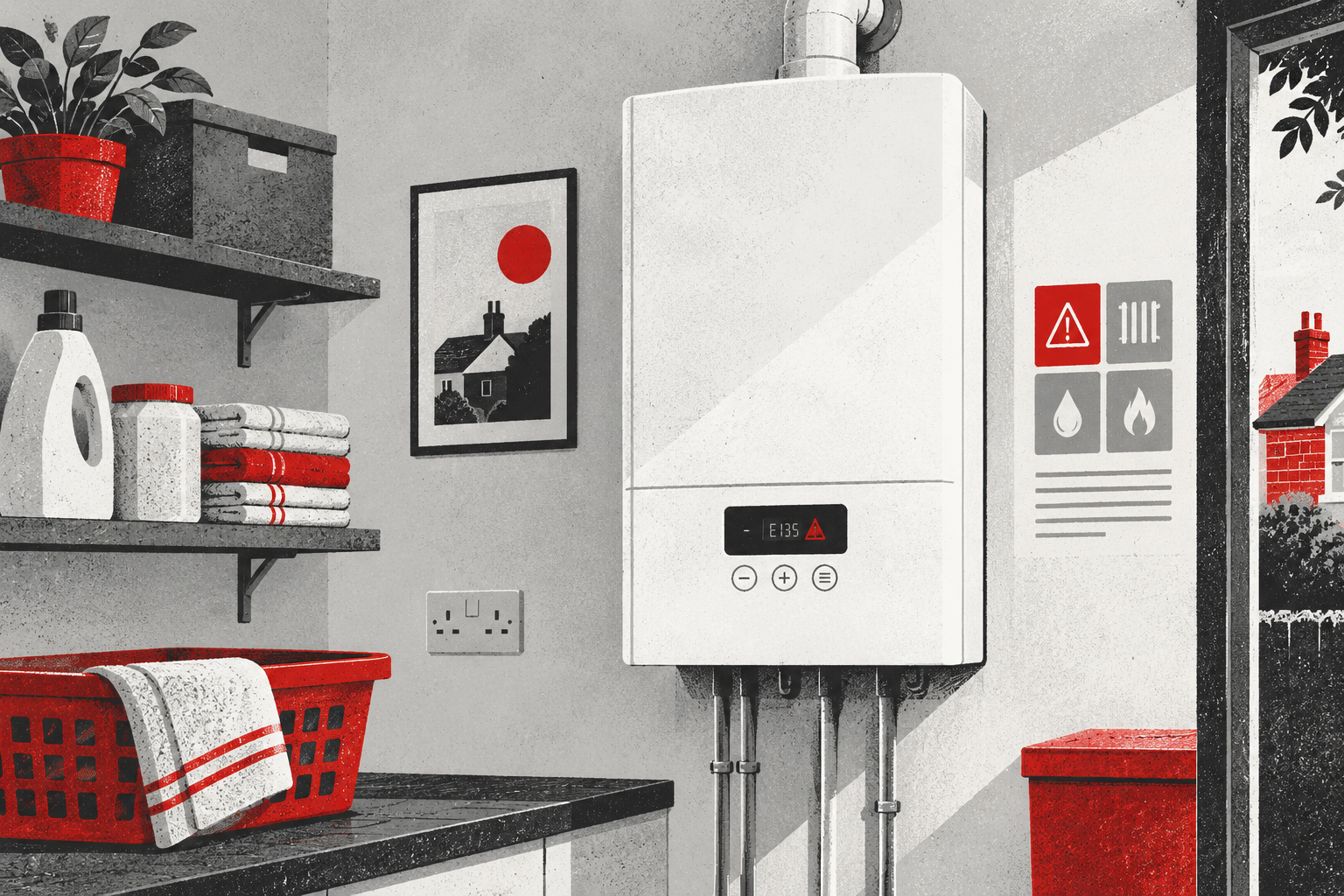
Main Eco Compact E135 fault code: internal error
If your Main Eco Compact is showing E135, the boiler has stopped after its controls recorded an internal error. Baxi’s current public fault-code table gives the meaning simply as “Internal error”.
That is deliberately broad. E135 does not identify one failed component, and it does not prove that the main control board needs replacing. The boiler has detected a condition it cannot continue with safely, so it has locked out and needs the right checks rather than a guessed part.
What Main Eco Compact E135 means
An “internal error” means the appliance’s control and safety sequence has not completed as expected. The public code description does not name a particular sensor, wire, board, valve or software fault. For a homeowner, the useful information is that the boiler has stopped itself and the exact cause must be established by competent testing.
Main’s technical documentation adds some broader context. It describes E135 as “Interruption of gas supply (internal error)” and groups E133, E134 and E135 with situations where gas was interrupted, ignition failed or a flame was not detected. That helps an engineer decide which sequence to test, but it still does not turn E135 into a confirmed diagnosis.
In other words, do not read “internal” as “the PCB is broken”. It tells you where the boiler detected the problem—in its own controlled operating sequence—not which replacement part to order.
Which Main boilers use E135?
Baxi’s current table lists Main Eco Compact Combi and Main Eco Compact System among the models that use E135. The same code appears across several related Baxi and Potterton ranges, but meanings and procedures should always be checked against the exact appliance.
The model name is normally printed on the boiler and in its paperwork. Record it along with the complete code before arranging a repair. A photo of the display and the boiler label can prevent confusion between similar Compact models.
What you might notice
E135 can appear when the boiler is trying to respond to a heating or hot-water demand. The household symptoms may include:
- the heating stays cold even though the thermostat is asking for heat;
- a combi boiler produces no hot water when a tap is opened;
- the boiler starts briefly and then stops;
- the display shows E135 immediately after another fault code;
- the boiler works after a reset but E135 later returns;
- the fault appears intermittently, making the heating unreliable.
These details are worth recording, especially the order in which codes appear. They are not enough to identify an internal part. A short noise, click or fan run can happen during several stages of operation and should not be treated as a DIY test result.
Safe things to check and record
You do not need to open the boiler to provide useful information. Keep the casing closed and make only normal household observations:
- Photograph E135 and note the time it appeared.
- Write down whether heating, hot water or both were being requested.
- Record any other code shown before or after E135.
- Note whether there has been a local gas-supply interruption or work at the meter.
- If you have a prepayment meter, read its normal display and check that it has credit.
- Look at the boiler’s pressure gauge without altering anything, and record the reading.
- Tell the engineer if the power supply has recently been interrupted or if professional work was carried out.
- Describe whether the code is permanent or only appears at particular times.
If the boiler stops repeatedly rather than remaining in a single lockout, our guide to a boiler that turns off explains the general household signs worth noting. E135 still needs to be assessed using the correct Main Eco Compact information.
Can you reset Main Eco Compact E135?
The Main Eco Compact guide distinguishes between errors that can be reset by the user and errors that cannot. If your display shows the resettable-error symbol and the instructions for your exact model permit it, you can try one normal reset from the front control.
For the referenced Main Eco Compact Combi guide, the reset button is pressed for approximately one second; holding it for more than two seconds will not reset the boiler. Follow your own manual because control layouts can vary.
If E135 returns, do not keep resetting, power-cycling or creating repeated heat demands. A brief return to operation does not show that the fault has been repaired. Recurring lockout is evidence that a fault remains and should be investigated.
What not to do
- Do not remove the boiler casing or touch internal wiring.
- Do not enter installer or service menus.
- Do not change calibration values, factory parameters or software settings.
- Do not unplug or reseat internal connectors.
- Do not buy a control board, gas valve or sensor on the basis of E135 alone.
- Do not copy a reset sequence from another model.
- Do not repeatedly interrupt the electrical or gas supply to force the boiler to restart.
Internal gas-boiler work must be carried out by a suitably qualified Gas Safe registered engineer. The boiler’s error history, operating sequence and safety checks need to be assessed with appropriate equipment. That is how a real fault is separated from a guess.
How E135 differs from nearby fault codes
The codes can look related but should not be treated as interchangeable:
- E133 is publicly listed as a gas-supply fault and points the engineer toward the supply, ignition and flame-sensing sequence.
- E134 is described as elapsed time with the gas valve open without gas, including the manufacturer’s “short request in a short period” wording.
- E135 is publicly listed as an internal error, with the Main technical manual providing broader gas-interruption context.
Knowing which code appeared first can matter. Photograph the screen rather than relying on memory, particularly if the display changes after a reset.
When to arrange a repair
Book a repair if E135 remains after the one permitted reset, comes back later, or prevents reliable heating or hot water. An engineer can check the stored fault information and the relevant control, supply, ignition and flame-confirmation sequence without assuming that one part is responsible.
If the boiler is already under professional isolation or has been labelled unsafe, do not turn it back on. Follow the engineer’s instructions and leave it off until the repair is complete.
Gas and carbon-monoxide safety
E135 by itself does not mean that gas is leaking. But if you smell gas, suspect a leak or think any gas appliance is unsafe, do not reset or operate the boiler. Open doors and windows, turn off the gas at the meter if you know how to do so safely, leave the affected area and call the National Gas Emergency Service on 0800 111 999.
If a carbon-monoxide alarm sounds or anyone develops possible carbon-monoxide symptoms—including headache, dizziness, nausea, breathlessness or unusual tiredness—move into fresh air and seek urgent medical help. Do not use the boiler again until it has been checked and declared safe.
Restore dependable heating or hot water
Book a fixed-price boiler repair to fix the E135 fault
Quick answers about Main Eco Compact E135
What does E135 mean on a Main Eco Compact?
Baxi’s current public description is “Internal error”. Main’s technical documentation adds gas-supply interruption context, but the code does not identify one failed part.
Does E135 mean the PCB needs replacing?
No. The public wording is too broad to confirm that. A control board is only one possible area within a much wider operating sequence, and replacement should never be guessed from the code.
Can I reset E135 myself?
You may try one reset only if your exact boiler’s display and user guide mark it as resettable. If E135 remains or returns, arrange a repair.
Why does E135 come back after a reset?
A reset clears the lockout so the boiler can try its checks again; it does not repair the condition that caused the code. A returning fault needs investigation.
Is it safe to keep using the boiler?
Do not rely on a boiler that repeatedly shows E135. Keep the casing closed and arrange repair. If you smell gas, a carbon-monoxide alarm sounds or the appliance seems unsafe, stop using it and follow emergency guidance.