
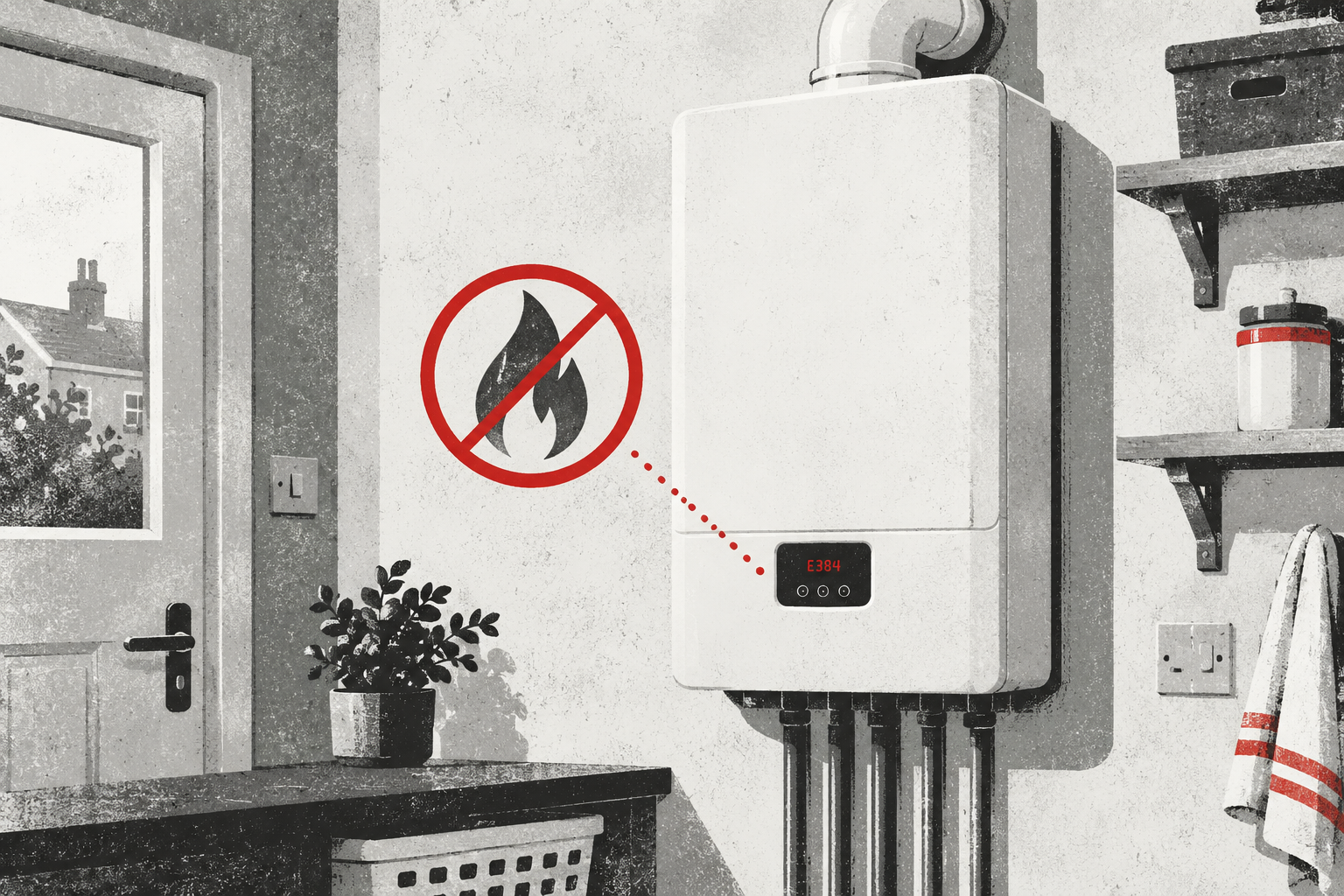
Main Eco Compact E384 / 164 fault code: false flame
If your Main Eco Compact is showing E384 or 164, Baxi’s current fault-code table describes it as “False flame (parasitic flame)”. The official listing pairs the two references as E384 / 164.
This means the boiler’s controls have detected a flame-related signal at a time when that signal does not match the expected operating state. It does not necessarily mean there is a visible flame, and it does not prove that one particular component has failed.
What “false flame” means
A gas boiler constantly supervises whether a flame is present as part of its safety sequence. The control system expects a flame signal only during the correct stages of operation. E384 / 164 is displayed when the boiler detects a signal that appears inconsistent with the state it expects.
Baxi also uses the term “parasitic flame” in brackets. That is manufacturer terminology for the detected condition. It is not a description of something a homeowner should look for through the casing, and it is not an invitation to inspect the burner.
The display tells an engineer which safety check has failed. It does not say whether the reason is a sensing issue, an electrical influence, a control problem or another condition in the combustion sequence. Those distinctions require approved testing with the boiler closed until a qualified person works on it.
Why are there two code numbers?
The current Baxi table presents this fault as E384 / 164. Depending on the display or documentation, you may see E384, 164 or the paired reference. Photograph the exact screen rather than relying on memory.
Both references lead to the same published description. Do not assume that 164 is a separate fault or combine it with another number that appeared at a different time.
Which boilers can show E384 / 164?
Baxi includes Main Eco Compact Combi and Main Eco Compact System in the model group using this code. Related Baxi and Potterton ranges also appear in the group, but the exact appliance should still be identified before repair.
Main Eco Compact Combi models provide heating and hot water directly. Main Eco Compact System models heat the central-heating circuit and a separate hot-water cylinder. The effect on the household can differ, while the underlying published code meaning remains the same.
What you may notice at home
E384 / 164 can stop the boiler from starting or interrupt a demand. You may notice:
- the code appears even though the burner does not seem to be running;
- the heating stays cold despite a thermostat demand;
- a combi boiler does not provide hot water;
- the boiler starts a sequence and then quickly locks out;
- the code appears after another ignition or flame-related fault;
- the boiler works after a reset but later shows the same code again.
These observations can help establish the sequence. They cannot safely identify the failed part. Do not listen for clicks, watch the flue or repeatedly create a demand as a test.
Safe information to collect
Keep the boiler casing closed. Useful homeowner information includes:
- Photograph E384 / 164 and all display symbols.
- Record whether heating, hot water or both were being requested.
- Note whether the code appeared immediately or after the boiler had run.
- Write down any earlier or later fault code.
- Record whether the fault is permanent or intermittent.
- Tell the engineer about recent power interruptions or professional boiler work.
- Note any unusual smell, carbon-monoxide alarm activation or change in normal operation without approaching the flue.
- Provide the complete model name from the boiler paperwork or accessible label.
If the burner will not start and the display stays lit, our guide to a boiler not firing up explains other household details worth recording. The E384 / 164 code still requires its own flame-safety checks.
Can you reset Main Eco Compact E384 / 164?
The Main Eco Compact user guide distinguishes between resettable and non-resettable errors. If your display shows the resettable-error symbol and your exact model’s instructions permit it, you can try one normal reset using the front control.
On the referenced Main Eco Compact Combi guide, the reset button is pressed for approximately one second; holding it for more than two seconds will not reset the boiler. Follow the instructions for your own appliance.
If the code remains or returns, stop resetting. Repeated starts are not a repair and can remove useful information about the order in which the boiler’s safety checks failed.
What not to do
- Do not remove the boiler casing.
- Do not look for or touch the burner, electrodes or flame-sensing parts.
- Do not adjust the gas valve, gas pressure, combustion or flue.
- Do not test internal voltage, wiring, connectors or control boards.
- Do not enter installer menus or alter combustion parameters.
- Do not buy an electrode, valve or PCB from the code alone.
- Do not repeatedly reset or power-cycle the boiler.
Flame supervision is part of the boiler’s gas and combustion safety system. Testing and repair must be carried out by a suitably qualified Gas Safe registered engineer with the correct equipment and manufacturer information.
How E384 / 164 differs from other flame codes
Main Eco Compact fault tables contain several codes that mention gas, ignition or flame, but they are not interchangeable:
- E128 is a safety error for frequent loss of flame.
- E133 is listed as a gas-supply fault.
- E134 describes elapsed time with the gas valve open without gas.
- E384 / 164 is false flame, also called parasitic flame.
E384 / 164 concerns an unexpected flame-related signal, while loss-of-flame codes concern a flame that was expected and then not confirmed. Record the exact number and the order in which codes appear.
When to arrange a repair
Book a repair if E384 / 164 remains after the one permitted reset, returns later or leaves you without dependable heating or hot water. Tell the engineer whether it appeared on heating, hot water or both, and share photographs of any other code.
If a professional has isolated the boiler or labelled it unsafe, do not turn it back on. Follow their instructions until the appliance has been repaired and declared safe.
Gas and carbon-monoxide safety
The false-flame code does not by itself confirm a gas leak. However, it relates to flame supervision, so never ignore separate warning signs. If you smell gas, suspect a leak or think the appliance is unsafe, do not reset or operate it. Open doors and windows, turn off gas at the meter if you know how to do so safely, leave the affected area and call the National Gas Emergency Service on 0800 111 999.
If a carbon-monoxide alarm sounds or anyone develops possible symptoms such as headache, dizziness, nausea, breathlessness or unusual tiredness, move into fresh air and seek urgent medical help. Do not use the boiler again until it has been checked and declared safe.
Restore safe, dependable operation
Book a fixed-price boiler repair to fix the E384 / 164 fault, with the cost agreed before the engineer visits.
Quick answers about Main Eco Compact E384 / 164
What does E384 / 164 mean?
Baxi lists it as “False flame (parasitic flame)”. The boiler has detected a flame-related signal that does not match the expected operating state.
Does false flame mean I can see a flame?
No. It describes a control signal, not something a homeowner should try to see. Keep the casing closed.
Does the code prove the flame sensor is faulty?
No. The code does not identify one failed part. Approved testing is required before anything is replaced.
Can I reset E384 / 164?
Try one reset only if your exact model’s display and guide mark the error as resettable. If it returns, arrange repair.
Is it safe to keep using the boiler?
Do not rely on a boiler that repeatedly reports a flame-safety fault. Arrange repair and follow emergency guidance immediately if you smell gas or a carbon-monoxide alarm sounds.