
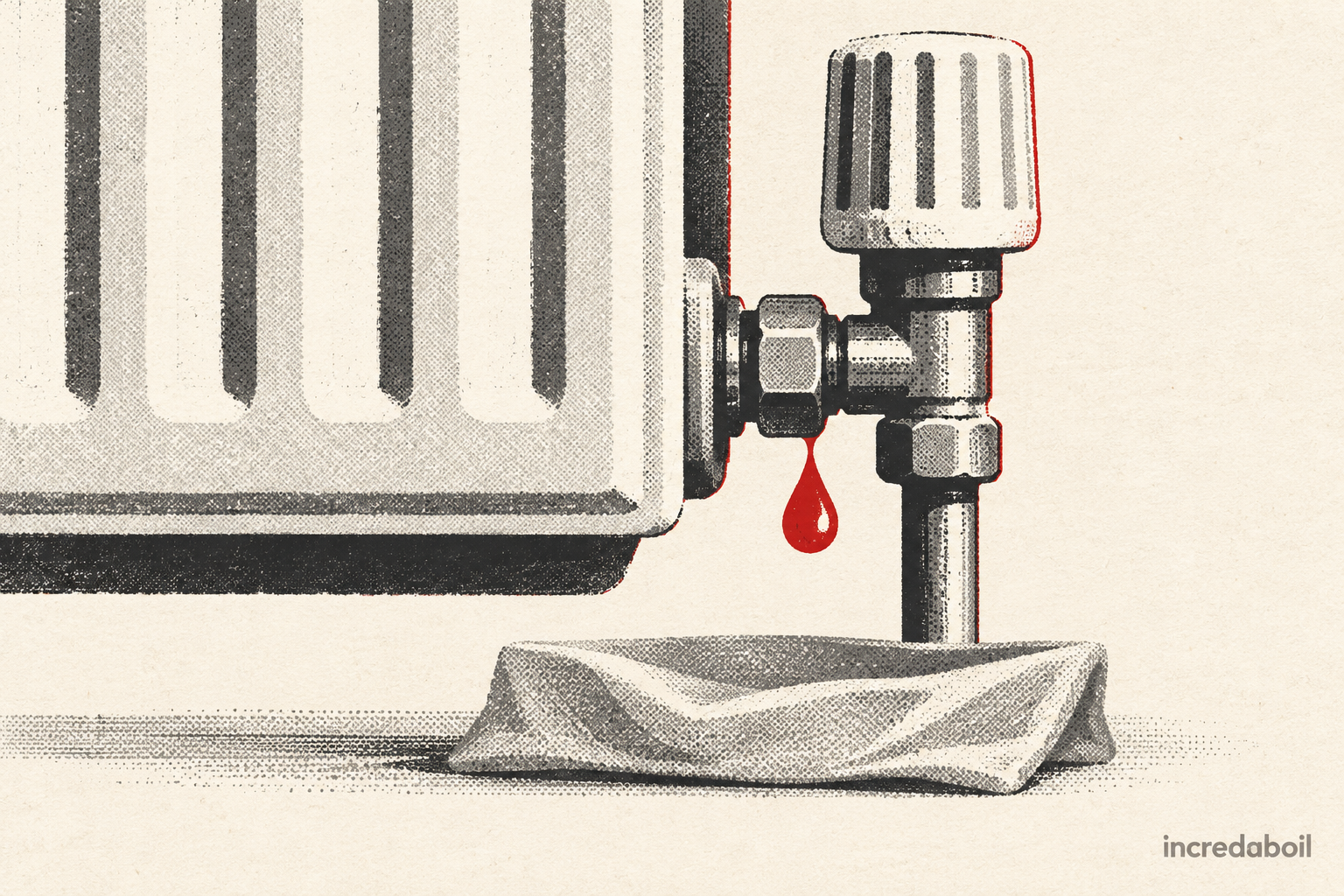
A leaking radiator valve may produce an occasional bead of water, a damp patch around a joint or a steady flow onto the floor. Even a slow leak matters: it can damage flooring, reduce sealed-system pressure and worsen without warning. Switch the heating off, let the radiator cool, contain the water and identify where it appears—without dismantling the valve.
The source might be the connection to the radiator, the pipe connection, the valve spindle or the valve body itself. Each needs a different repair. Wiping the area dry and watching where the first new droplet forms is more useful than tightening random nuts.
What to do straight away
- Turn the heating off. Let the radiator and pipes cool before approaching the leak.
- Protect the floor. Place a shallow tray or absorbent towels beneath the valve and move electrical items away.
- Dry and observe. Wipe the outside carefully, then look for the first point that becomes wet.
- Check the boiler pressure. Record the reading rather than repeatedly topping it up.
- Arrange repair. A continuing leak, falling pressure or damaged fitting needs a competent heating engineer or plumber.
If water is flowing rapidly, spreading toward electrics, coming through a ceiling or cannot be contained, treat it as urgent. Use the property’s normal water-isolation controls if you know exactly which safe control applies, contact an emergency plumber and warn occupants about slippery floors. Do not handle hot water or energised electrical equipment.
Where is the valve leaking from?
Between the valve and radiator
Water at the large connection beside the radiator can come from the union, its sealing surface or movement between the radiator and pipework. The droplet may travel along the metal before falling, so the wettest point is not always the original source. A professional may need to isolate and drain enough of the system to remake the joint correctly.
Where the pipe enters the valve
A leak at the lower compression joint can follow disturbance, corrosion, a damaged olive, poor pipe alignment or a problem with the valve body. Overtightening can deform fittings or worsen a damaged joint. Do not use force, especially on older or painted pipework.
Around the valve spindle
Manual radiator valves and some lockshields have a moving spindle beneath a cap. Water around that area may indicate a spindle seal or gland problem. Thermostatic radiator valves have a separate sensing head, but the wet valve body beneath it still belongs to the water circuit. Drayton’s TRV4 documentation confirms that body-seal service kits exist for valve-body leaks; selection and fitting are jobs for someone who can identify the exact product and safely control the system water.
From the valve body itself
A crack, pinhole, corrosion or failed body seal generally means the valve needs repair or replacement. Do not rely on external sealant, tape or epoxy as a permanent fix. Heating water repeatedly expands and contracts, and a temporary surface patch can conceal deterioration.
From the radiator rather than the valve
Rust staining or moisture from the radiator panel, bleed point or blanking plug can run toward a valve and imitate a joint leak. Dry the whole lower corner and inspect from above. A corroded radiator may need replacement rather than valve work.
Is it safe to tighten a leaking radiator valve?
Not as a blind first response. Different joints use different seals, and movement at one connection can stress another. A tiny controlled adjustment may form part of a competent repair, but over-tightening a compression fitting can damage the olive, pipe or valve. The safest homeowner action is to cool, contain, observe and call for help if the leak persists.
Avoid online instructions that assume every radiator has the same valve. Modern TRVs, manual valves, lockshields, push-fit connections, iron pipework and decorative valves are not interchangeable. Painted or corroded fittings can also fail when disturbed.
Should you close the radiator valves?
Closing both valves may reduce water movement through that radiator, but it does not guarantee isolation. A valve can be faulty, a thermostatic head can be misunderstood, and trapped water remains in the radiator. Turning an unknown lockshield also loses the setting used to balance the system.
If you have been shown how to isolate that exact radiator and the controls move freely, you can follow the installer’s instructions and record the original lockshield position. Do not force a seized control. If water continues or the leak is significant, seek urgent help rather than assuming the radiator is safely isolated.
Why boiler pressure may fall
Many combi and system-boiler installations use a sealed heating circuit. Water escaping at a radiator valve reduces the amount of water in that circuit and can make the displayed pressure fall. The boiler may eventually stop and show a low-pressure message.
Repressurising can restore operation temporarily, but it does not repair the leak. Continually adding fresh water can introduce oxygen and contribute to corrosion. Follow the exact boiler manual only when a one-off pressure correction is appropriate; if the reading drops again, repair the cause.
Could it be condensation?
Occasionally moisture from cleaning, drying clothes or condensation on unusually cold pipework can collect near a valve. Heating-system pipework is normally warm when operating, so repeated beads from the same joint should be treated as a leak. Dry the area fully and observe it with the heating both off and then operating normally.
Why radiator valves begin to leak
- ageing seals and repeated heating-and-cooling cycles;
- corrosion in the valve, radiator or connecting pipe;
- movement caused by decorating, flooring or radiator removal;
- poor alignment placing strain on a joint;
- a damaged compression connection or sealing face;
- a spindle or body seal that no longer holds; or
- excessive system pressure that reveals a weak point.
If the boiler pressure rises abnormally when hot, approaches the red zone, or water also discharges outside from a safety pipe, tell the engineer. The leak may be one symptom of a wider pressure-control problem rather than an isolated loose fitting.
Can leak sealer fix a radiator valve?
A bottled internal leak sealer is not a substitute for repairing a visible valve leak. Heating manufacturers set requirements for water treatment and acceptable chemicals, and unsuitable products can affect small waterways, pumps, heat exchangers or warranties. A visible external joint should be identified and repaired correctly.
What will an engineer check?
The engineer will confirm the true source, inspect the valve and pipe condition, assess system pressure and decide whether a seal, connection, complete valve or radiator needs attention. The system may need partial draining or controlled freezing equipment, followed by refilling, venting, pressure checks and restoration of inhibitor where appropriate.
If a lockshield or TRV is replaced, the radiator’s flow may need recommissioning so that it does not take too much or too little water. Worcester Bosch’s homeowner guidance notes that lockshield valves regulate flow during system balancing. A repair is complete only when the joint remains dry under operating temperature and pressure.
Protecting the room while you wait
- Keep absorbent material and a shallow container beneath a slow drip.
- Change wet towels so moisture does not sit against timber, laminate or carpet.
- Keep children and pets away from hot surfaces and collected water.
- Do not place a deep unstable bucket where it can tip.
- Photograph the leak and pressure reading for the engineer or landlord.
- In rented accommodation, report the fault promptly in writing and keep a copy.
Citizens Advice recommends that tenants report repair problems to their landlord. Responsibility depends on the tenancy and circumstances, but early written notice helps prevent damage and establishes when the problem was reported.
When the leak is urgent
Get urgent help when water cannot be contained, the floor or ceiling is swelling, electrics may be affected, the pressure is dropping quickly, the valve or pipe is visibly cracked, or a vulnerable person could touch hot water or a hot radiator. HSE highlights the burn risk from hot water, pipes and radiators for people who may not react quickly.
If the boiler itself is leaking, do not remove its case. Switch it off using its normal control and arrange an appropriately qualified engineer. Any work that involves a gas appliance must be performed by someone on the Gas Safe Register who is competent for that appliance and task.
Frequently asked questions
Can I still use the heating with a dripping valve?
It is better to switch it off until the leak is assessed. Heat and pressure changes can increase leakage, and escaping water can cause hidden damage.
Will turning the TRV to zero stop the leak?
Not reliably. The setting controls room-temperature response; it does not isolate every possible leak point or remove water already in the radiator.
Why does it leak only when the heating is on?
Heating raises water temperature and changes system pressure, while metal and seals expand. A marginal joint may therefore leak only during operation.
Why has the boiler lost pressure?
A visible radiator-valve leak can remove water from a sealed circuit. Repair the leak rather than repeatedly topping up the boiler.
Does the whole radiator need replacing?
Not if the leak is confined to a serviceable valve or joint and the radiator is sound. Corrosion in the radiator panel or connection may change that decision.
Related boiler-help guides
- Why does boiler pressure keep dropping?
- Radiator pipes are hot but the radiator is cold
- One radiator is much hotter than the others
- What is magnetite in a heating system?
Is a leaking radiator valve making your boiler pressure fall?
Book a fixed-price Incredaboil repair for an eligible Baxi, Worcester Bosch or Ideal boiler when the leak is affecting the heating system or boiler operation.