
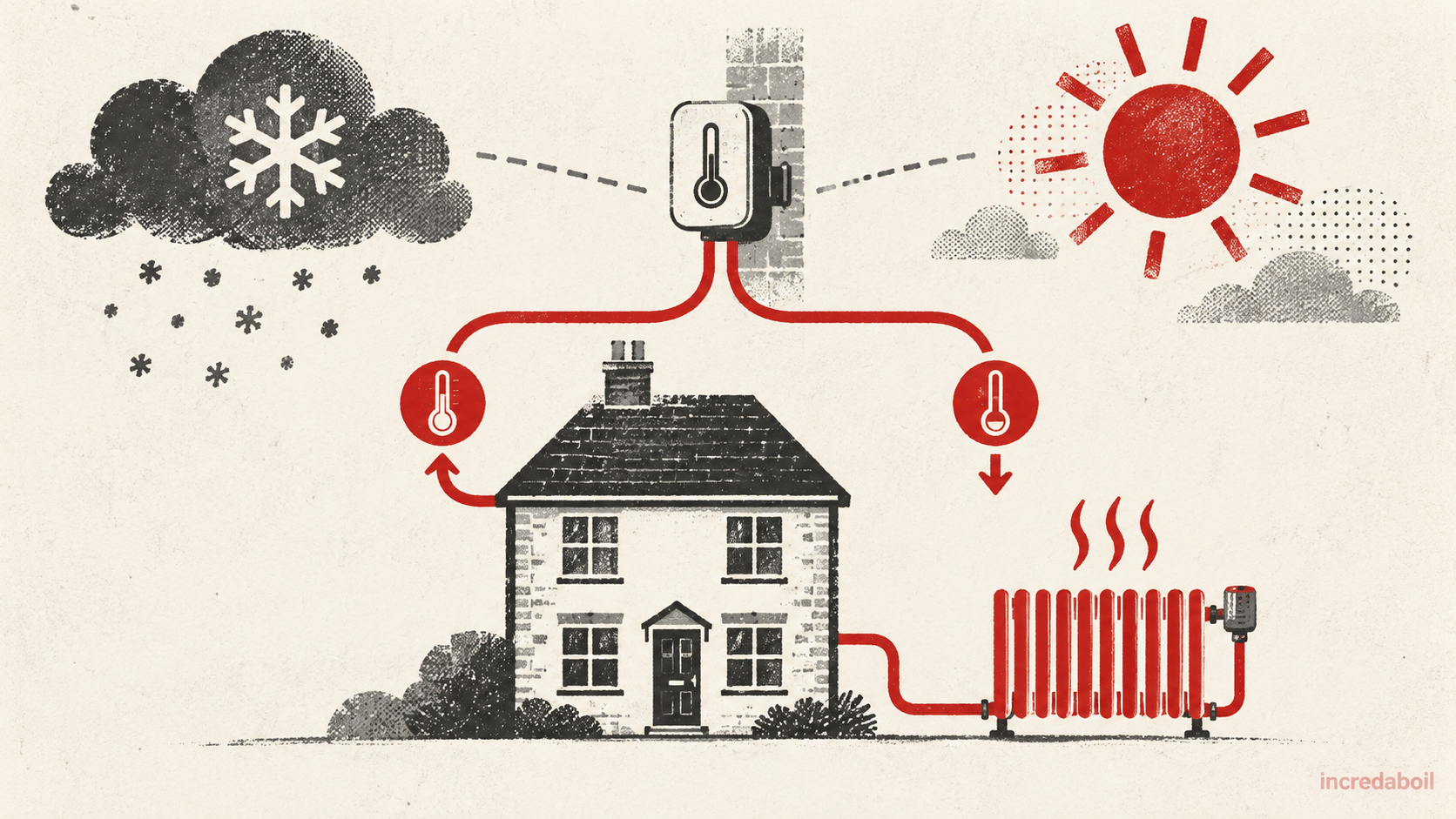
Weather compensation is a heating control that watches the outdoor temperature and automatically changes how hot the water sent to your radiators needs to be. Colder outside means a higher heating flow temperature; milder outside means a lower one. The aim is steady comfort with less waste, not a house that is deliberately cooler.
It is a simple idea, but homeowners are often surprised by the result: radiators may feel warm rather than fiercely hot, the boiler may run for longer at a lower output, and the house can hold a more even temperature. Those can be signs of correct operation, provided the rooms actually reach their targets.
What weather compensation controls
An outdoor sensor—or, on some connected controls, local internet weather data—tells the heating controller how conditions are changing. The controller then adjusts the central-heating water temperature. It does not normally decide what room temperature you want; that still comes from the programmed comfort setting or room control.
Energy Saving Trust describes weather compensation as an automatic way to adjust the boiler thermostat as the weather becomes colder or warmer. Government Boiler Plus guidance explains the purpose: modern condensing boilers are more efficient at lower water temperatures, so the control sends only as much heat as the conditions require.
A simple example
On a bitter morning, the home loses heat quickly. The controller raises the radiator flow temperature so the radiators can keep up. On a mild afternoon, heat loss falls, so the controller lowers the flow temperature. Instead of repeatedly firing very hot water and switching off, a compatible boiler can spend more time running gently.
The actual temperatures are not universal. They depend on the building’s heat loss, radiator sizes, boiler or heat pump, desired room temperature and the chosen heating curve. Copying somebody else’s curve from an online forum is not commissioning.
What is a weather-compensation curve?
The heating curve is the relationship between outdoor temperature and required heating-water temperature. A steeper curve produces hotter water as the weather becomes colder. A flatter curve keeps water temperatures lower.
Some controls show numbered curves; others offer simple “warmer” and “cooler” adjustments or ask for design temperatures. The installer should set a starting point and explain the homeowner adjustment. The best curve is normally the lowest setting that keeps the whole home comfortable in the relevant weather.
Why lower flow temperature can save energy
A condensing gas boiler recovers more heat from its flue gases when the returning system water is cool enough. Government’s Boiler Plus review states that lowering flow temperature can help a boiler operate in condensing mode for more of the time. That can reduce fuel use, although the saving varies substantially between homes.
Weather compensation makes this adjustment continuously. It avoids leaving the boiler at a high winter setting throughout a mild spring day. It can also reduce temperature overshoot, where rooms become warmer than requested after the thermostat has stopped calling.
Do not treat a quoted percentage as a promise. Savings depend on the previous controls, insulation, emitter sizing, occupancy and how the system is commissioned. Comfort must remain the test.
How it feels in everyday use
- radiators may be warm for longer instead of cycling between very hot and cold;
- rooms may approach the set temperature more steadily;
- the boiler display may show different heating temperatures on different days;
- the boiler may fire at a lower rate for a longer period; and
- recovery after a deep overnight setback can take longer.
A cooler radiator is not automatically a fault. If the room reaches and maintains the chosen temperature, the emitter is doing its job. Turning the curve up just to make the radiator feel hot can remove much of the efficiency benefit.
Weather compensation, room thermostats and TRVs
These controls have different jobs. Weather compensation anticipates how much heat the building is likely to lose based on outdoor conditions. A room thermostat measures indoor temperature and can provide a stop signal or additional “room influence”. Thermostatic radiator valves, or TRVs, limit individual rooms.
The controls must be designed to work together. A room thermostat in a cold draught, a TRV closing around the main sensor, or incompatible on/off controls can make an otherwise good system behave poorly. Do not add a second controller without checking compatibility.
How is the outdoor temperature measured?
Many systems use a wired or wireless outdoor sensor positioned where sunlight, boiler flue discharge and other heat sources will not distort it. Some controls use online weather information instead. Baxi offers an in-flue outdoor sensor on compatible boilers; Worcester Bosch describes controls that use an outdoor sensor; Vaillant’s sensoCOMFORT is supplied with an outdoor sensor.
The correct product is manufacturer- and model-specific. An outside sensor is not a generic thermostat that can simply be wired into any boiler.
Can it work with Baxi, Worcester Bosch and Ideal boilers?
Yes, selected models and control combinations support it. Baxi’s current accessories include its IFOS weather sensor. Worcester Bosch lists weather compensation among its intelligent-control features. Ideal publishes an outside-sensor kit for specific Logic and Vogue boiler families.
Compatibility must be checked against the exact boiler model, control, wiring arrangement and installation instructions. Even within one brand, a control designed for a recent boiler may not work with an older range. Ask the installer to name the proposed sensor or controller on the quotation.
What about Vaillant and Viessmann?
Vaillant’s sensoCOMFORT and related controls use weather-compensating technology, while Viessmann publishes weather-compensation controls and heating-curve guidance for compatible systems. These are useful examples of how mainstream the principle has become.
Is weather compensation only for gas boilers?
No. It is especially important for heat pumps because their efficiency and steady operation depend strongly on keeping water temperatures as low as practical. Energy Saving Trust’s installer guidance describes the outdoor sensor and curve as central to heat-pump design.
A heat-pump curve should be commissioned as part of that specific system. Do not apply gas-boiler curve numbers to a heat pump, or vice versa.
What happens to stored hot water?
Weather compensation primarily changes space-heating flow temperature. A system or heat-only boiler with a cylinder still needs hot-water controls and temperatures that safely heat the stored water. Energy Saving Trust warns that a boiler serving a cylinder needs a sufficiently high hot-water setting so the cylinder can reach its required temperature.
A properly designed control can give the cylinder a different demand from the radiators. Do not lower cylinder or boiler settings blindly, and do not assume a weather-compensated radiator temperature is also the stored-water temperature.
Is it required under Boiler Plus?
In England, Boiler Plus raised the standard for new and replacement domestic gas boiler installations. For a new combi installation, one qualifying additional measure can be weather compensation, load compensation, flue-gas heat recovery, or a smart control with automation and optimisation. Weather compensation is an option, not the only permitted route.
Existing homes do not all have to retrofit it. Building requirements also differ across UK nations and can change, so an installer should confirm the rules applying to the job.
Weather compensation versus load compensation
Weather compensation responds to outdoor temperature. Load compensation responds to the gap between the actual indoor temperature and the target. Both can reduce boiler flow temperature, but they use different information.
Some advanced controls combine outdoor sensing with room influence. That can correct for sunshine, cooking or extra occupants—heat gains an outdoor sensor cannot see. The boiler and control must support the intended communication method.
Common problems after installation
The house is consistently too cold
The curve may be too low, the schedule may use a deep setback, or radiators may be undersized at the selected flow temperature. Balancing, closed TRVs and insulation also matter. Ask the installer to tune the curve rather than simply disabling the feature.
The house is too warm in mild weather
The curve or offset may be too high, the outdoor reading may be distorted, or room influence may be configured incorrectly. Record indoor and outdoor temperatures before changing one setting at a time.
It takes too long to warm up
Compensated systems often favour steady operation. A severe overnight drop can require an early start. Use the control’s optimisation or schedule before demanding a permanently hotter flow.
Only some rooms are cold
That usually points towards balancing, radiator sizing, TRV settings or local heat loss rather than the entire curve. Raising the curve for one cold room may overheat every other room.
What can a homeowner safely adjust?
Use only the homeowner controls described in the user guide: desired room temperature, schedule, holiday mode and any clearly labelled curve offset. Make small changes, wait through comparable weather and keep notes.
Do not open the boiler case, alter installer parameters without guidance, relocate a wired sensor or modify boiler wiring. Gas-appliance work and internal control connections require a competent Gas Safe registered engineer.
When to ask the installer back
Request recommissioning if the home cannot reach a safe comfortable temperature, the outdoor reading is obviously implausible, cycling remains excessive, controls conflict, the cylinder does not heat correctly or the system was never explained. NHS winter advice says regularly used rooms should be comfortably heated and, where possible, at least 18°C—particularly for people with health conditions.
The installer should check the heat-loss assumptions, radiator outputs, balance, curve, sensor position and control compatibility. Weather compensation cannot correct an undersized radiator or a blocked system.
Frequently asked questions
Should my radiators be hot with weather compensation?
Only when the weather and heat loss require it. Warm radiators can be entirely normal in mild conditions if rooms reach temperature.
Will it work without an internet connection?
A physical outdoor sensor normally can. Controls that obtain weather data online may lose that function or use a fallback, depending on the product.
Can I fit a weather sensor myself?
It should be specified, positioned, wired and commissioned for the compatible boiler by a competent installer. It is not a plug-in universal accessory.
Does weather compensation control hot tap temperature?
Its main purpose is space-heating flow temperature. Domestic hot water has separate controls and safety requirements.
Related boiler-help guides
- Should I turn down my boiler flow temperature?
- Can I use a smart thermostat with an older boiler?
- How to balance radiators
- What size boiler do I need?
Is your compensated heating still leaving rooms cold?
If an eligible Baxi, Worcester Bosch or Ideal boiler is not heating the home properly, book a fixed-price Incredaboil repair and have the system diagnosed.