
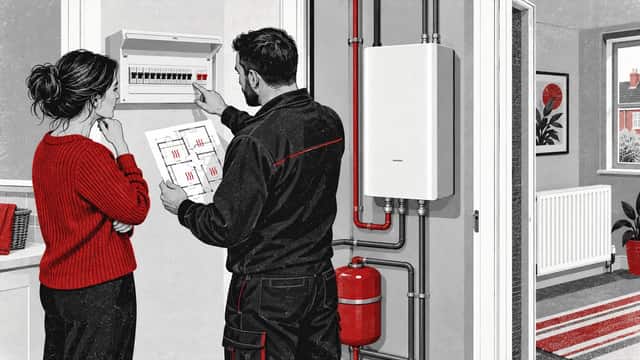
What is an electric boiler?
An electric boiler uses electric heating elements to warm water for radiators or underfloor heating. It can run a familiar wet central-heating system without a gas supply, oil tank or combustion flue, but its output, electrical demand and running cost must be assessed carefully.
“Electric boiler” covers several arrangements. A compact flow boiler may provide space heating only, with a separate cylinder if domestic hot water is required. A packaged electric combination unit can provide heating and stored hot water in one casing. Neither should be confused with a heat pump, which moves heat rather than creating it directly with resistance elements.
The short answer
- Electric boilers heat water for a wet radiator or underfloor system.
- They do not burn fuel, so the boiler itself needs no combustion flue.
- A heat-loss calculation determines the required output; floor area alone is not enough.
- The property’s electricity supply, consumer unit and dedicated circuit must be checked before a model is selected.
- Direct electric heat is efficient at the point of use, but each kilowatt-hour of heat normally requires about one kilowatt-hour of electricity.
- Electricity costs much more per kWh than mains gas on current capped rates, so whole-home running costs can be high.
How does an electric boiler work?
When the controls call for heat, electricity passes through one or more elements inside the boiler. Those elements transfer heat to circulating water. A pump sends the water through radiators or underfloor pipes, and the cooler return water comes back to be reheated.
There is no burner and no combustion gas. That removes the need for a gas connection and boiler flue, but it does not make installation a plug-in job. The hydraulic system still needs correct expansion, pressure, flow, controls and commissioning, while the electrical installation may carry a sustained high current.
Where are electric boilers used?
They can suit well-insulated smaller homes, flats without gas, rural properties where an oil or LPG installation is impractical, and projects where a wet radiator system must be retained. They are also considered for extensions, loft conversions, garages and separate zones where running new gas pipework or a flue is awkward.
Heatrae Sadia describes Amptec as suitable for extensions, loft conversions, conservatories and garages, as well as standard radiator and underfloor systems. Suitability still depends on heat loss, controls and electrical capacity rather than the room label.
What is an Amptec boiler?
Amptec is Heatrae Sadia’s slim electric flow-boiler range. The current product page lists standard and underfloor models from 4kW to 12kW. It works with ordinary wet-system components such as radiators, pumps, programmers, room thermostats and thermostatic radiator valves.
An Amptec is principally a space-heating boiler. The manufacturer says domestic hot water can be provided with an indirect cylinder heated by the boiler, or by a separate direct cylinder. It is not an instantaneous gas-style combi that heats unlimited tap water as it passes through.
How is an electric boiler different from a heat pump?
A resistance boiler turns electricity into heat directly. In broad terms, one kWh of electricity produces around one kWh of useful heat at the appliance. A heat pump uses electricity to move heat from outside air or the ground and can therefore deliver several units of heat for each unit of electricity under suitable conditions.
This is why a boiler can advertise near-100% appliance efficiency while still costing more to run than a heat pump or mains-gas boiler. The efficiency percentage does not include the relative price of the fuel or the seasonal performance of the whole home.
What electrical supply does it need?
Output and current rise together. Amptec’s official installation information gives a range from 4kW to 12kW; older manufacturer tables show nominal currents from about 17A for 4kW up to about 50A for 12kW at 240V, with model-specific protective-device requirements.
That demand can be a large share of a domestic supply before showers, ovens, vehicle chargers or other loads are counted. A competent electrician should assess the service head, meter arrangements, consumer unit, cable route, earthing, protective devices and diversity. Some larger products or combinations may need a three-phase supply or network-operator involvement.
Do not buy the boiler first and assume the supply can be upgraded later. The electrical feasibility check belongs near the start of the design.
How is the size chosen?
The installer should calculate room-by-room heat loss using insulation, glazing, air leakage, design temperatures and exposed surfaces. A boiler that is too small may run continuously and still fail to maintain comfort. One that is unnecessarily large can create avoidable electrical demand and may cycle if the system cannot absorb its output.
Existing radiator sizes and flow temperatures also matter. Underfloor heating normally uses lower water temperatures and must follow the boiler manufacturer’s suitable model and control arrangement.
How much does an electric boiler cost to install?
There is no reliable single installed price. A quote may include the boiler, controls, pump and hydraulic components, cylinder, labour, electrical cable and protective equipment, consumer-unit work, supply upgrade, radiator changes, system cleaning and disposal of the old appliance.
A simple heating-only replacement with a suitable existing supply is very different from a whole-home conversion requiring a cylinder and new high-current circuit. Ask for the heating design and electrical work to be itemised. Product-only prices are not installed prices and can change without notice.
What are the running costs?
The basic calculation is straightforward: electricity used in kWh multiplied by your tariff’s unit rate. A 9kW boiler operating at full output for one hour can use up to 9kWh. At Ofgem’s average Direct Debit electricity rate of 26.11p/kWh for 1 July to 30 September 2026, that example is about £2.35 for the hour, excluding the standing charge. At the published 26.32p/kWh average from 1 October 2026, it is about £2.37.
The boiler will not necessarily run at full output continuously. Weather, insulation, set temperatures, zoning, heat loss and controls determine actual use. Your own regional tariff may differ, particularly on fixed, prepayment or multi-rate plans.
Energy Saving Trust notes that standard-rate electricity is more expensive per unit than gas or oil and that direct electric whole-home heating can have high running costs. A proper comparison should use the home’s annual heat demand, not one appliance’s efficiency label alone.
Could an off-peak tariff help?
It may help when the system can store heat or hot water during cheaper periods. Energy Saving Trust says electric boilers are often paired with storage and time-of-use arrangements such as Economy 10. The benefit depends on the exact tariff, meter, controls and how much consumption can genuinely move off peak.
A flow boiler serving radiators during an expensive peak period cannot simply pretend that energy was bought overnight. Compare tariff windows, peak rates, standing charges and household usage before relying on a headline off-peak price.
Can you get an electric combi boiler?
Yes, but the term needs checking. Some electric “combi” products combine an electric heating boiler and a stored hot-water cylinder inside one packaged unit. For example, Electric Heating Company’s Comet range is offered in 9kW, 12kW and 14.4kW versions with a 140-litre internal cylinder.
That is different from a compact gas combi producing hot water instantaneously. Stored volume, reheat time, incoming mains flow, simultaneous outlets, physical size and weight all limit performance. Our guide to getting an electric combi boiler explores that decision in more detail.
What are the advantages?
- No on-site combustion, gas pipe or boiler flue.
- Compact flow-boiler models can fit narrow locations.
- They can retain wet radiators and familiar room controls.
- No oil or LPG storage tank is required.
- Fewer combustion components and no gas-safety inspection for the boiler itself.
- They can suit specific small or difficult-to-flue projects.
What are the limitations?
- High whole-home running costs on standard-rate electricity.
- Potentially substantial electrical demand and upgrade cost.
- Lower available output than many gas boilers, making heat-loss design critical.
- Domestic hot water may require a cylinder and storage space.
- A packaged combination unit still has finite stored hot water and reheat time.
- It is not automatically the lowest-carbon option when a suitable heat pump is feasible.
What should you ask before accepting a quote?
- What is the calculated design heat loss?
- Which exact boiler output meets it, and at what design temperature?
- Has an electrician confirmed the available supply and dedicated circuit?
- How will domestic hot water be produced and stored?
- What will one year of electricity use look like under realistic assumptions?
- Would a heat pump, storage system or targeted electric heating be a better fit?
- Which parts of the quote are provisional on network or consumer-unit work?
The practical conclusion
An electric boiler is a straightforward way to heat water for a wet system without burning fuel in the property. Amptec shows how compact a heating-only flow boiler can be, while packaged electric combination units show that heating and stored hot water can share one enclosure.
The important decisions sit outside the casing: heat loss, electrical capacity, hot-water demand, tariff and alternatives. Get those assessed before comparing product prices, because a boiler that is easy to fit in a cupboard may still be expensive or impossible to supply adequately.
Planning a boiler change?
Compare the heating design, electrical supply and hot-water requirement before choosing an appliance.