
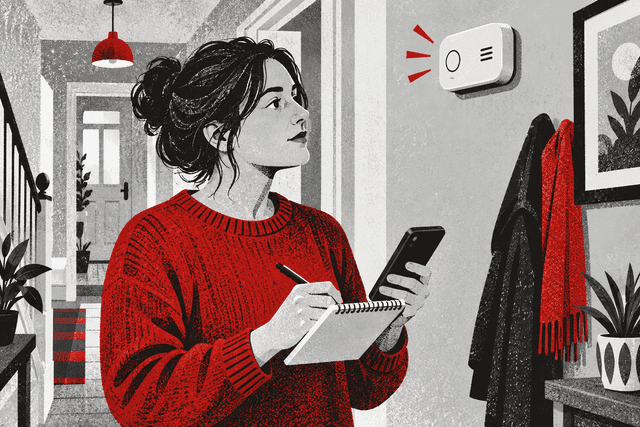
What should a tenant record if a carbon-monoxide alarm chirps after a battery change?
Write down the alarm make and exact model, the sound pattern, indicator lights or display message, the battery type and fitting time, the replace-by date and who you contacted. A short chirp is not automatically a carbon-monoxide warning, but patterns differ between alarms: it can indicate a loose or unsuitable battery, low power, a fault or the end of the unit’s life. Never decide what it means from another model’s instructions.
Keep everyone safe first. If the alarm gives its full emergency pattern, displays a carbon-monoxide reading, or anyone has possible symptoms, leave for fresh air and follow the alarm and NHS emergency guidance. For a single recurring chirp after a battery change, photograph the front and rear labels without dismantling a fixed unit, record the sequence and consult the exact manufacturer’s manual. Report a rented-home alarm that may be faulty to the landlord or agent promptly.
First decide whether this is a chirp or an alarm
People often use “beep” for every sound, but the distinction matters. A maintenance chirp may be an isolated sound repeated at an interval. A carbon-monoxide alarm warning usually has a deliberately urgent repeating pattern, often with a light or display indication. The exact pattern is set by the manufacturer and model.
Do not stand beside the alarm timing it if there is a full alarm, a displayed carbon-monoxide level, a gas smell, visible signs of combustion trouble or anyone feels unwell. Move into fresh air and follow the emergency wording printed on the alarm or in its manual.
Carbon monoxide has no colour, smell or taste. A quiet room, a recently changed battery or a button that appears to work cannot prove that the air is safe.
Record the sound exactly
Once there is no emergency indication, note whether it is one short chirp, several chirps together, a continuous tone or a repeating alarm sequence. Record the interval using a clock rather than guessing: for example, “one chirp at 14:03, 14:04 and 14:05.”
Write down when it began, whether it started immediately after the battery was installed and whether it happens only at night, after a power interruption or in a particular room condition. A short phone recording can help the landlord or manufacturer identify the pattern, but do not delay leaving to make one during an alarm.
Keep observation separate from interpretation. “One chirp every minute with one amber flash” is useful. “It is definitely only the battery” is not established until checked against the correct guide.
Identify the exact alarm
Photograph the front, model number, manufacturer, power type and any replace-by or installation date. If the label is safely visible on a removable battery unit, photograph it after following the manual. Do not detach a mains-wired alarm, undo wiring, open sealed sections or remove a landlord’s equipment from its mounting unless the instructions specifically make that a normal user step.
Record whether it has replaceable batteries, a sealed long-life battery, mains power with backup, or interconnection with other alarms. A sealed unit may need replacement rather than a battery change. A mains alarm can still have a backup-battery or fault indication.
Manufacturer examples show why model details matter. Kidde says chirping may follow a loose, incorrectly fitted or low battery, a malfunction, or end of life. FireAngel manuals use different chirp and light combinations for low battery and fault conditions. Those examples must not be copied onto an unidentified alarm.
Record the battery change
Note the battery brand, chemistry, voltage and size, the date or use-by marking, whether it was new from a sealed pack, and the exact time it was fitted. Keep the packaging until the issue is resolved. A battery that physically fits is not necessarily the type approved in the manual.
Record polarity and whether the battery door or drawer closed normally, without forcing it. Do not wedge a compartment shut, bridge contacts, tape over a sounder or remove the battery simply to silence the device.
If the guide tells ordinary users to press a test button after replacement, record the result. Use only the manufacturer’s stated test method. A test button checks specified alarm functions; it is not a test of the room’s air and does not rule out carbon monoxide.
Check the date and status messages
Many alarms have a finite service life. Photograph the “replace by” date or installation-date field and record any display wording such as low battery, fault or end of life exactly. Do not reset or erase a stored peak reading before the responsible person has seen it.
A continuing chirp after a correct fresh battery can be important evidence of a fault or end-of-life warning. Kidde advises that an end-of-life chirp does not stop after batteries are replaced and that the alarm should be replaced. Apply that only to a model whose own documentation confirms the behaviour.
Dust, paint, cleaning products, steam and unsuitable placement may affect some alarms, but do not assume one of these is the cause. Note recent decorating, water leaks, unusual temperature, power cuts or building work for the person assessing it.
What a tenant should send to the landlord or agent
- Property address, room and alarm location.
- Make, model, power type and serial number if visible.
- Replace-by or installation date.
- Exact chirp, light and display pattern with times.
- Battery specification, package photo and fitting time.
- Whether the manufacturer’s user test completed as described.
- Photos or a short recording made only when safe.
- Any symptoms, emergency action or appliance concerns.
- A clear request for the alarm to be checked and, if faulty, repaired or replaced.
Send this in writing and keep the acknowledgement. If the landlord phones, add a short written summary afterwards. Do not let the record become a reason to leave a questionable alarm unresolved.
Who is responsible in a rented home?
Rules differ across the UK, so use the guidance for the nation and tenancy. In England, the 2022 smoke and carbon-monoxide alarm guidance says relevant landlords must repair or replace a prescribed alarm found not to be in proper working order after a tenant reports it, as soon as reasonably practicable. Tenants should report faults promptly.
This does not mean a tenant should wait for a routine response during a possible carbon-monoxide event. Emergency action comes first. Nor does changing a user-replaceable battery transfer responsibility for a defective alarm to the tenant.
Give the landlord reasonable access to assess or replace the device, and keep proposed appointment times. If you cannot make a slot, reply with alternatives rather than leaving the report open-ended.
When to leave and seek medical help
NHS guidance lists possible symptoms including headache, dizziness, nausea or vomiting, weakness, tiredness or confusion, chest or muscle pain, shortness of breath and loss of vision. Symptoms may worsen in a building and improve outside.
If you think you may have carbon-monoxide poisoning, stop using a suspected appliance if you can do so without delay, go outside and get medical advice as soon as possible. NHS says to call 111 for suspected symptoms, and to call 999 or go to A&E for serious signs such as difficulty breathing, sudden confusion, loss of consciousness, weakness or chest or muscle pain.
HSE directs anyone who suspects a gas appliance is spilling carbon monoxide to call the National Gas Emergency Service on 0800 111 999, ventilate, turn off the appliance and gas at the meter where safe and known, and seek medical advice. Follow current emergency advice rather than troubleshooting the alarm.
What not to do
- Do not remove or silence the alarm and then continue as normal.
- Do not rely on smell to detect carbon monoxide.
- Do not use a naked flame, exhaust gas or another improvised substance to test it.
- Do not paint, cover, wet or spray cleaner into the alarm.
- Do not open sealed alarm sections or alter mains wiring.
- Do not assume every chirp code is shared across brands.
- Do not ask an online forum to overrule the exact manual or an emergency warning.
A simple incident record
Start with: “At [time] on [date], the alarm in [room] made [exact pattern]. Its make and model are [details]. The indicators showed [details]. A new [battery specification] was fitted at [time] in accordance with [manual]. The chirp [continued/stopped]. No full alarm or symptoms were present / emergency action was taken as follows.”
Add who was notified, the response deadline and the eventual outcome. If the alarm is replaced, record the new model, installation date, replace-by date and successful manufacturer-prescribed test. Keep the old device available for the responsible person unless emergency advice says otherwise.
The practical conclusion
A chirp after a battery change is a status that needs identifying, not a diagnosis. Record the exact model, sound, indicators, dates, battery and contact history. Use only that model’s manual and ask the landlord, manufacturer or competent professional to resolve a continuing fault.
Any full alarm, displayed carbon-monoxide reading or possible symptom changes the task completely: leave for fresh air and follow emergency and medical guidance. Documentation is valuable only after people are safe.
Related guidance: what to record if a carbon-monoxide alarm stops before help arrives.
Concerned about the boiler as well as the alarm?
Keep the alarm record and any appliance observations ready for the repair team.