
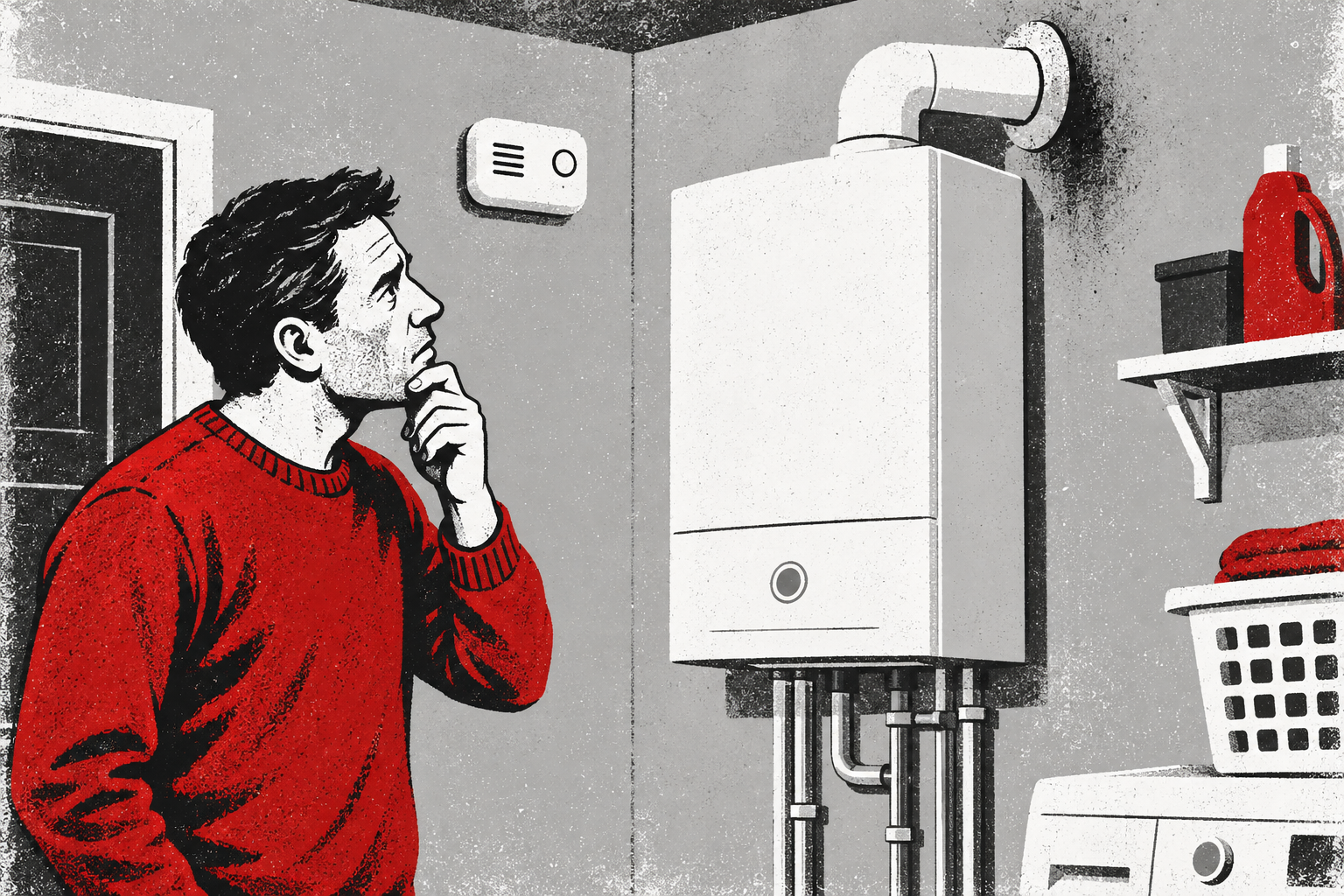
What should I do if I see soot or staining near the boiler or flue?
Do not ignore new soot or dark staining on or around a boiler, gas appliance or flue. HSE identifies soot and yellow or brown staining around an appliance as possible signs of incomplete combustion, which can produce carbon monoxide.
Stop using the appliance, keep the area ventilated and arrange an urgent check by a Gas Safe registered engineer. If a carbon-monoxide alarm sounds, anyone feels unwell, or you suspect fumes are entering the property, go outside and call the National Gas Emergency Service on 0800 111 999.
The short answer
Photograph the mark from a safe position, note when you first saw it and leave it in place for the engineer to assess. Do not wipe it away, open the boiler casing, block the flue, climb to inspect an outside terminal or restart the boiler to see whether the mark returns.
The stain may eventually prove to have another cause, such as dust, moisture or weathering, but soot-like deposits beside combustion equipment must be treated as a safety warning until a competent person has checked them.
Why soot matters
Gas should burn in controlled conditions and the products of combustion should leave safely through the flue. Soot can be associated with incomplete combustion. Carbon monoxide may also be produced when fuel does not burn properly.
Carbon monoxide cannot be seen, smelled or tasted. The visible stain is therefore not a measure of how much carbon monoxide may be present, and the absence of a stain does not prove that an appliance is safe.
What counts as a concerning mark?
Look for a new black, grey, yellow or brown deposit on the boiler casing, nearby wall or ceiling, around a flue joint, or close to where the flue leaves the building. A mark that grows, returns after cleaning or appears with an unusual smell or boiler behaviour is especially important.
Do not touch the flue or stain. Flue surfaces can be hot, and disturbing a joint or terminal can make an unsafe situation worse.
Indoor and outdoor staining
Soot or staining inside the home near the appliance or flue route needs prompt attention. A mark outside beneath a flue terminal can sometimes be caused by rainwater, dirt, condensate or the building surface, but it still deserves assessment if it is new, dark, spreading or accompanied by deposits around the terminal.
Take a ground-level photograph if you can do so safely. Do not use a ladder, put anything into the terminal or cover it to stop a draught. HSE advises householders not to inspect flue systems themselves.
What to do immediately
- Stop using the affected boiler or appliance.
- Open doors and windows to ventilate the room.
- Keep people and pets away from the area.
- Photograph the stain and any boiler display without touching the appliance.
- Arrange an urgent Gas Safe registered engineer visit.
- Follow emergency advice immediately if an alarm sounds or anyone has symptoms.
Carbon-monoxide symptoms
NHS guidance lists headache, dizziness, nausea or vomiting, weakness, tiredness, confusion, chest or muscle pain and shortness of breath among possible symptoms. They may get worse inside the affected building and improve after going outside.
If you think you may have carbon-monoxide poisoning, stop using the suspected appliance if you can, go outside and get medical advice promptly. Call 999 for severe symptoms such as difficulty breathing, sudden confusion, loss of consciousness, weakness, or chest or muscle pain.
What if the carbon-monoxide alarm is silent?
A silent alarm does not make visible soot safe. The alarm may not be in the right place for the appliance, may be outside its service life or may not yet have detected a dangerous concentration.
Do not test the boiler by running it while watching the alarm. Use the alarm’s test button only as its instructions describe, and keep the appliance off until it has been professionally checked.
What the engineer will assess
A Gas Safe registered engineer can inspect the appliance, flue route, terminal, ventilation and combustion performance using appropriate tests. They can identify whether the deposit is combustion-related and make the appliance safe.
Do not ask a general handyman to remove the stain before that assessment. Cleaning or repainting may hide useful evidence without addressing the cause.
Useful information to give the engineer
- Where the stain is and when it first appeared.
- Whether it has grown or returned.
- The boiler make, model and any display code.
- Any unusual smell, noise, shutdown or change in the flame of another appliance.
- Whether a carbon-monoxide alarm sounded or anyone felt unwell.
- Any recent work near the boiler, flue, ventilation or extractor fans.
Related Incredaboil guidance
If an alarm has sounded, follow our carbon-monoxide alarm guidance. For a visible problem outside, read our guide to a damaged or loose boiler flue.
Seen soot or a new stain?
Leave the boiler off and arrange a professional safety check.