The best thermostat is not automatically the cleverest one. It is the control that suits your heating system, your routine and the way you actually want to use it. A £200 smart thermostat that never gets programmed can be less useful than a straightforward programmable control that everyone in the house understands.
For most UK homes, the decision comes down to five questions: what type of boiler and hot-water system you have, whether you want phone control, whether different rooms need different schedules, which smart-home platform you use, and whether the boiler can use a modulating control such as OpenTherm.
This guide compares the main choices without assuming that smart is always better. Product features and advertised prices were checked in September 2026, but compatibility and offers can change. Always check the exact boiler, control and wiring arrangement before buying.
Quick answer: which thermostat is best for you?
Start with compatibility, not the app
A thermostat is part of the heating controls, not a universal accessory. A combi boiler normally needs heating control only because it heats tap water on demand. A system or heat-only boiler with a cylinder may need separate hot-water timing as well. Homes with two heating zones need the correct number of control channels. Underfloor heating can have its own wiring centre and zone thermostats.
Then check how the control talks to the boiler. Basic relay controls switch heat demand on and off. A compatible modulating control can ask a suitable boiler to vary its heating-water temperature rather than simply run at one fixed output. OpenTherm is one communication standard, but some manufacturers use their own controls and protocols. A product having OpenTherm support does not prove that every boiler installation can use it.
If you are replacing an existing wired thermostat, do not assume the wires can be transferred to any new device. Some systems need a receiver at the boiler, a hub, a neutral connection or changes to the programmer. Work on a gas boiler and its final heating connections must be handled by a suitably qualified Gas Safe registered engineer. Mains electrical work also needs appropriate competence.
Do you need a smart thermostat at all?
Energy Saving Trust says a boiler system should normally have a programmer, at least one room thermostat and thermostatic radiator valves. A programmable room thermostat combines time and temperature settings, which is enough for many households. Smart controls add remote access, easier interfaces and features such as learning, geofencing or room-by-room scheduling.
The potential saving depends on what the new control replaces and how you use it. If your current heating runs for long periods when nobody is home, better scheduling may make a noticeable difference. If you already use a well-set programmer and thermostat carefully, the extra saving may be smaller. Buy smart control for useful control and convenience first, not for a promised bill reduction that no product can predict for every home.
Hive Thermostat review
Hive is easy to understand: a physical thermostat, app control and a receiver connected to the heating system. The standard thermostat was listed at £119 when checked. Schedules, boosts and basic control are available in the normal system, while Hive+ is an optional paid service for additional energy-management features.
What it does well: the controls are approachable, the app is familiar to many UK users and the system can expand with compatible radiator controls. It is a good option for a household that wants remote control without spending time building complicated automations.
What to consider: identify the correct kit for a combi boiler, stored hot water or multiple zones. If you want sophisticated room-by-room control, price the radiator controls as part of the whole project rather than comparing thermostat starter prices alone.
Google Nest Learning Thermostat review
The UK Google Store listed the third-generation Nest Learning Thermostat at £219 when checked. Its distinguishing feature is learning: after you adjust it over time, it can build a schedule around your preferences. Home/Away functions can reduce heating when the home is empty, and the display is one of the most polished.
What it does well: it suits people who want automation without programming every period manually. The Heat Link connects to the heating system, and the UK third-generation model can support selected stored-hot-water arrangements and OpenTherm systems.
What to consider: Nest is not the clearest choice for detailed radiator-by-radiator zoning. Hot-water control differs by thermostat model and system type. For example, Google says the Nest Thermostat E cannot control a separate hot-water tank, while the third-generation Learning Thermostat can control selected systems. Use Google’s compatibility information for the exact model, not a US installation guide.
tado° X review
tado° X is designed as an expandable smart-heating system using Thread and Matter-enabled devices. The official shop listed a wired starter kit at £119.99 on offer when checked, with a normal listed price of £159.99. The free app provides schedules and remote control; some advanced automatic features sit in the optional AI Assist service.
What it does well: it is attractive for a household that wants modern smart-home integration and may add radiator controls later. Schedules are stored locally, so scheduled operation can continue if the internet connection drops.
What to consider: tado° X is a different product platform from older V3+ equipment. The manufacturer says X and earlier lines cannot simply be mixed in one heating setup. The X range also has a different compatibility profile, so use the current compatibility checker before ordering.
Wiser review
Wiser’s strength is zoning. Its kits combine a hub and room thermostat, and compatible smart radiator thermostats can create independent room schedules. That can be useful in a larger home, a property with a home office, or anywhere bedrooms and living spaces are occupied at different times.
What it does well: the system is designed to grow. Wiser offers different hubs for combi boilers, conventional heating and hot-water systems, and two heating zones. Its product information describes a 1-channel kit for combi boilers, a 2-channel kit for heating plus stored hot water, and a 3-channel option for two heating zones plus hot water.
What to consider: room-by-room control costs more because each controlled radiator needs suitable hardware. The official shop showed newer starter kits from £247.80 when checked, so compare the complete system cost, not just one thermostat. Smart radiator controls also need suitable valve bodies and sensible placement.
Honeywell Home T6R review
The T6R is a wireless smart programmable thermostat with app control, flexible schedules and geofencing. Resideo lists support for on/off and OpenTherm control, together with Apple Home, Amazon Alexa, Google Home and IFTTT integrations. Scheduling can be done at the thermostat or through the app.
What it does well: it retains the feel of a conventional heating control. You can use a detailed seven-day schedule and make changes on the thermostat, while still gaining remote access and location-based control.
What to consider: the T6R itself is a single-zone control. If your real aim is independent temperatures across many rooms, compare it with a purpose-built zoning system such as Wiser or Resideo’s evohome rather than expecting one thermostat to create zones by itself.
What about a basic programmable thermostat?
Do not dismiss the simple option. A modern programmable thermostat can give several temperature periods each day, holiday or frost settings and a clear manual override. It can be ideal for an older relative, a rental property or anyone who does not want heating control to depend on accounts, apps or broadband.
The important distinction is between a timer and a programmable room thermostat. A timer only decides when heating is allowed to run. A programmable thermostat sets both time and target room temperature. If your existing setup has a separate programmer and room thermostat, an installer can explain which parts a replacement would take over.
Five buying checks before you order
Name the heating system. Confirm combi, system or heat-only boiler; stored hot water; underfloor heating; and the number of heating zones.
Check the exact boiler model. Compatibility can vary within one brand. Find the model name and serial information without removing the boiler casing.
Decide whether you need zoning. If only one room thermostat controls the whole home now, a replacement thermostat alone will not make every radiator independent.
Choose your preferred fallback. Ask what still works locally if Wi-Fi or the supplier’s service is unavailable.
Price the installed system. Include the correct receiver, hub, hot-water channel, radiator controls and professional work where needed.
Frequently asked questions
Will a smart thermostat work with any boiler?
No. Many work with a wide range of boilers, but the wiring, control protocol, hot-water arrangement and number of zones all matter. Use the manufacturer’s checker and have the proposed setup confirmed for your exact system.
Does a smart thermostat need Wi-Fi?
Wi-Fi or an internet-connected hub is normally needed for remote app features. Some products keep local schedules or allow direct thermostat control during an outage, but the behaviour varies. Check this before buying if reliable offline control matters to you.
Where should a room thermostat go?
It should sense a representative room temperature, away from direct sun, draughts, curtains and strong local heat sources. It should not be hidden behind furniture. Follow the product instructions and the installer’s assessment.
Is room-by-room control worth it?
It can be valuable when rooms have very different occupancy patterns. It is less compelling in a small, evenly used home. Zoning also needs the system to be designed so the boiler and water circulation continue to operate correctly.
Our recommendation
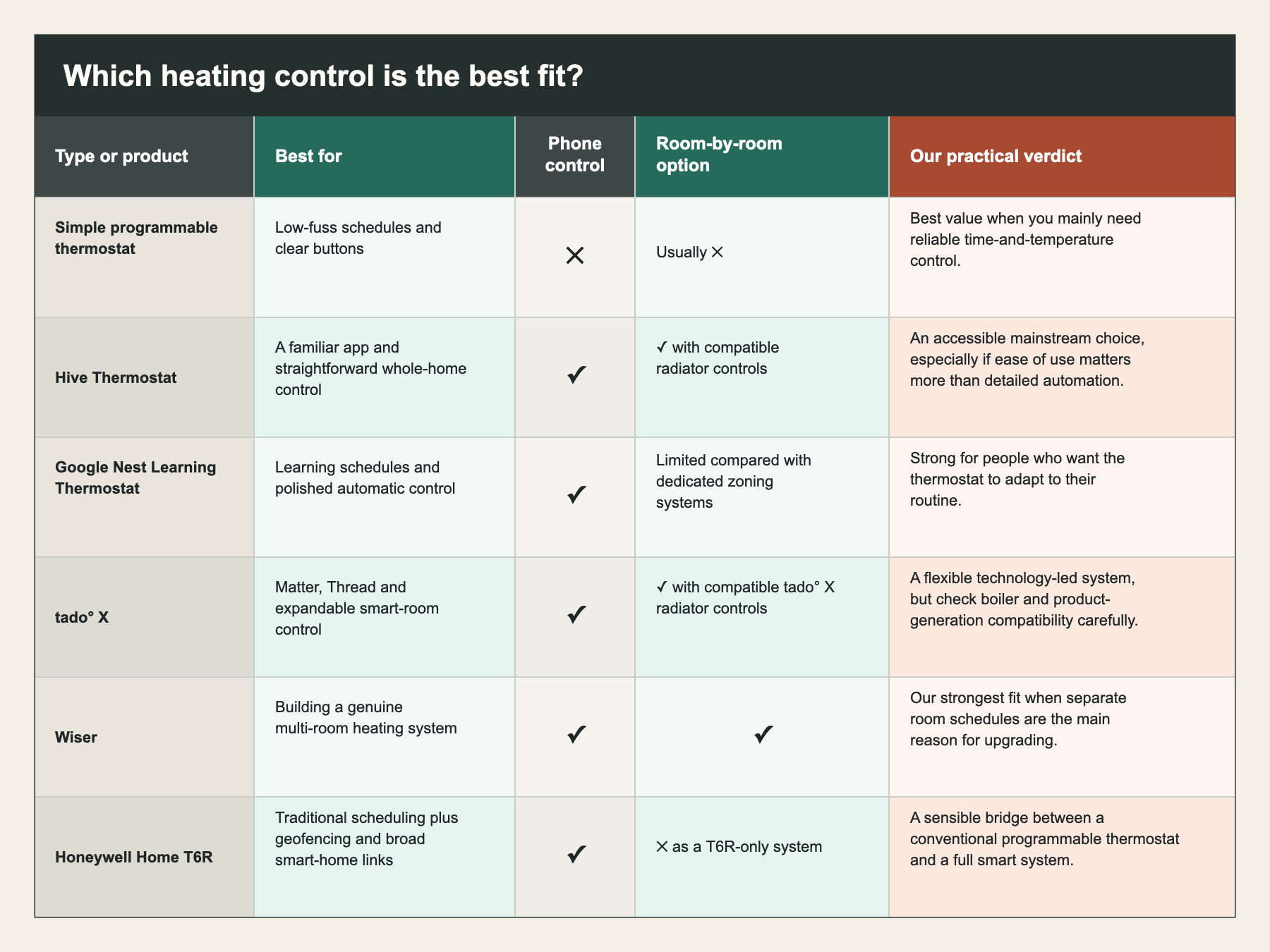
Choose a simple programmable thermostat if reliability, low fuss and clear manual control come first. Choose Hive for an approachable mainstream app, Nest for learning behaviour, tado° X for a modern expandable smart-home platform, Wiser for room-by-room zoning, or the Honeywell Home T6R for familiar scheduling with geofencing.
The final choice should follow the heating system, not the other way round. A short compatibility check before purchase is usually more valuable than another hour comparing app screenshots.
We use cookies on our website to give you the most relevant experience by remembering your preferences and repeat visits. By clicking “Accept All”, you consent to the use of ALL the cookies. However, you may visit "Cookie Settings" to provide a controlled consent.
This website uses cookies to improve your experience while you navigate through the website. Out of these, the cookies that are categorized as necessary are stored on your browser as they are essential for the working of basic functionalities of the website. We also use third-party cookies that help us analyze and understand how you use this website. These cookies will be stored in your browser only with your consent. You also have the option to opt-out of these cookies. But opting out of some of these cookies may affect your browsing experience.
Necessary cookies are absolutely essential for the website to function properly. These cookies ensure basic functionalities and security features of the website, anonymously.
Cookie
Duration
Description
cookielawinfo-checkbox-analytics
11 months
This cookie is set by GDPR Cookie Consent plugin. The cookie is used to store the user consent for the cookies in the category "Analytics".
cookielawinfo-checkbox-functional
11 months
The cookie is set by GDPR cookie consent to record the user consent for the cookies in the category "Functional".
cookielawinfo-checkbox-necessary
11 months
This cookie is set by GDPR Cookie Consent plugin. The cookies is used to store the user consent for the cookies in the category "Necessary".
cookielawinfo-checkbox-others
11 months
This cookie is set by GDPR Cookie Consent plugin. The cookie is used to store the user consent for the cookies in the category "Other.
cookielawinfo-checkbox-performance
11 months
This cookie is set by GDPR Cookie Consent plugin. The cookie is used to store the user consent for the cookies in the category "Performance".
viewed_cookie_policy
11 months
The cookie is set by the GDPR Cookie Consent plugin and is used to store whether or not user has consented to the use of cookies. It does not store any personal data.
Functional cookies help to perform certain functionalities like sharing the content of the website on social media platforms, collect feedbacks, and other third-party features.
Performance cookies are used to understand and analyze the key performance indexes of the website which helps in delivering a better user experience for the visitors.
Analytical cookies are used to understand how visitors interact with the website. These cookies help provide information on metrics the number of visitors, bounce rate, traffic source, etc.
Advertisement cookies are used to provide visitors with relevant ads and marketing campaigns. These cookies track visitors across websites and collect information to provide customized ads.