
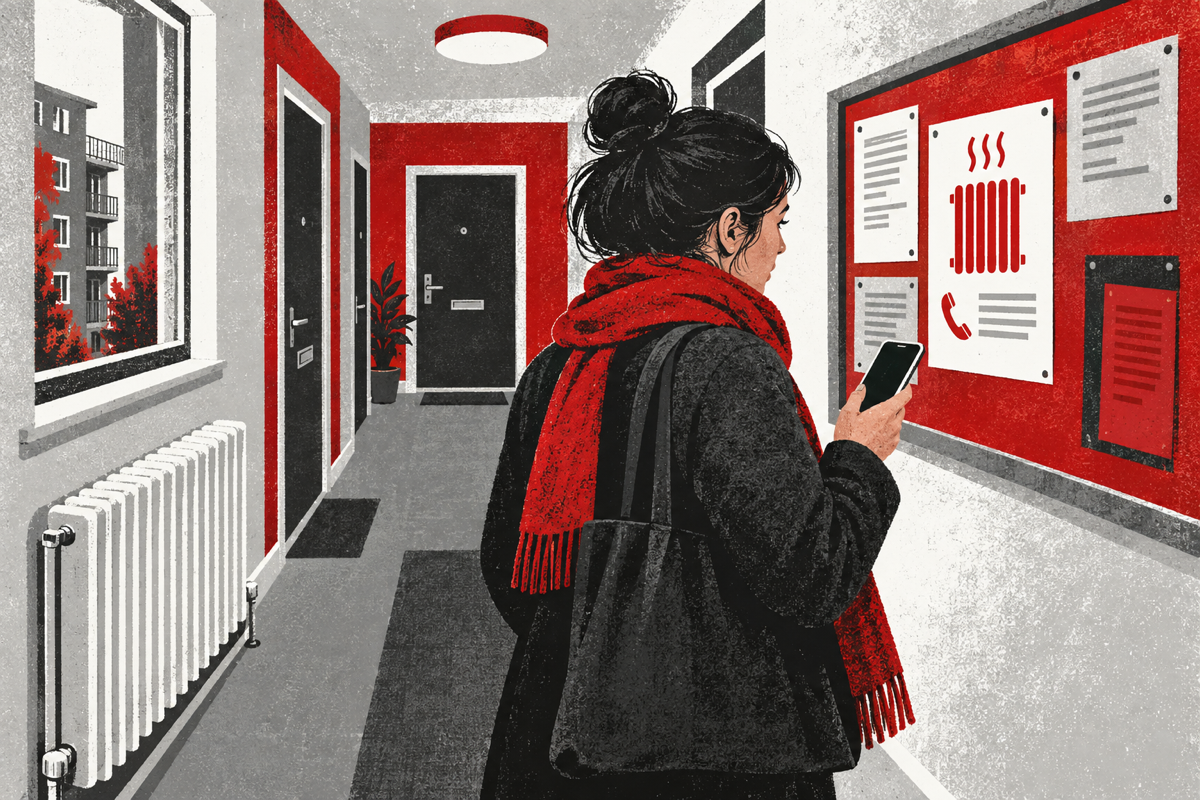
Who should a tenant contact about a communal heating fault?
Start with the repair contact given by your landlord, letting agent, housing provider or building manager. If your home is supplied by a communal heat network, the central plant is normally controlled by the building’s heat supplier or operator—not by the gas company shown on an ordinary energy bill and not by a domestic boiler engineer chosen by the tenant.
Report the fault to your landlord as well, even when a managing agent or heat-network helpline is dealing with it. A private landlord remains responsible for heating and hot-water repairs in the rented home, although they may need the freeholder, managing agent or network operator to fix shared equipment.
First, work out whether the system is communal
A communal or district heating system supplies heat or hot water to several flats from a shared source. Your flat may have radiators, a programmer and a unit sometimes called a heat interface unit, but no individual gas boiler. The shared boiler room or energy centre may be elsewhere in the building or estate.
Look at your tenancy information, welcome pack, heat bill or noticeboard. GOV.UK advises heat-network customers to ask their estate agent, letting agent or landlord for the name and contact details of the heat supplier, details of interruptions and the correct fault-reporting route.
If there is a wall-mounted appliance in the flat, do not assume it is a gas boiler. A heat interface unit transfers heat from the communal network into the flat. Keep its casing closed and use only the resident controls described in the building instructions.
Who to contact first
- Use the dedicated communal-heating repair number if one is shown on your heat bill, tenancy pack, building app or noticeboard.
- Tell your landlord or letting agent that heating, hot water or both have failed. Give them the reference from the first report.
- Contact the managing agent, housing association or council repairs team when they operate the building service or your tenancy information directs you there.
- Ask for the heat supplier or operator’s details if nobody can tell you who controls the network. The freeholder or managing agent should be able to identify the responsible organisation.
Do not spend hours being passed between organisations without keeping a record. Note the time, the number called, the name or team you spoke to and each repair reference.
Is it a flat-only fault or a building-wide outage?
Ask a neighbour whether they also have no heat or hot water, but do not delay an urgent report while checking the whole block. Several affected flats suggest a shared supply problem. One affected flat may point to the controls, valves, meter or heat interface equipment serving that home.
The distinction helps the repairs team send the right contractor, but it does not make the tenant responsible for diagnosing the system. Report what you can observe and let the operator decide where the fault sits.
What information makes the report useful?
- Your address, flat number and a contact number.
- Whether heating, hot water or both are affected.
- When the fault started and whether it is constant or intermittent.
- Whether neighbours appear to have the same problem.
- What the normal resident display shows, including any exact code.
- Whether the flat has power and whether the ordinary controls are on.
- Any leak, burning smell, gas smell, carbon-monoxide alarm or vulnerable occupant.
- Safe access arrangements and any previous repair reference.
A photograph of the resident display and a short timeline can help. Do not remove a cover, enter a plant room or operate labelled service valves to collect more detail.
What should the landlord do?
For private renting in England, GOV.UK says the landlord is responsible for heating and hot water. A communal system can make the repair chain more complicated, but it does not remove the need to respond to the tenant, chase the party controlling the shared equipment and explain what will happen next.
The landlord should keep the tenant updated, pass on outage information, record vulnerability and arrange any flat-side access. If the central network is working but equipment inside the flat is not, the lease or management agreement may decide which organisation appoints the contractor.
Tenants should continue reporting through the agreed route and keep paying rent while a repair is outstanding. Do not deduct repair costs or arrange work on shared equipment without proper advice and permission.
Heat-network consumer protection now applies
Ofgem’s heat-network consumer-protection rules came into force in Great Britain in January 2026. Its guidance covers standards of conduct, quality of service, complaints, protections for consumers in vulnerable situations and security of supply.
The practical first step is still to contact the heat supplier or operator and use its complaint process. If you do not know who that is, ask the freeholder or managing agent. Record missed updates, repeated outages and the effect on anyone vulnerable so the complaint is specific.
A tenant can separately pursue the landlord’s repair process. In England, GOV.UK advises contacting the local council’s environmental health department if a landlord does not deal with a problem that could harm health. Procedures differ in Scotland, Wales and Northern Ireland, so use the housing route for the nation where the property is located.
When the fault is urgent
Loss of heating in cold weather needs prompt attention, especially where a baby, older person, disabled person or someone with a health condition is affected. Tell the repair team about vulnerability at the first report and ask what temporary support and update timetable are available.
A suspected gas escape, carbon-monoxide alarm, fire, burning smell, serious leak or water near electrics is not an ordinary heating complaint. Move away from immediate danger and follow the emergency advice for that hazard. Do not enter a communal plant room or try to shut down shared machinery.
What not to do
- Do not open a heat interface unit, boiler or communal control cabinet.
- Do not reset shared plant or follow online internal-repair instructions.
- Do not book a domestic gas-boiler repair for central plant you do not control.
- Do not assume the ordinary gas or electricity supplier is the heat-network operator.
- Do not close the report merely because heat returned briefly after an intermittent outage.
Keep a simple outage record
Write down when each service stopped and returned, room temperatures if safe to take, displayed messages, who was contacted and what response was promised. For repeated faults, a clear sequence is more useful than several separate messages saying only that the heating is broken.
If the problem comes and goes, see our landlord checklist for an intermittent heating fault. It explains how to preserve evidence and keep the repair open until the cause has been assessed.
What if the flat has its own gas boiler?
If the appliance serves only your home and the tenancy information confirms that it is an individual gas boiler, report it to the landlord or agent and use the repair provider they authorise. Gas-boiler work must be carried out by an appropriately qualified Gas Safe registered engineer.
Incredaboil’s fixed-price repair service is for suitable individual boiler faults, not a communal energy centre or shared heat-network plant. Confirm which system you have before booking.
Individual boiler rather than communal plant?
Check the tenancy details, then choose the right repair route.