
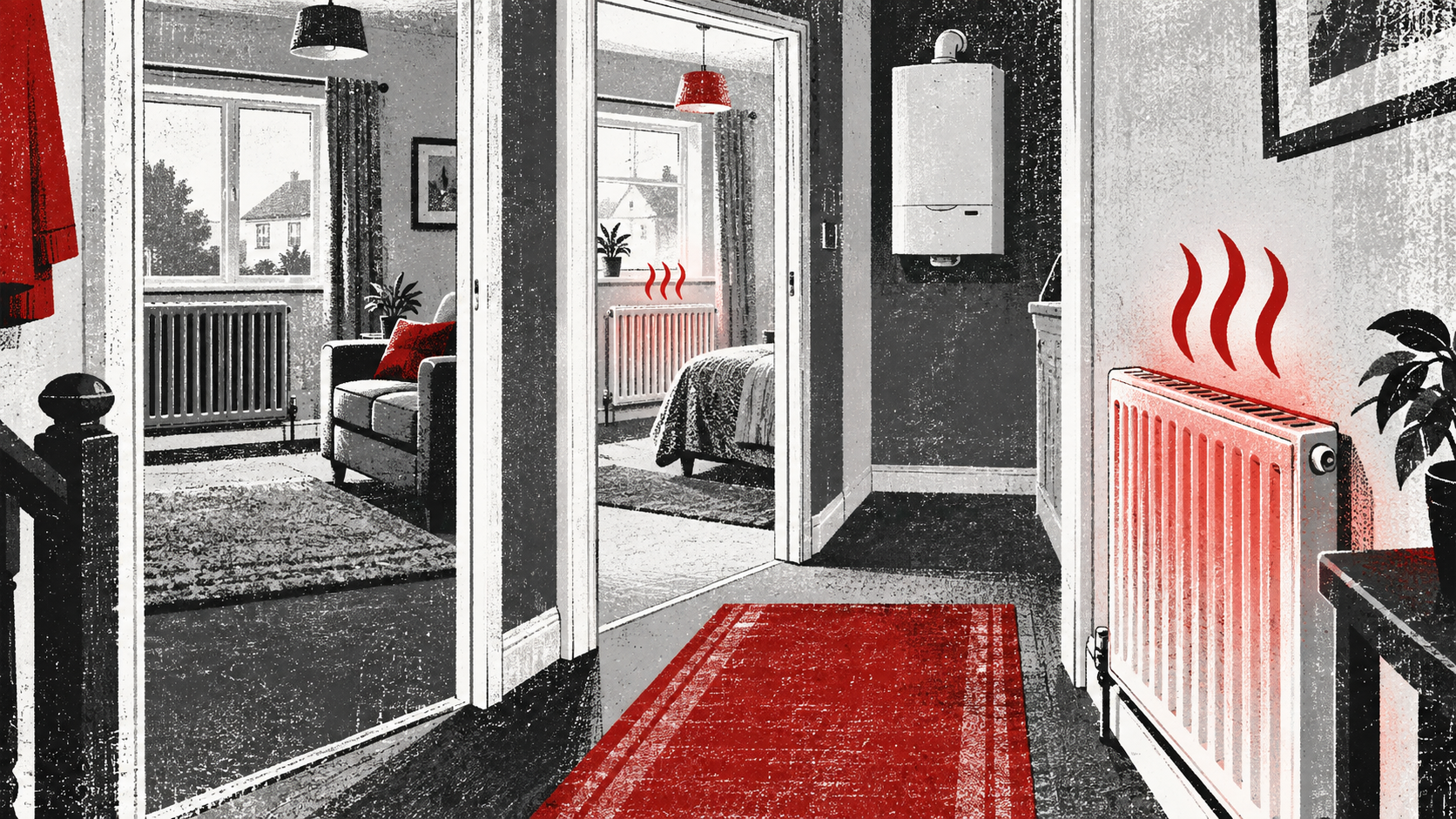
Why do my radiators heat in a different order?
Radiators do not normally become hot at exactly the same moment. The water has different distances and restrictions to travel, and thermostatic valves may be asking for different amounts of heat. A small, repeatable difference can be normal. A radiator that stays cold or only heats after another is turned down points more strongly to a valve, flow or balancing problem.
You can observe the pattern from a cold start using the normal heating controls. Do not remove the boiler casing or adjust hidden boiler or pump settings.
Why the first radiator is not always the nearest one
When the heating starts, a pump moves heated water around a network of pipes. Water follows every open route, but it does not divide equally. Pipe length, pipe diameter, bends, radiator valves and the layout of different floors all affect resistance to flow.
A radiator near the boiler may warm early, but a farther radiator with a more open route can beat it. The order alone does not identify a fault.
What thermostatic radiator valves change
A thermostatic radiator valve, usually called a TRV, senses the air temperature around it. Energy Saving Trust explains that it opens when the room is cooler than its setting and closes down as the room warms.
That means yesterday’s order may differ today. A sunny bedroom, a warm kitchen or a room that is already occupied may ask for less heat. Compare radiators only when their rooms start at broadly similar temperatures and their normal valve settings have not been changed.
A useful cold-start observation
Choose a time when the system has been off long enough for the radiators to feel cool. Turn on the heating normally and note which radiator first becomes slightly warm at its inlet end. Check again after 10, 20 and 30 minutes.
Use the back of your hand cautiously and do not touch exposed metal pipework if it may be hot. The aim is to record the pattern, not to prove exact temperatures.
Look at the result as well as the order
The final room temperature matters more than winning a heat-up race. If every occupied room reaches a comfortable temperature and the radiators warm reasonably evenly, a few minutes’ difference is rarely a concern.
Arrange a check if one room remains cold, one radiator never warms fully, the boiler stops before distant rooms are comfortable, or the pattern has changed sharply without an obvious setting change.
What system balancing means
Balancing adjusts the flow available to each radiator so nearby, easy-flow routes do not take more than their share. Manufacturer guidance describes a balanced system as one that gives radiators the flow they need for more even heating.
This is different from setting the TRV for room comfort. Balancing normally uses the valve under a plain cap at the other end of the radiator, often called a lockshield. Its position is part of the system setup rather than a day-to-day user control.
Do not copy another home’s valve positions
There is no universal number of turns for a lockshield valve. The correct setting depends on the pipework, radiator output, pump and design temperatures. Moving several valves without measurements can simply move the cold-room problem elsewhere.
If the home is consistently uneven, ask a heating professional to assess the whole circuit rather than opening every valve fully.
Air produces a different pattern
Air trapped in a radiator commonly leaves its upper section cooler and may cause gurgling. That is different from an entire radiator warming later than the rest.
If a radiator needs frequent bleeding, do not treat repeated bleeding as the complete answer. A leak, pressure problem or air entering the system may need investigation.
Cold at the bottom is another clue
A radiator that is persistently cold across the bottom may have restricted circulation or deposits. Worcester Bosch advises professional assessment for uneven heating because several causes can produce a similar surface pattern.
Do not remove a radiator or attempt chemical cleaning as a diagnostic step. Record which section stays cool and whether the same symptom appears elsewhere.
Zones can create an intentional order
Larger homes may have separate upstairs and downstairs zones, more than one room thermostat, or smart controls that call for heat room by room. A zone valve can therefore allow one group of radiators to warm while another group remains off.
Check the schedule and the indicated room temperature for each zone. If the entire zone remains cold despite a clear demand, report that pattern rather than adjusting individual radiators.
The thermostat room has extra influence
The main room thermostat decides when a simple single-zone system has had enough heat. If that room warms quickly, the thermostat may stop the demand before a slower bedroom catches up.
Energy Saving Trust advises keeping the thermostat in free air, away from curtains, furniture and direct heat. Do not turn it up far above the temperature you want: that does not make radiators heat faster.
Low boiler flow temperature changes the timing
A lower heating flow temperature makes every radiator cooler and can lengthen the warm-up period. It may also make differences between rooms more noticeable if some radiators are small or the system is not balanced.
Judge a lower setting over a complete heating period. If the home cannot reach comfort, return to the previous user setting or seek advice rather than changing installer parameters.
Recent work can change the pattern
A new radiator, replaced valve, drained system, added extension or pump adjustment can alter the distribution of water. Tell the installer if the heat-up order changed immediately after work.
Also mention whether any radiator was removed for decorating or left with a valve closed. That timeline may be more useful than the exact order.
When the boiler may be involved
A boiler problem is more likely when all radiators warm poorly, the appliance repeatedly stops with a code, pressure changes abnormally, or both heating and hot water are affected. One slow radiator with the rest working usually points first to the heating circuit around that emitter.
Work inside a gas boiler must be carried out by an appropriately qualified Gas Safe registered engineer. Wet-system radiator work can be separate, but the person should still be competent for the task.
What to tell an engineer
Provide the order from a cold start, which rooms fail to reach temperature, valve settings, visible boiler pressure, any code, recent work and whether the issue affects a whole floor or zone.
A simple floor sketch can help. Mark the boiler, thermostat and slow radiators without guessing how hidden pipes run.
Common questions
Should every radiator heat at the same speed?
No. Small differences are normal. Comfort, final temperature and a repeatable pattern matter more than exact synchronisation.
Does the first hot radiator show where the boiler is?
Not reliably. Pipe routes may be hidden, and valve openings or zone controls can change which emitter receives flow first.
Can I turn all radiator valves fully open?
TRVs can be adjusted for room comfort, but changing every lockshield can disturb the system balance. Keep a record and seek professional help for persistent uneven heating.
Why has the order suddenly changed?
Check schedules, TRVs, room temperatures and recent work. A stuck valve, air, loss of balance or zone-control problem can also change the pattern.
Related guides: Radiators warm up slowly, One radiator heats when another is turned off and Normal pressure but cold radiators.
Radiators still heating unevenly?
Have the circulation, controls and system balance checked.