
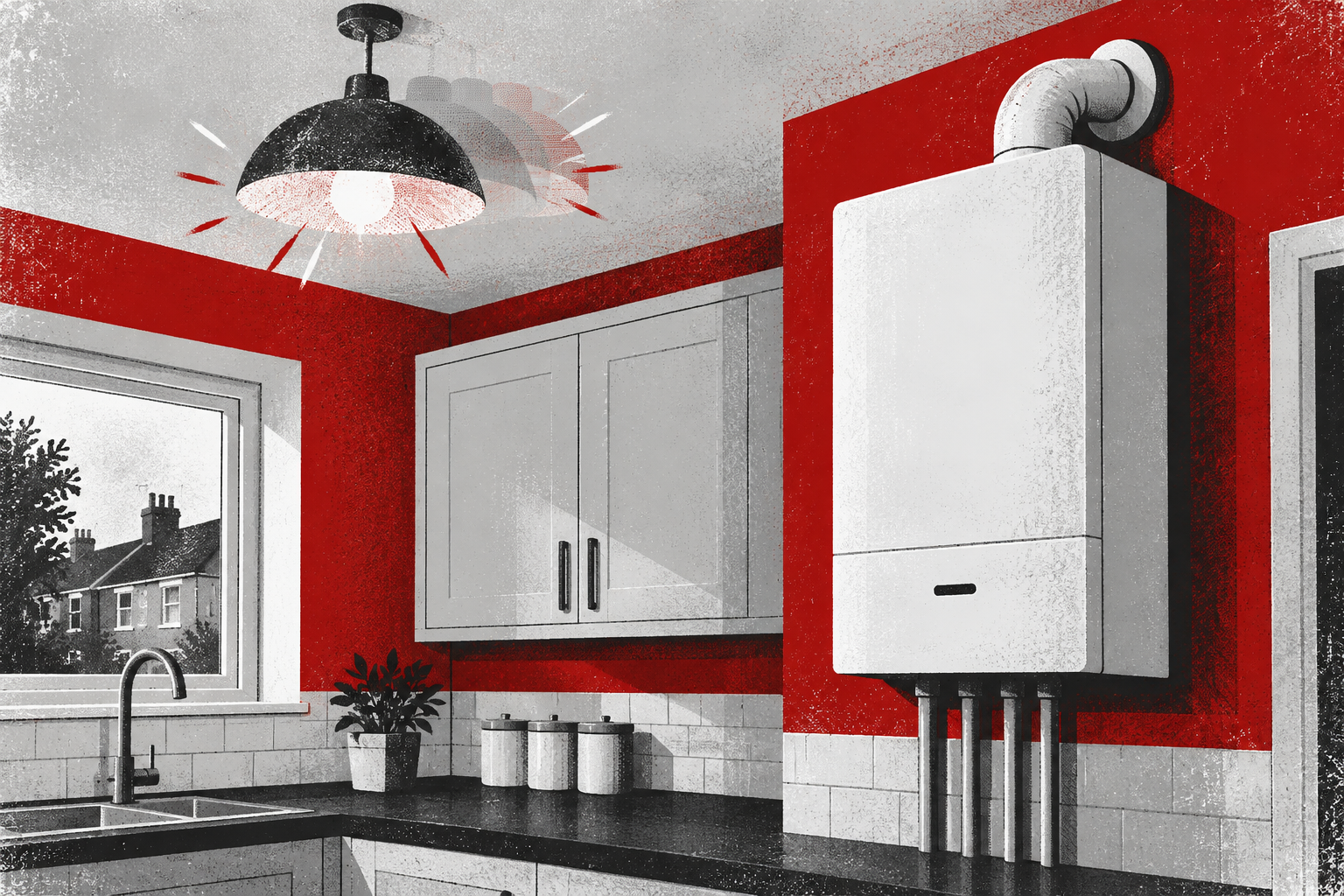
Why do the household lights flicker when the boiler starts?
If the lights dip or flicker at the same moment the boiler starts, the timing suggests an electrical change but does not prove the boiler is faulty. The cause could be a lamp or dimmer issue, a connection in the home’s wiring, a change in the incoming supply, or a fault affecting the boiler or its electrical circuit.
Do not remove the boiler casing, open the fused spur or consumer unit, or try live electrical tests. Note exactly which lights are affected and arrange the right professional check if the flicker is repeated, new or accompanied by another warning sign.
The short answer
One tiny dip seen once is different from strong, repeated or whole-home flickering. Electrical Safety First says flickering lights should not be ignored because they can indicate that the electrical installation needs inspection by a registered, competent electrician.
The boiler provides a useful timing clue: its controls, pump and fan begin operating as demand starts. But boilers are normally supplied from a modest fused electrical connection; an Ideal Heating installation guide, for example, specifies a 230-volt supply and a 3-amp external fuse for that model range. A visible dip should not automatically be dismissed as the normal effect of a high-powered appliance.
First identify what “flicker” means
Describe the change as precisely as possible. Does one LED lamp blink once, do all the lights in a room dim for a second, or does brightness rise and fall across several rooms while the boiler runs?
Also note whether the boiler is starting for central heating or hot water. If the symptom appears only when heating begins, the pump or another heating component may be part of the timing. If it happens whenever a hot tap opens, the boiler is responding to a hot-water demand. Timing helps an electrician or heating engineer reproduce the fault, but it is not a diagnosis.
Record whether the flicker stops immediately, continues for several seconds or carries on throughout the boiler cycle. A short phone video that shows the room light and the closed boiler display can be useful.
Could it be just one bulb?
If only one fitting flickers, the issue may be local to that lamp, fitting, driver or dimmer. LED lamps can behave differently from older bulbs, particularly on an unsuitable or failing dimmer. That remains an electrical matter rather than proof of a boiler fault.
Do not touch a hot, damaged or crackling fitting. If the lamp is a straightforward user-replaceable bulb and there are no danger signs, follow the light manufacturer’s instructions. Stop if access requires removing a fixed cover, disturbing wiring or working at unsafe height.
If several fittings change together, especially on different floors or circuits, a single bulb is less likely to explain the whole pattern.
Why several lights might change together
UK Power Networks explains that voltage fluctuations can make lighting very dim, very bright or visibly flicker. Sudden changes in electricity use on the local network can contribute, as can a network fault. Problems within the property can also affect voltage at the lights.
A loose or deteriorating connection can create intermittent symptoms and needs prompt attention. Circuit loading, a problem at the boiler’s electrical supply, or a fault in another device operating at the same time may also be relevant. Only proper testing can separate these possibilities.
Notice whether another appliance starts at the same moment. A fridge compressor, pump, cooker or electric shower may be the actual changing load, with the boiler start merely coinciding with it.
Does the boiler use much electricity?
A gas boiler still needs electricity for its controls, pump, fan, ignition and valves. The exact consumption and fuse requirement depend on the model. Manufacturer installation instructions give the figures for the appliance and must guide testing.
The boiler’s electrical demand can change as components start, but a pronounced household-wide flicker is not something a homeowner should classify as normal from that fact alone. The appliance, its supply and the wider installation may need to be considered together.
Do not replace a fuse with a different rating, fit an extension lead or move the boiler to another socket. A boiler should have the electrical supply arrangement specified by its manufacturer and installation requirements.
Safe observations before calling
Keep the boiler casing and electrical covers closed. From an ordinary viewing position, note the time, which lights change, how long the change lasts and which boiler symbol appears. Check whether the same lights flicker when another appliance starts, but do not repeatedly cycle equipment to provoke the symptom.
Ask whether neighbours have noticed similar voltage changes only if that is easy and appropriate. If several nearby homes are affected, the local electricity network may be involved. If the symptom is confined to your property, the installation still needs its own assessment.
Write down any recent work, such as a new boiler control, light fitting, dimmer, kitchen appliance or consumer-unit change. Do not assume the newest item is responsible, but the timing is useful evidence.
Warning signs that need quicker action
Stop using the affected equipment and seek urgent professional help if flickering comes with a burning smell, smoke, sparks, crackling, scorch marks, a hot switch or fused spur, repeated tripping, partial loss of power or lights becoming unusually bright as well as dim.
If there is smoke or fire, leave the property and call the emergency services. Do not touch the boiler, consumer unit or a damaged switch to investigate.
If you smell gas, avoid electrical switches and flames, open doors and windows if safe, leave the property and follow the gas emergency procedure. The flicker may be unrelated, but a suspected gas leak takes priority.
Should you call an electrician or a boiler engineer?
A registered electrician is the sensible first call when several household lights flicker, switches feel warm, breakers trip, other appliances cause the same symptom, or the pattern appears to involve the fixed electrical installation. Electrical Safety First recommends registered electricians for installation and repair work.
A Gas Safe registered engineer should assess the boiler when it also locks out, restarts, shows a fault code, makes a new internal noise, loses its display, or operates unreliably. Work on the gas appliance itself belongs to a suitably qualified Gas Safe registered engineer.
Sometimes both trades are needed. The electrician can test the supply and circuit; the heating engineer can test the appliance within their competence. Tell each person what the other has found rather than asking either to guess.
What if the lights flicker with every heating cycle?
Frequent repetition makes the pattern easier to reproduce but also means it should not be left indefinitely. Record two or three examples, including the thermostat demand and any boiler display change, then arrange inspection.
Do not avoid the symptom by setting the thermostat extremely high or low, and do not keep resetting the boiler. Those actions can disguise the pattern without addressing its cause.
For tenants and landlords
A tenant should report the affected rooms, frequency, warning signs and whether the boiler or another appliance triggers the change. Photographs of visible scorching or a short video of the flicker can help, provided it is safe to take them.
Landlords should treat repeated flickering as an electrical safety report, not just a lighting annoyance. Arrange competent inspection and include the boiler engineer if the appliance also behaves abnormally. Do not ask a tenant to open the fused spur, consumer unit or boiler casing.
What to tell the professional
Give the boiler make and model, whether heating or hot water was requested, which lights flickered, whether they dimmed or brightened, the duration, and any noise, smell, heat, tripping, display change or loss of power.
Mention whether the symptom occurs with other appliances, whether neighbours are affected, and what electrical or heating work was completed recently. This helps direct safe testing without treating coincidence as proof.
Common questions
Is one quick flicker normal?
A tiny one-off change can have a simple explanation, but repeated or noticeable flicker should be investigated. The pattern and any accompanying warning signs matter more than a universal time limit.
Can an LED bulb make the problem look worse?
Yes. Some LED lamps and dimmers show voltage or compatibility changes more visibly. That does not rule out a wiring or supply problem.
Can I test the boiler at another socket?
No. Do not alter the boiler’s electrical supply or use an extension lead. Its connection should match the manufacturer’s requirements.
Who checks a warm boiler switch?
A warm, discoloured, buzzing or damaged electrical switch needs a registered electrician. If the boiler also shows abnormal operation, tell the heating engineer as well.
Related guides: Warm boiler fused spur or switch, Boiler controls after a power cut and Information to give a boiler engineer.