
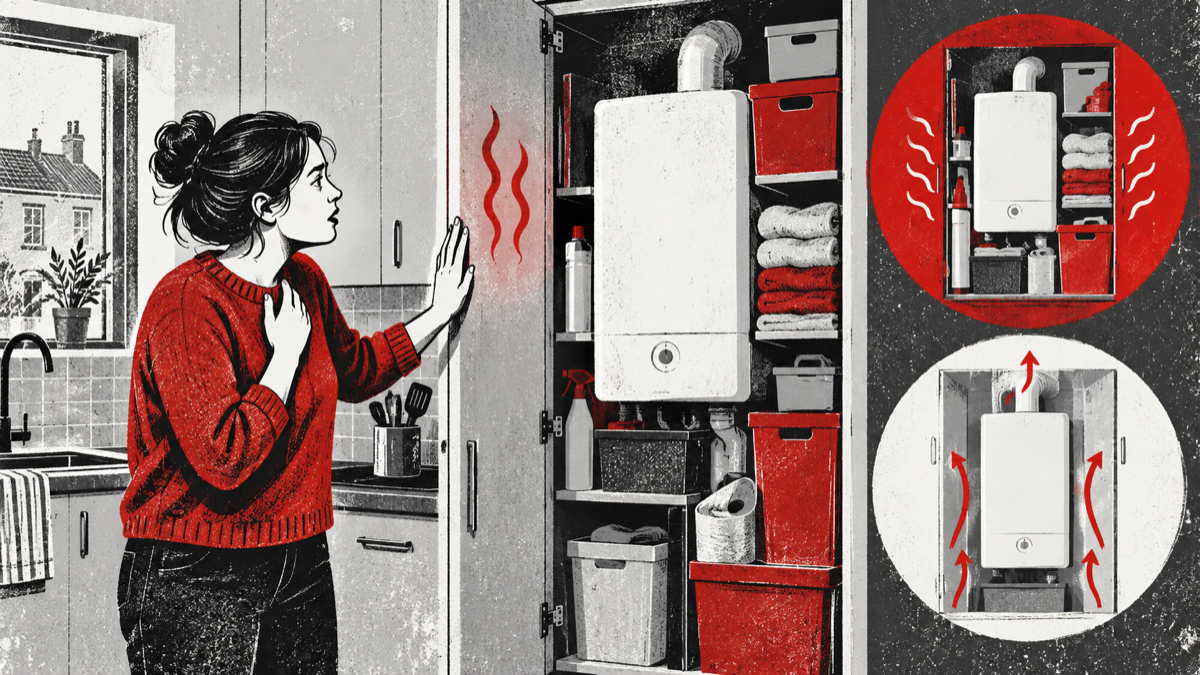
Why does a boiler cupboard become hotter after storage is added?
Boxes, towels and household supplies can reduce the open space around a boiler and trap warm air in its cupboard. They may also block a ventilation grille or make the appliance harder to inspect. Remove the recently added items without touching the boiler or pipework, then compare the cupboard during normal use.
A boiler cupboard can feel warm while the appliance is running. A sharp change after storage was added is still worth taking seriously because the required clearances and ventilation depend on the exact boiler and cupboard design.
The short answer
Modern room-sealed boilers do not all need a cupboard vent for combustion, but that does not mean every cupboard can be packed tightly. Manufacturer instructions specify spaces needed for safe installation, cooling, access and servicing. Some installations also require ventilation openings that must remain clear.
Do not copy a clearance shown for a different boiler. Find the exact model instructions or ask a Gas Safe registered engineer to confirm the arrangement.
How storage changes the cupboard
A boiler gives off some heat through its casing and connected pipes. In an open cupboard, that heat disperses into the surrounding air. Filling the space with boxes, bedding or folded towels reduces air movement and gives the heat less room to escape.
Soft items can settle against the casing or pipes. Tall items can cover vents in the door, wall or shelf. Containers can also make it difficult to see a small leak, staining or a changed display.
Clearance is model-specific
Boiler makers publish installation and user instructions for each model. These can give different spaces for normal operation and for servicing. A removable cupboard door may permit a different service clearance from a fixed panel.
Some room-sealed boilers can be installed in an unventilated compartment when the stated clearances are maintained. Other cupboard arrangements need high- and low-level ventilation. The safe conclusion is not “all boiler cupboards need vents” or “none do”; the exact instructions decide.
For the wider question, read why a boiler cupboard can feel unusually warm.
What to remove first
Remove recently added loose belongings from the cupboard, especially anything touching the boiler, visible pipes, flue route, valves, electrical controls or ventilation grilles. Keep aerosols, paints, solvents, cleaning chemicals and other flammable or heat-sensitive products elsewhere.
Do not move fixed shelves, panels or vents yourself. A shelf may form part of the approved compartment arrangement, and altering it could reduce a required gap or affect access.
A safe comparison
Once loose storage is clear, close the cupboard as it is normally used and let the heating run naturally. Without touching hot surfaces, note:
- whether the door and surrounding wall still feel much warmer than before;
- whether the boiler display shows a fault;
- whether any vent is visibly blocked;
- whether there is a burning, hot-plastic or unusual chemical smell;
- whether the boiler cycles, stops or makes a new noise;
- whether there is staining, moisture or a leak.
Do not use a thermometer inside the casing or reach behind the boiler. A phone photograph of the cupboard layout, taken from outside, can help an engineer assess access.
Do not add ventilation by guesswork
Cutting holes in a door or fitting a grille is not a universal repair. Vent size and position can be safety-critical, and a modern appliance may rely on specified clearances rather than cupboard ventilation. A competent installer should compare the cupboard with the model instructions.
Never cover an existing air vent to stop a draught. HSE guidance is clear that ventilation and flues must remain unobstructed.
Access matters as much as temperature
An engineer needs to open the casing, inspect the flue connection and reach service points. Storage that can be removed easily may still delay an emergency visit, while a fixed shelf or cabinet built too close can make proper servicing impossible.
Keep the floor and access route clear. Do not balance objects on top of the boiler or hang clothes from pipework.
Warning signs that need prompt action
Switch the boiler off with its normal user control and arrange advice if there is a burning smell, smoke, melting or discoloured plastic, a very hot electrical switch, water near electrics, a leak, repeated lockout or a carbon-monoxide alarm.
If you smell gas, leave the area and follow the national gas-emergency advice. Do not operate electrical switches or return to move belongings.
A warm fused spur has its own electrical risks; see what to do when the boiler switch feels warm.
For tenants and landlords
A tenant should remove their loose storage, keep the cupboard accessible and report unusual heat, smells, damage or a blocked fixed vent. They should not alter the cupboard or appliance.
A landlord should keep the model instructions and ensure later shelving or joinery has not reduced required space. If the approved arrangement is uncertain, ask a Gas Safe registered engineer to inspect it rather than relying on a generic cupboard rule.
The practical conclusion
Storage can make a boiler cupboard hotter by trapping heat, blocking ventilation or reducing the space around the appliance. Clear loose items first and keep every existing vent and service route open.
If the cupboard remains unusually hot or shows any warning sign, arrange a model-specific safety check. Do not modify the cupboard or boiler yourself.
Boiler cupboard still unusually hot?
Keep the cupboard clear and have the installation checked against the correct instructions.