
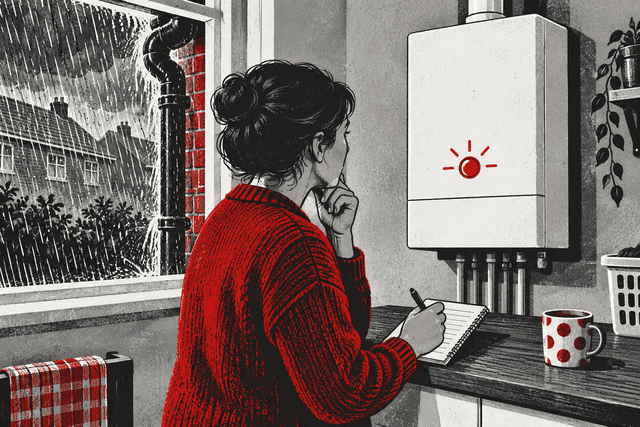
Why does a boiler fault appear only during heavy rain?
Heavy rain can expose a problem in drainage, a condensate connection, an external terminal or weatherproofing, but timing alone does not identify the fault. The same lockout may also have an unrelated electrical, ignition, pressure or control cause. Record the weather, exact code and sequence, make only safe ground-level observations, and give the pattern to a Gas Safe registered engineer.
If the boiler works in dry weather and faults during intense rain, photograph the display, record when rain starts and stops, note gurgling or visible external overflow, and check whether other services lost power. Do not open the casing, dismantle a flue, climb to a terminal or clear hidden pipework. A gas smell, carbon-monoxide alarm or suspected unsafe appliance needs the emergency route, not another reset.
Rain is a clue, not a fault code
A repeatable weather pattern is genuinely useful evidence. It narrows the conditions under which an engineer should inspect the installation. It does not prove that rainwater has entered the boiler, that a flue is blocked or that a condensate pipe is at fault.
Boilers monitor several things at once: ignition, flame, air and flue performance, water circulation, temperature, pressure, condensate drainage, sensors and electrical supply. Different faults can produce similar visible behaviour, and codes are specific to the exact model.
Write “fault appeared 12 minutes after very heavy rain began” rather than “rain got into the flue.” The first is evidence. The second is a diagnosis that requires inspection.
One possible route is the condensate drainage
Modern condensing boilers create condensate during normal operation and send it to a suitable drain. If condensate cannot discharge, some appliances can gurgle or lock out. Manufacturer instructions describe how drainage design must account for flooding and adverse weather.
Worcester Bosch explains that when condensate connects to a rainwater downpipe, an external air break is important so a blocked or full downpipe cannot drive rainwater back towards the boiler. Ideal Heating installation instructions similarly require an air break to avoid reverse flow if a downpipe floods or freezes.
That does not mean every rain-linked fault has this arrangement. The condensate may run to an internal soil stack, gully, waste connection, pump or soakaway. Its design and compliance need checking against the appliance and installation instructions.
A blocked or overwhelmed drain can reveal itself in heavy rain
Leaves, debris, poor falls, a full gully, local flooding or an unsuitable connection can reduce drainage capacity. Where the boiler’s condensate shares part of that route, the weather may reveal a weakness that remains hidden in light rain.
Record visible ground-level facts: a downpipe overflowing, water standing above a gully, unusual discharge near the condensate route or gurgling heard as the boiler tries to start. Take photographs only from a safe position.
Do not remove drain covers in floodwater, insert tools into the boiler’s condensate pipe, disconnect joints or pour chemicals into it. The engineer or drainage professional needs to distinguish an installation issue from a temporary external blockage and check for any resulting damage.
The flue and terminal also need professional consideration
The flue carries combustion products safely outside and forms part of the gas appliance. Its condition, joints, support, terminal position and compatibility matter. HSE says gas engineers need to be able to inspect flues and that householders should not attempt flue checks themselves.
Wind-driven rain, damaged seals, an unsuitable terminal arrangement, building alterations or a defect elsewhere along a flue route may be relevant in some cases. Equally, the visible terminal may be entirely sound and the fault may lie elsewhere.
Do not cover a terminal, fit a homemade rain shield, alter terminal components or reach it from a ladder. Changes can obstruct combustion air or flue-gas discharge. A Gas Safe registered engineer competent for the appliance must assess gas and flue work.
Check whether the event was actually electrical
Storms can coincide with brief supply interruptions, tripped protective devices, water affecting another electrical component, broadband or smart-control outages and local network disturbances. Record whether lights flickered, clocks reset, other circuits tripped or the thermostat lost power at the same time.
Look at the consumer unit only from a safe dry position. Do not repeatedly reset a protective device, touch wet electrics or remove covers. If there is water near electrical equipment, keep clear and use a qualified electrician or emergency service as appropriate.
A power event can explain why a boiler restarted or displayed a generic message without proving an internal boiler failure. Give both the weather and electrical observations to the attending professional.
Record the exact sequence
- Date, time and property location.
- Rain intensity and when it began; add wind direction only if easily known.
- What the boiler was doing: heating, hot water, preheat or idle.
- Exact display code, symbols and light colours.
- Sounds such as gurgling, repeated ignition or fan operation.
- Whether heating and hot water stopped together.
- Any visible downpipe, gully or external overflow from ground level.
- Any power interruption, tripped circuit or control outage.
- Reset attempts permitted by the user manual and their result.
- When operation returned and whether rain had eased.
Keep the original photos and short videos with timestamps. Two or three well-recorded events are more useful than a long list of guesses.
Use the exact manual for the display code
Record the complete model name and code exactly, including dots, letters and leading zeros. Search only the current manufacturer documentation for that model. Do not attach a meaning from a different range simply because the code looks similar.
Some manufacturer fault tables include several possible causes for one lockout, such as gas supply, ignition, condensate or air/flue conditions. That is why a code rarely establishes that rain is the cause.
If the manual permits one ordinary user reset, follow its stated limit. Repeated resetting can erase the timing pattern, delay diagnosis and keep attempting operation where a safety control is deliberately stopping the boiler.
What the engineer should receive
Send the model, serial number if accessible, code, weather timeline, photographs, service history and any prior work on the flue, roof, guttering, downpipes, drainage, kitchen extraction or nearby building fabric. Mention whether the fault began after an extension, render, roofing work or a drainage change.
Say whether the appliance is in warranty and whether the installer or manufacturer has already attended. A model-trained engineer may need the installation and servicing instructions, not just the user booklet.
Ask for the cause and completed remedy to be written on the job sheet. “Reset and working” is not a satisfactory explanation for a repeated weather-linked lockout unless the underlying assessment is documented.
Safety signs that override ordinary fault-finding
If you smell gas, suspect a gas escape or a carbon-monoxide alarm sounds, stop treating this as a rain-pattern investigation. HSE directs people who suspect a gas leak to call the National Gas Emergency Service on 0800 111 999, ventilate and turn off the gas at the meter if they know how and can do so safely.
If you suspect an appliance is unsafe, switch it off and do not use it until checked by a Gas Safe registered engineer. If anyone has possible carbon-monoxide symptoms, move to fresh air and seek urgent medical advice.
Water entering the boiler casing, water near live electrics, scorching, repeated loud ignition, a damaged flue or an appliance that has been isolated also needs professional action. Do not restart equipment an engineer has declared unsafe.
What not to do during or after the storm
- Do not open the boiler casing or service panels.
- Do not climb to the flue terminal, roof or high-level pipework.
- Do not cover, extend or redirect the flue.
- Do not disconnect condensate joints or force rods, air or chemicals through them.
- Do not work in floodwater or beside wet electrical equipment.
- Do not keep resetting a repeating lockout.
- Do not accept a fault-code meaning from an unrelated model.
Can the problem be prevented?
Prevention depends on the verified cause. It may involve correcting a condensate connection, providing the specified air break, clearing or redesigning drainage, repairing building defects, replacing approved flue components, correcting terminal positioning, weatherproofing suitable external controls or resolving an electrical issue.
These are not interchangeable repairs. For example, an air break protects certain drainage arrangements; it is not a universal cure for rain faults. A terminal accessory must be approved for the exact flue system, not improvised.
Regular boiler and flue maintenance can identify deterioration, but a weather-specific incident should still be reported with its evidence. Ask the engineer whether inspection is best arranged during wet weather or whether photographs and fault history are sufficient.
The practical conclusion
A boiler fault that appears only in heavy rain deserves investigation because the pattern may expose a drainage, condensate, flue, weatherproofing or electrical weakness. It does not identify which one.
Record the exact code, weather, operating state, safe external observations and any power event. Avoid internal or high-level investigation and give the evidence to a competent Gas Safe registered engineer. Use the emergency route immediately for gas, carbon-monoxide or unsafe-appliance concerns.
Related guidance: what to do if rainwater is dripping near the boiler flue.
Need a rain-linked boiler fault checked?
Have the model, code, weather timeline and photographs ready for the repair team.