
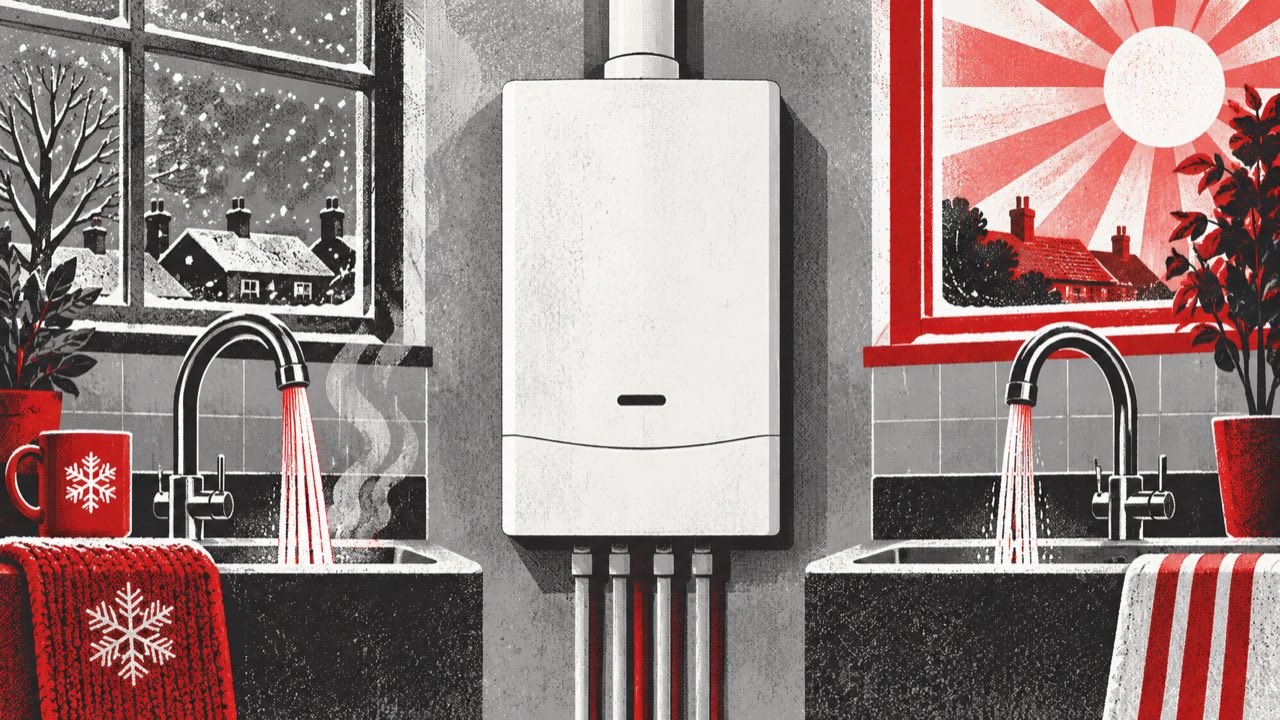
Why does a combi flow test change between winter and summer?
The same combi boiler can appear to deliver a stronger hot-water flow in summer than in winter without anything being faulty. The main reason is simple: winter mains water usually enters the boiler colder, so the boiler must add more heat to every litre before it reaches the tap.
What is a combi boiler flow test measuring?
A flow test measures how much water reaches an outlet over a set period, usually shown in litres per minute. When testing hot water from a combi boiler, the result is affected by more than the boiler itself.
The reading is a combination of:
- the temperature of the incoming cold water;
- the hot-water temperature being requested;
- the boiler’s maximum heat output to hot water;
- the available mains water pressure and flow;
- whether another tap, shower or appliance is using water; and
- restrictions at the tap, shower head, filter or pipework.
That is why a single litres-per-minute figure should never be treated as a complete diagnosis.
Why winter makes such a difference
A combi boiler heats water as you use it. It does not normally keep a cylinder full of hot water ready for the tap. The burner therefore has only the short journey through the boiler to raise the incoming water to the requested outlet temperature.
Imagine filling two kettles to make water at the same final temperature. One starts with cool summer water and the other starts with much colder winter water. The colder kettle needs more energy. A combi boiler faces the same basic problem, but water continues moving through it while it heats.
If the boiler is already delivering its maximum useful heat, it has two broad variables: the temperature rise and the amount of water passing through. When the required temperature rise is greater in winter, the available hot-water flow may be lower. In summer, warmer incoming water needs less heating, so the same boiler can often supply more litres per minute at the same tap temperature.
What does “flow rate at a 35°C rise” mean?
Manufacturer flow-rate figures are normally tied to a stated temperature rise. A figure quoted at a 35°C rise means the boiler is being assessed while raising the incoming water temperature by 35 degrees Celsius.
For example, if water entered at 10°C, a 35°C rise would produce water at about 45°C under the stated test conditions. If the incoming water were colder and the desired outlet temperature stayed the same, the boiler would need to achieve a larger rise. The achievable flow could therefore fall.
Current Worcester Bosch, Ideal and Baxi technical information all present combi hot-water performance against a defined temperature rise. Their published figures vary by boiler output and also rely on adequate incoming mains conditions. That makes the temperature-rise wording just as important as the headline litres-per-minute number.
Does a lower winter reading mean the boiler is undersized?
Not necessarily. Some seasonal variation is normal. Whether the boiler is suitable depends on the home’s expected hot-water demand, incoming mains supply and how many outlets are likely to be used at once.
A higher-output combi can generally deliver more hot water at a given temperature rise, but it still cannot supply more water than the mains can provide. If the cold supply to the property is limited, fitting a boiler with a larger published flow rate will not automatically produce that figure at the tap.
Likewise, opening two outlets at once divides the available supply. A shower may feel weaker when somebody opens a kitchen hot tap even though the boiler is operating correctly.
How to make a useful comparison at home
You can make a simple external check without touching the boiler casing:
- Use the same hot tap for every comparison.
- Make sure no other tap, shower, washing machine or dishwasher is drawing water.
- Open the hot tap fully and allow the temperature to settle.
- Collect the water in a suitably sized container for a measured period.
- Convert the amount collected to litres per minute and record the outlet temperature if you can do so safely.
- Note the date, boiler hot-water setting and which outlet you used.
Repeat the test under similar conditions. Comparing a fully open bath tap in winter with a restricted basin tap in summer tells you very little.
Take care with hot water and heavy containers. This is only an observation test; do not remove the boiler case, alter internal flow controls or interfere with gas components.
Other reasons a flow test can change
Season is only one possible cause. A different result may also come from:
- a change in local mains pressure or demand;
- another outlet drawing water during the test;
- a partially closed stop tap or service valve;
- a scaled or blocked tap aerator or shower head;
- a restriction in domestic water pipework;
- different boiler temperature settings;
- a control or sensor problem; or
- an issue inside the boiler that needs professional diagnosis.
If cold-water flow has also fallen, the cause may be on the incoming supply or at the outlet rather than the boiler. If only one tap is affected, check the condition of that outlet before assuming the boiler is responsible.
When should the boiler be checked?
Arrange a professional check if:
- the change is sudden or much larger than the normal seasonal difference;
- hot water repeatedly runs hot and cold;
- the boiler shows a fault code;
- the water will not reach a stable usable temperature;
- hot-water flow is poor at every outlet despite a healthy cold supply; or
- performance has deteriorated compared with previous winters under similar conditions.
A heating engineer can compare the actual inlet conditions, temperature rise and delivered flow with the boiler manufacturer’s data. That is more useful than judging the boiler from a headline flow figure alone.
Can the seasonal difference be prevented?
You cannot control the temperature of the water arriving from the street, but a correctly selected and maintained system should provide predictable performance within its design limits.
Good decisions start with realistic measurements: the property’s available mains flow, expected simultaneous demand and the boiler’s output at the relevant temperature rise. Where a household needs high flow at several outlets at once, a combi may not always be the most suitable system type. That is a design discussion, not evidence that every winter flow reduction is a fault.
The short answer
A combi flow test often drops in winter because colder incoming water requires a larger temperature rise. The boiler has a finite heat output, so it may pass fewer litres per minute while still producing hot water at the requested temperature. A small repeatable seasonal change can be normal; a sudden, severe or unstable change deserves investigation.
Has your hot-water performance changed?
A proper visit can separate normal seasonal behaviour from a supply restriction or boiler fault.