
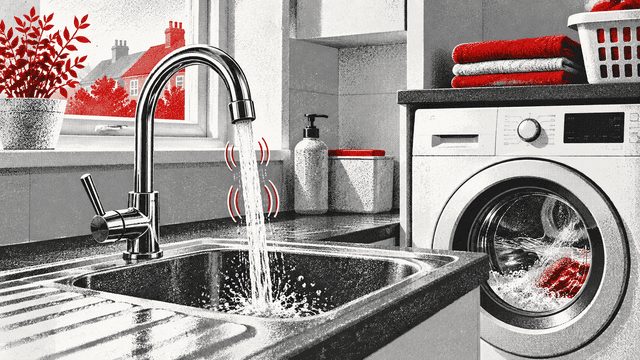
Why does a kitchen tap pulse when the washing machine fills?
A washing machine usually fills in short controlled bursts rather than taking water continuously. If the kitchen tap and machine share the same cold-water supply, those rapid changes in demand can make the tap stream dip, surge or pulse. A small, repeatable change may simply reveal the way the pipework is shared; strong hammering, worsening flow or leaks need attention.
Watch whether the tap changes exactly when the washing machine inlet opens and settles when filling stops. Compare the cold tap at a moderate flow, then repeat once with the machine idle. Do not dismantle the tap, washing machine valve or hidden pipework. Record banging, vibration, reduced whole-house flow, discoloured water or any leak for the water supplier, appliance engineer or approved plumber as appropriate.
Why the washing machine affects a separate tap
The cold kitchen tap and washing machine are often branches of the same incoming mains supply. Opening the tap creates one demand. When the machine opens its electrically operated inlet valve, it creates another. Both outlets then share the flow available through the service pipe, internal stop tap and household pipework.
WaterSafe explains that pressure and flow inside a home vary with the property, pipework, appliances and simultaneous demand. A change at the tap while another appliance takes water is therefore possible even though the tap itself has not moved.
The effect is often most obvious at a flowing tap because the stream gives an immediate visual clue. It does not automatically mean the boiler is faulty: the cold kitchen tap normally receives mains water without passing through a gas boiler.
Why the change can feel rhythmic
A modern washing machine does not necessarily keep its inlet valve open for one long fill. It may take a measured amount of water, pause while the drum turns or the level is assessed, then take more. Each valve opening increases demand and each closure releases that demand.
If the tap is already running, its stream can mirror that pattern: weaker as the machine fills, stronger during a pause, then weaker again. The apparent pulse may be slow and regular because it follows the wash programme rather than a fault oscillating inside the tap.
Use the sound of water entering the machine and the visible tap stream as timing clues. Do not open the machine, defeat its door lock or run repeated empty cycles just to reproduce the symptom.
A gentle dip is different from water hammer
A smooth change in flow as the machine takes water is not the same as a bang when its inlet valve shuts. Water hammer is a pressure shock caused by a rapid change in moving water. WaterSafe notes that washing machines and dishwashers have fast-closing valves that can contribute to pressure shocks.
Hammer may sound like a single thud, a knock in a wall or several short bangs. Loose pipework can move and amplify it. A tap stream may twitch at the same moment, but the important clue is the abrupt noise or vibration rather than a simple reduction in flow.
Repeated hammer can stress pipework, joints and fixings. Do not accept violent banging as normal appliance operation, and do not start adding arrestors or changing pressure controls without a plumber identifying the cause and suitable location.
Pressure and flow are not the same thing
Pressure is the force available to move water; flow is the volume delivered over time. A home can have acceptable static pressure when nothing is running yet show a noticeable loss of flow when two outlets operate together.
WaterSafe says UK water suppliers work to a statutory service standard of 10 metres head, or one bar, at the supply boundary. That minimum at the boundary does not promise unchanged flow at every internal outlet while an appliance and tap run together.
Service-pipe size, long pipe runs, old or restricted valves and the internal layout all influence the result. A plumber may need dynamic measurements under demand; a homeowner cannot diagnose the whole route from the appearance of one stream.
What is likely to be normal?
A modest, repeatable dip can be ordinary when all of the following are true:
- It begins only while the machine can be heard filling.
- The stream remains usable and returns promptly afterwards.
- There is no banging, shaking pipework or leaking.
- Other taps behave normally when the machine is idle.
- The water remains clear and has no unusual smell or taste.
- The washing machine completes its programme without an inlet error.
The exact amount of change differs between homes. “Normal” means consistent with the known shared demand and free of warning signs, not that every tap must show the same movement.
When the tap itself may make the pulse look worse
An aerator shapes the stream by mixing air with the water. Limescale or debris can make that pattern uneven, so a small supply change becomes a conspicuous flutter or spray. A worn tap cartridge or flexible connector can also alter the way one outlet responds.
Compare another cold mains-fed tap if one is safely accessible. If only the kitchen outlet breaks up while another merely becomes slightly weaker, the kitchen tap or its local branch may deserve inspection.
Follow the tap manufacturer’s user instructions if they specifically describe cleaning a removable aerator. Otherwise leave dismantling to a plumber, particularly in rented accommodation or where a finished fitting could be damaged.
A partly restricted supply can exaggerate the effect
If the internal stop tap is not fully open, is damaged or has a worn mechanism, the whole home may have less useful flow under simultaneous demand. Old service pipes, filters or local isolation valves can add further resistance.
Do not force a stiff stop tap. WaterSafe advises turning stop taps slowly and never using excessive force. A seized or leaking valve needs competent repair, not a wrench applied in an emergency.
If every mains-fed outlet is weak, read our completed guide to how a partly closed stop tap can affect a combi boiler and other outlets. The useful distinction is whole-house restriction versus one local tap pattern.
Could a combi boiler be involved?
Not when the symptom is confined to the cold kitchen tap. That water normally travels from the mains to the outlet without being heated. A washing-machine fill may still affect combi hot-water performance because both use the incoming supply, but that is a separate comparison.
If a hot tap cools or weakens as the machine fills, our completed article on hot water cooling when the washing machine fills explains shared supply and combi response.
Keep the boiler casing closed. A boiler fault code, unstable hot water at ordinary single-outlet flow, internal leak or repeated ignition failure belongs with a competent Gas Safe registered engineer.
A safe comparison that produces useful evidence
- Note the washing programme and when filling begins.
- Run the cold kitchen tap at a moderate, ordinary flow.
- Record whether the stream dips smoothly, pulses, sprays or stops.
- Listen for a matching fill sound, click, bang or pipe vibration.
- Note whether the stream recovers during each pause.
- Later, compare the same tap at the same position with the machine idle.
- Check one other cold tap without running several outlets together.
- Look around visible hoses and joints for drips, dampness or movement.
A short video showing the stream and capturing the sound can help. Keep the phone dry and do not reach behind a running appliance or pull it across flooring to expose hoses.
What if the washing machine also reports a fill problem?
An inlet warning, unusually long fill or repeated programme pause may indicate that the machine is not receiving water as expected. Check only the normal user items in its manual, such as whether the household supply is on and whether a visible hose is kinked.
Do not undo a pressurised hose while the machine is connected, probe its inlet valve or remove panels. Use the appliance manufacturer’s support route or a competent appliance engineer. A plumber may be needed when the restriction is in the household supply rather than the machine.
When the water supplier is the right contact
Contact the supplier if several cold taps have suddenly weakened, neighbours report the same issue, the change follows street works or an interruption, or the water is discoloured or unusual. Follow any current flushing or drinking-water notice rather than running a tap indefinitely.
Water suppliers are responsible for their network up to the relevant boundary; internal plumbing normally belongs to the property owner. The supplier can explain current incidents and its pressure investigation process.
When to call a plumber
Arrange a WaterSafe-approved or otherwise appropriately competent plumber if the pulsing is strong, new or worsening; if pipes bang or move; if several outlets lose excessive flow; or if there is a leak. Also get help if a stop tap is stiff, damaged or cannot isolate the supply.
For a rented home, report the video, affected outlets and any leak in writing. GOV.UK’s England guidance says landlords are generally responsible for pipes, basins, sinks, heating and hot water. Rules and reporting routes differ across the UK, so use the relevant national guidance and tenancy terms.
The practical conclusion
A kitchen tap can pulse while a washing machine fills because the two branches share the incoming cold-water supply and the machine takes water in stages. A mild stream change that follows the fill cycle and disappears afterwards can be an ordinary interaction.
Strong hammering, severe loss of flow, an appliance inlet error, discoloured water or a leak is different. Record the timing and comparison, then send the evidence to the supplier, appliance engineer or plumber best placed to investigate—without dismantling either outlet.
Hot-water performance changes at the same time?
Keep the tap comparison and washing-machine timing ready for the repair team.