
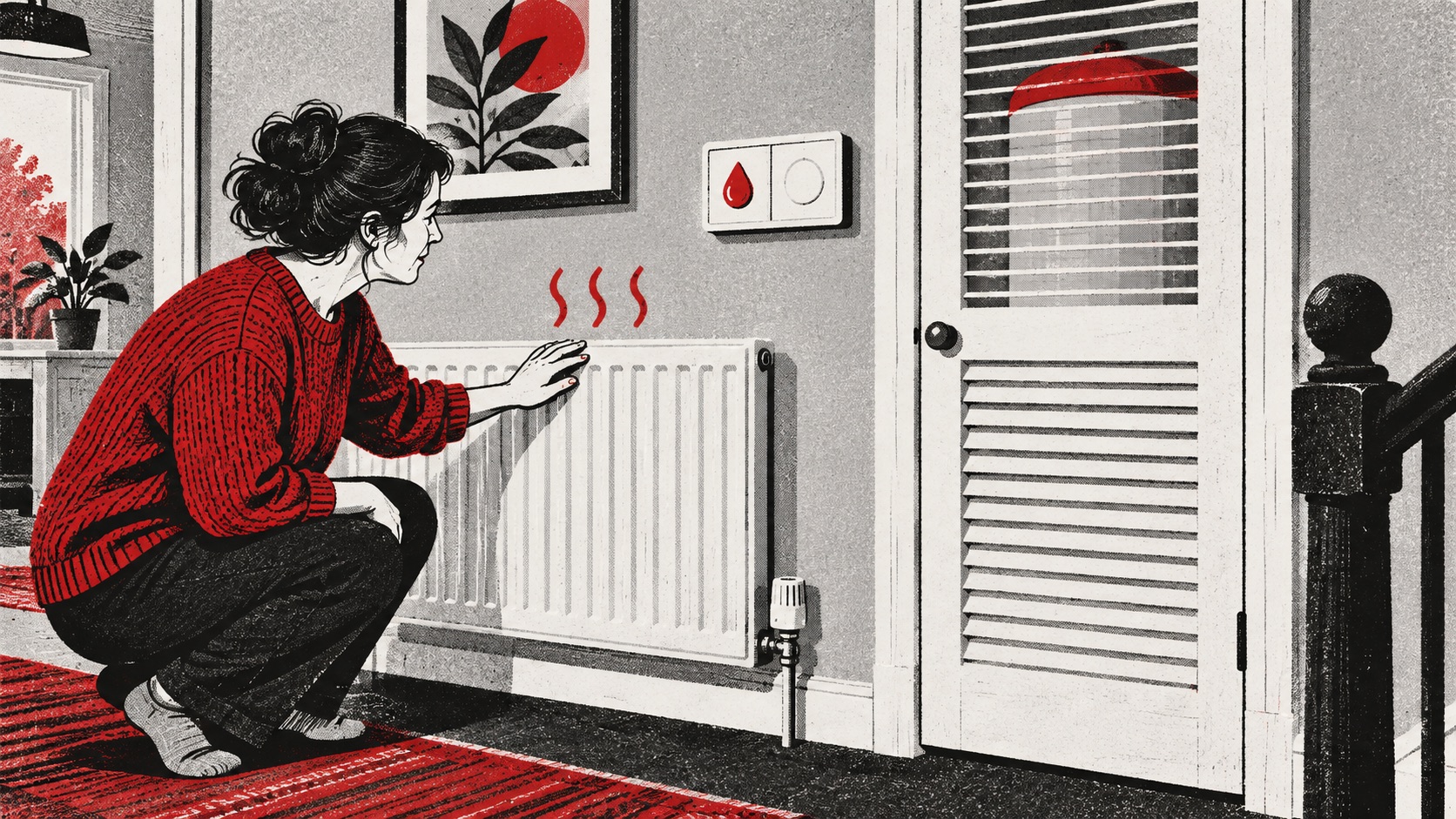
Why does a radiator warm up when only hot water is selected?
A little warmth in a nearby pipe or radiator just after the heating has run can be leftover heat. If one or more radiators become clearly hot every time the cylinder reheats, water may be passing into the heating circuit when the controls are asking for hot water only.
The pattern matters more than a single touch. Note which radiators warm, how far the heat spreads and whether the heating had been running shortly beforehand. Keep all boiler, valve and wiring covers closed.
The short answer
On a typical fully pumped system with a hot-water cylinder, motorised valves direct heated water to the cylinder, the radiators or both. In a hot-water-only period, the heating route should normally remain closed.
Mild warmth that fades may be residual heat or heat travelling along nearby pipework. Repeated, substantial warming across a radiator or several rooms suggests unintended circulation and deserves a professional check.
Why the hot-water cylinder needs the boiler
A system or heat-only boiler usually warms the cylinder indirectly. Hot system water travels through a coil inside the cylinder, transfers its heat to the stored tap water, then returns to the boiler. The radiator water and drinking water do not mix.
The programmer asks for hot water, while the cylinder thermostat decides whether the stored water needs more heat. Depending on the installation, one or more motorised valves then open the correct route and the boiler and pump run.
Because the cylinder and radiators can share parts of the same primary pipework, a control or flow problem can make a radiator warm even though no room-heating demand was intended.
Residual heat can be normal
If the heating stopped only recently, the boiler, pump, pipes and radiator water may still be warm. Some boilers keep the pump running briefly after the burner stops so that remaining heat can move safely away from the appliance.
A radiator close to the boiler, cylinder cupboard or shared flow pipe may pick up a small amount of this heat. The pipe can also feel warmer than the radiator panel itself.
Residual heat should normally fade rather than build. It is less convincing as an explanation when the radiators start from cold and become progressively hot during every hot-water-only cycle.
The motorised valve may not be separating the circuits
Motorised valves control the route taken by water in a closed heating system. Some homes use two separate two-port valves: one for the heating circuit and one for the cylinder. Others use a three-port or mid-position valve that can send water to hot water, heating or both.
When only hot water is selected, the valve arrangement should direct flow through the cylinder circuit. If a valve does not travel fully, sticks, is left in a manual-open position or receives the wrong electrical instruction, some flow can reach the radiators.
That description helps explain the symptom; it is not a do-it-yourself repair. Valve heads contain electrical parts and the fault can involve the valve body, actuator, wiring centre or controls. A heating engineer should test the system.
Older layouts can behave differently
Some older systems rely partly on gravity circulation and may not separate heating and hot water as neatly as a modern fully pumped, zoned system. Their behaviour can depend on pipe layout, check valves and how the controls were installed.
If a radiator has always become slightly warm during cylinder heating, that may be a characteristic of the installation. If the behaviour is new, much stronger or spreading to more rooms, treat the change as useful evidence of a developing fault.
One warm radiator or several?
- Only the nearest pipe feels warm: conducted or residual heat is more likely.
- One radiator warms at one end: a small unwanted flow or heat travelling from a shared pipe may be involved.
- One radiator becomes hot across the panel: water is probably circulating through it.
- Several radiators warm together: the heating circuit may be receiving flow during the hot-water demand.
- Every radiator heats as normal: check that the programmer, room thermostat or smart control is not also requesting heating.
Safe checks at the controls
- Confirm the programmer or app shows hot water on and central heating off.
- Check the room thermostat is not calling for heat. On a smart system, look at the ordinary activity history if available.
- Note whether the radiators were cold before the cylinder began reheating.
- Without removing covers, observe which radiator warms first and whether the whole panel or only a pipe changes.
- Record when the warmth begins and whether it stops when the hot-water demand ends.
- Write down any exact boiler message or fault code.
One normal heating cycle is enough. Do not repeatedly force the cylinder to reheat, move a valve lever, disconnect an actuator or alter wiring to reproduce the fault.
Could the controls be asking for both?
A programmer can have separate schedules for heating and stored hot water, while smart controls may use frost protection, optimisation or individual room schedules. A room thermostat set low is not proof that no heating demand exists if another zone or control is active.
Check the user-facing schedule and status rather than changing installer settings. Our guide to a boiler starting when no radiator feels warm explains other reasons that a boiler may run without an obvious whole-home heating demand.
When should you arrange a repair?
Arrange a check if the same radiators become properly hot during every hot-water-only cycle, the problem is worsening, rooms overheat or the cylinder takes unusually long to recover. Also seek help if the boiler or pump appears to run continuously, a valve makes repeated buzzing or clicking, or a fault code appears.
A suitably competent heating engineer can compare the control demand with the valve position and water flow. Work on gas-appliance internals must be carried out by someone appropriately Gas Safe registered. Keep the boiler casing closed.
The practical conclusion
A trace of fading warmth can be leftover heat, especially close to shared pipework. A radiator that repeatedly becomes hot from cold while only the cylinder is being heated points more strongly to unwanted circulation or a valve-and-controls issue. Record the pattern at the normal controls and let an engineer test the system rather than trying to move or dismantle the valve yourself.
Radiators heating during hot-water-only periods?
Note which rooms warm and when it starts before arranging a diagnosis.