
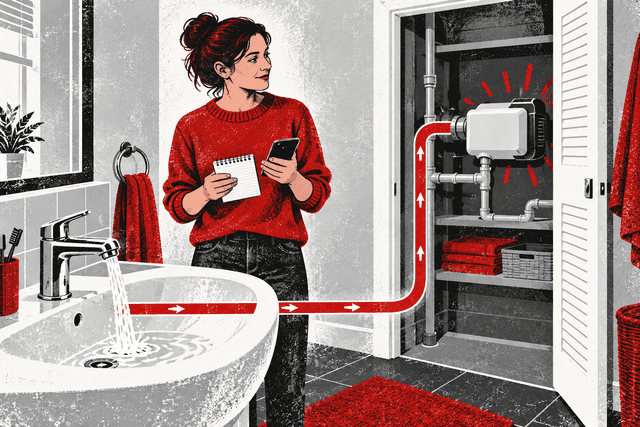
Why does a shower pump start when a basin tap opens?
The basin may be intentionally connected to the same boosted pipework as the shower. A pump reacts to water flow or a pressure drop, not to the name of the outlet, so opening a pumped basin tap can start it normally. The important questions are whether the tap receives a steady boost, whether hot, cold or both sides trigger the pump, and whether it stops promptly when the tap closes.
Open the basin tap only during normal use and note which side starts the pump, whether flow strengthens and whether the pump runs steadily until closure. That pattern usually shows a shared pumped branch. Repeated pulsing, delayed stopping, poor flow, leaks or activation with every outlet closed need a plumber or pump specialist. Do not open the pump, adjust pressure controls or turn unfamiliar valves.
A “shower pump” may serve more than a shower
The everyday name is misleading. Manufacturers sell pumps for one shower, a bathroom or several outlets. A suitable bathroom pump may boost a shower, bath and basin together, provided the water storage, pipework and pump selection meet its requirements.
If the basin was included in the installation, its tap creates the same kind of demand as the shower. The pump starting is then expected rather than evidence of a crossed connection.
Our broader completed guide explains why a shower pump starts when a nearby tap opens. Here the focus is the basin: small flow rates, mixers and identifying which side is actually boosted.
Positive-head pumps start with natural flow
A standard positive-head pump normally contains flow switches. When an outlet opens, gravity must move enough water through the pump to operate the switch. The motor then boosts the flow.
Salamander’s current guidance specifies two litres per minute of natural flow through each relevant side for its positive-head bathroom pumps. That number belongs to the stated products and must not be treated as a universal threshold for every make or model.
A basin tap with a restrictive aerator may sit close to a pump’s activation threshold. The pump may start only when the tap is opened farther, or it may pulse if the natural flow cannot keep the switch reliably engaged.
Universal pumps can start from pressure change
A universal, or negative-head, pump is designed for outlets that cannot create enough natural flow. It maintains pressure on the outlet side and starts when opening a tap causes that pressure to fall.
The basin tap may therefore start a universal pump immediately even when gravity flow is weak. A pressure vessel visible on some models is one clue, but identify the exact pump from its label and manual.
If the pump starts when all taps are closed, that is a different symptom. A drip or leak can let pressure decay and cause brief hunting.
Which side of the basin triggers it?
A twin pump can boost both stored hot and stored cold supplies. A single-ended pump may boost only hot or only cold. Some basin mixers combine pumped hot with mains cold, while others use two gravity-fed boosted supplies.
During ordinary use, note separately whether fully hot, fully cold or a mixed position starts the pump. Do not keep running very hot water or create a lengthy test. A few seconds is enough to record the response.
If only one side triggers the pump, that may match the intended layout. It does not automatically mean the other side has failed.
A simple outlet map
Create a short table for the engineer with one row for the shower, bath and basin. For each outlet, record:
- whether hot, cold or mixed demand starts the pump;
- whether water flow increases when it starts;
- whether the pump sounds steady or pulses;
- whether it stops promptly after closure; and
- whether the behaviour is new or has always occurred.
This map is more useful than describing every pump sound as random. It shows which outlets share the boosted branch without requiring pipework to be opened.
When the behaviour is probably intended
An intended pumped basin normally gives a repeatable pattern: the tap opens, the pump starts, flow strengthens, the pump runs steadily, and it stops shortly after the tap closes. Similar behaviour at the bath and shower supports a bathroom-wide installation.
Check the pump model’s declared application and any handover paperwork. The installer should also have considered water storage capacity, hot-water temperature, pipe sizing and electrical location.
The fact that the pump is noisy does not make the connection unintended, though excessive noise or vibration deserves its own check.
Patterns that need investigation
- the pump starts and stops repeatedly while the basin flow stays constant;
- the pump starts but the basin flow does not improve;
- the pump continues running after the tap closes;
- the basin temperature changes sharply when the pump starts;
- the shower is affected whenever the basin is used;
- the pump has begun operating with outlets closed;
- there is a leak, hot smell, tripped circuit or unusual vibration; or
- the behaviour appeared after plumbing work.
Record the pattern and stop using equipment that leaks, overheats or trips its electrical protection.
Why a small basin flow can make a pump pulse
A basin tap often has a lower flow than a bath outlet or shower. An aerator, restrictive cartridge, partially closed service valve or narrow flexible connector can reduce it further. On a positive-head pump, the result may sit near the flow-switch threshold.
Stuart Turner and Salamander both publish model-specific troubleshooting for pumps that pulse or fail to stay on. Restrictions and insufficient natural flow are among the possibilities, but the correct checks depend on the product.
Do not remove the tap aerator, clean pump filters or dismantle hoses as a diagnostic unless the relevant manufacturer instructions identify that as a user task. A plumber can measure flow and inspect safely.
Shared demand can change the shower
If the basin and shower are used together on the same pump, they share the pump’s available performance and the stored-water supply. The shower may become weaker or its mixer may respond to changing inlet conditions.
Do not deliberately run both to maximum as a stress test, especially with somebody under the shower. Simply note any naturally occurring change and stop if the shower becomes uncomfortably hot or cold.
A pump must be selected for the number and type of outlets it is expected to serve. A professional can compare the installed model with the manufacturer’s application guidance.
Mains cold and pumped hot need care
Some basin mixers receive mains cold water and boosted stored hot water. The pressures may differ substantially. The fitting, check-valve arrangement and backflow protection must be suitable for that combination.
The Water Supply (Water Fittings) Regulations require fittings to be appropriate for their circumstances and require adequate backflow prevention. If the basin behaves erratically, hot water pushes into a cold branch or the pump starts unexpectedly, have the arrangement checked.
Do not add or remove non-return valves without the pump and mixer manufacturers’ requirements. Some pump instructions specifically prohibit extra valves in certain discharge pipework.
Do not adjust the pump to silence it
Reducing an unknown valve, changing a pressure vessel charge or moving a flow switch can hide the symptom, damage performance or make another outlet unsafe. Pump covers may also expose electrical components in a damp environment.
HSE guidance emphasises the extra risk of electricity where equipment or surroundings are wet. Keep water away from the electrical connection and use a competent person for repair.
If the pump runs continuously or water reaches electrical equipment, use only a safe, normal accessible isolation control and seek prompt help.
Does the boiler need attention?
A conventional shower pump is usually associated with stored hot water. Opening a basin tap may draw from the cylinder and start the pump, but the boiler does not necessarily fire at the same moment. It may reheat the cylinder later under its thermostat and schedule.
If the property has a combi boiler, confirm what kind of pump is actually fitted. Traditional gravity shower pumps are not applied in the same way to mains-pressure combi hot water.
Any internal gas-boiler diagnosis or repair belongs to a suitably qualified Gas Safe registered engineer. The outlet map helps show whether the issue is hydraulic before the boiler is blamed.
Questions homeowners often ask
Is the basin supposed to be pumped?
It may be. Check the pump model, installation records and whether basin flow consistently increases. The label “shower pump” is not enough to decide.
Why does hot start the pump but cold does not?
The pump may serve only stored hot water while cold comes from the main or another gravity branch. Confirm the layout rather than altering valves.
Why does the pump start only when I open the tap fully?
A positive-head pump needs enough natural flow to operate its switch. A low-flow basin fitting may reach that threshold only at a larger opening.
Can a dripping basin tap make it start by itself?
Yes, on a pressure-activated universal pump a slow leak can cause hunting. Our completed guide covers brief cycling from a dripping pumped tap.
The practical conclusion
A basin tap can start a shower pump simply because it is an intended outlet on the same boosted supply. Steady operation that follows the tap and improves flow is the clearest sign of that arrangement.
Map which side triggers the pump and how it starts and stops. Pulsing, delayed stopping, no useful boost, leaks, electrical warning signs or a new change after plumbing work need a plumber or pump specialist—not adjustments to pump controls.
Basin tap unexpectedly starting the pump?
Keep the outlet map and pump model ready for the engineer.