
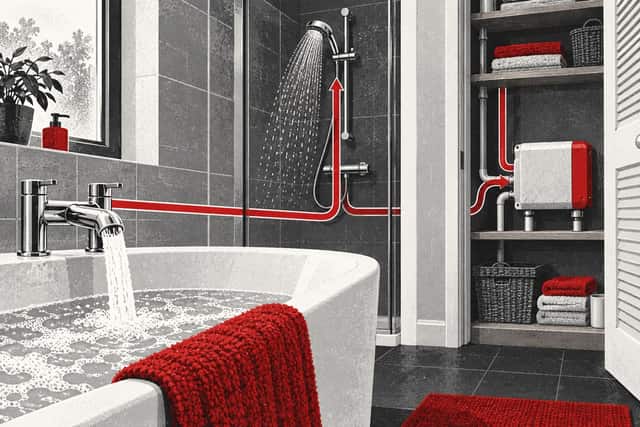
Why does a shower pump start when a bath tap is opened?
A pump sold or described as a “shower pump” may serve more than the shower. If the bath tap is connected to its boosted pipework, opening the tap creates the flow or pressure change that tells the pump to run. That can be the intended design. If the bath was never meant to be pumped, the pump starts unpredictably or the water surges, the installation needs checking rather than guesswork.
Notice whether the bath flow becomes stronger when the pump starts, whether hot, cold or both sides trigger it, and whether the pump runs steadily until the tap closes. Check the pump model and any installation records. Do not remove the pump cover, alter its pressure vessel, close unfamiliar valves or trace pipes by dismantling fittings.
The pump responds to water conditions, not the room
A shower pump does not identify a shower by name. Depending on its type, it detects either natural water flow through the pump or a fall in pressure in the pipework it serves. A bath tap on the same pumped branch can therefore make it start in exactly the same way as a shower.
Manufacturer ranges include shower-only, bathroom and whole-house pumps. Salamander Pumps currently describes bathroom pumps that can serve bath taps, basin taps, toilets and showers, while its whole-house models can serve several outlets. The label “shower pump” in conversation is not proof that only one shower is connected.
The installation and the exact model matter. A pump intended for one outlet should not be assumed suitable for several merely because water comes out.
Positive-head and universal pumps start differently
A positive-head pump normally starts when enough water flows naturally through it to operate a flow switch. Salamander specifies 2 litres per minute for its current positive-head ranges, while other manufacturers and models may use different figures. The model manual is the authority for the pump in your home.
A universal, sometimes called negative-head, pump can start when an outlet opening releases pressure from pressurised downstream pipework. These pumps are designed for situations where natural flow is too low to operate a conventional positive-head pump.
That difference explains why one bath tap may need to be opened further before a positive-head pump starts, while a universal pump may respond promptly to a small pressure change. It does not by itself show that either pump is faulty.
When the bath tap is deliberately pumped
A gravity-fed stored-water system can have modest natural pressure, particularly where the cold-water storage cistern is not far above the bathroom. A suitable bathroom or whole-house pump may be installed to improve the bath as well as the shower.
A repeatable pattern can support that explanation:
- The pump starts every time the same side of the bath tap is opened.
- The bath flow clearly strengthens when the pump starts.
- The pump runs smoothly for the whole time water is drawn.
- It stops normally when the tap closes, allowing for any model-specific brief run-on.
- The installation paperwork or product selection confirms that bath outlets are served.
- No unexplained cycling occurs when every outlet is closed.
This evidence suggests an intended connection, but it is not a substitute for checking the model and pipe layout.
Hot, cold and mixed tests tell different stories
Many bath mixers combine two supplies at the spout. A twin-ended pump may boost both gravity-fed hot and cold water, while a single-ended pump may boost only one side. Some homes have mains-fed cold water and stored hot water, so the two sides behave differently.
Use only the normal tap controls. Briefly note what happens with hot only, cold only and a comfortable mixed setting. If the pump starts on hot but not cold, it may be serving only the stored hot branch. If both sides start it, both may be routed through a suitable twin pump.
Do not run water at a scalding temperature for this comparison. Keep children and vulnerable people away from the outlet and stop if temperature control is unstable.
A steady run is different from a brief pulse
If the pump starts and continues smoothly until the bath tap closes, the bath is probably drawing through the pumped route. A short pulse followed by silence can mean that the initial flow or pressure change operated the control but did not produce a sustained demand.
A pump that stops and starts repeatedly while the tap is held at one position is another pattern. On a positive-head installation, marginal natural flow may make a flow switch drop in and out. On a universal pump, unstable pressure or a leak may be involved.
Record the pattern rather than trying to correct it with valves or pump controls. The installer needs the duration, tap position, hot or cold side, flow change and exact pump model.
Why a small bath-tap opening may behave oddly
A barely opened tap may not create the minimum natural flow required by a positive-head pump. It can remain unboosted, start late or hover around the pump’s switching point. A fully opened bath tap usually demands much more water and may start the pump decisively.
That does not mean the correct remedy is to adjust the pump. The pump type, stored-water supply, pipe size, tap restriction and available head must work together. If normal bath use is unreliable, ask a competent plumber to assess the installation against the manufacturer’s requirements.
Do not repeatedly flick the tap open and closed as a stress test. It creates unnecessary pump starts and provides poorer evidence than one timed observation.
Could it be a cross-connection?
An unexpected pump response can sometimes follow later plumbing alterations, a replacement mixer tap or incorrectly routed supplies. Pressure from one side of a mixer may also influence the other side if the fitting and check arrangements are unsuitable.
You cannot confirm a cross-connection from the pump noise alone. Warning clues include a new behaviour after plumbing work, temperature instability, flow from the “wrong” supply, the pump responding differently at a mixed setting, or another outlet changing at the same time.
The Water Supply (Water Fittings) Regulations and equivalent national rules protect water quality and require suitable fittings and arrangements. A WaterSafe-approved plumber can identify the supplies and check the finished plumbing without relying on trial-and-error valve operation.
Do not assume the boiler is starting the pump
A conventional shower or bathroom pump normally boosts stored water and operates independently of the boiler. Opening a bath hot tap may make the pump run while the cylinder supplies hot water; the boiler may reheat that cylinder later according to its controls.
On a combi system without a hot-water cylinder, a conventional pump for gravity-fed stored water is generally not the standard arrangement. If you have a combi and equipment described as a shower pump, have the system identified before applying generic advice.
If the boiler display changes at the same moment, read our guide to why a boiler display can change when a shower pump starts. Two devices can respond to the same water use without one electrically controlling the other.
Safe observations to make
- Photograph the pump label from a safe, dry position.
- Note whether the bath tap is separate hot and cold, or a mixer.
- Run one ordinary bath-tap demand and time when the pump starts and stops.
- Record whether the flow strengthens when it starts.
- Note whether hot, cold or both trigger the pump.
- Listen for smooth operation, pulsing or repeated restarts.
- Check visible outlets for drips after everything is closed.
- Look for commissioning paperwork showing which outlets are pumped.
Keep hands away from wet electrical equipment and do not remove cupboard panels, pump covers or terminal covers. HSE warns that unsuitable or damaged electrical equipment in wet surroundings can make nearby surfaces live.
When the behaviour needs attention
Arrange a plumbing or pump assessment if the behaviour is new, the pump starts only intermittently during normal bath use, flow or temperature surges, the motor repeatedly cycles, or the bath was not intended to be boosted. The same applies if plumbing work has recently changed the pattern.
Stop using the pump and use its normal accessible isolator if the casing leaks, becomes unusually hot, smells scorched, makes harsh mechanical noise or appears to run without water. If water is near damaged electrical equipment, do not touch it; isolate the electrical supply only if that can be done safely and seek urgent help.
If the pump merely continues for a fixed few seconds after the tap closes, check the model manual. Our guide to why a shower pump may run briefly after an outlet closes explains how designed run-on differs from hunting.
What a competent plumber will establish
The professional can identify the pump type, confirm which outlets it is designed to serve, trace hot and cold routes, measure natural flow and compare the installation with the manufacturer’s instructions. They can also check whether mixer and non-return arrangements are appropriate.
Give them the pump model, bath-tap type, a short video, the hot/cold comparison and details of recent work. That evidence narrows the job without anybody opening the pump on speculation.
The practical conclusion
A shower pump often starts with a bath tap because the bath is intentionally connected to the same boosted supply. The most useful clue is a strong, steady and repeatable boost that lasts for the whole bath demand.
Brief pulses, repeated cycling, surging, a new response after plumbing work or a bath that was never meant to be pumped justify competent investigation. Observe the normal controls, keep the model details and leave pump internals, pressure settings and unfamiliar valves alone.
Bath demand is making the pump behave differently?
Keep the model, outlet comparison and a short video ready for the visit.