
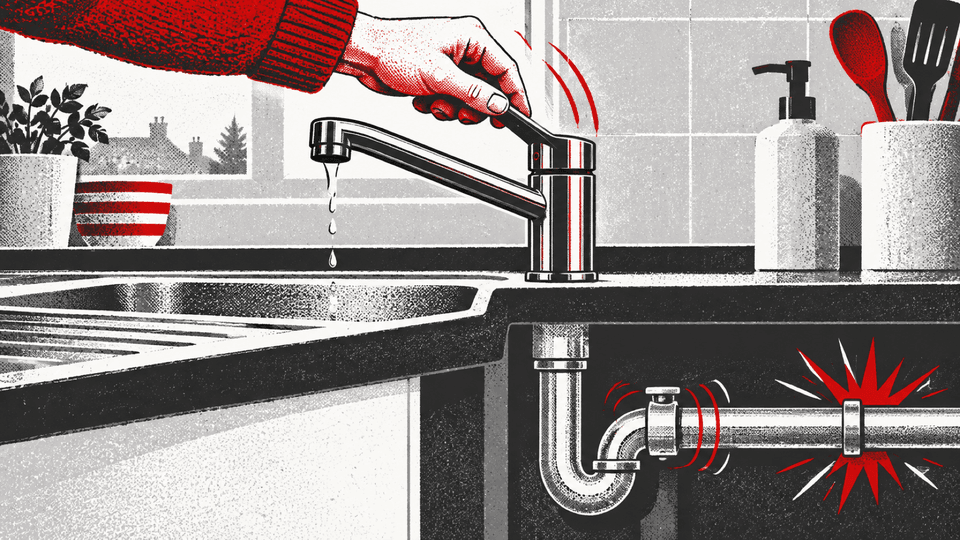
Why does a tap bang when it is turned off quickly?
A sharp bang immediately after a tap closes is commonly caused by a sudden change in water flow. The moving water stops quickly, creating a short pressure surge that can make pipework or fittings move and transmit noise through the building.
One isolated sound is not proof of damaged pipework, but repeated or worsening bangs deserve investigation—especially if pipes visibly move, joints leak or the noise follows recent plumbing work.
The short answer
The everyday name is water hammer. Water Regs UK describes transient pressure surges caused by the rapid closure of valves, which suddenly stops or changes the flow. A quick-closing lever tap, appliance valve or toilet inlet can make the effect more obvious.
The bang may occur close to the tap or travel along the pipe and seem to come from a wall, floor, boiler cupboard or another room. Sound location alone does not identify the faulty fitting.
Why closing speed matters
Water moving through a pipe has momentum. Closing a tap slowly reduces that flow over a longer moment. Snapping it shut creates a faster change and a sharper pressure wave.
That does not mean a normal tap should be left dripping or deliberately closed slowly forever. Closing speed is a useful observation for the plumber: if the noise appears only after a fast closure, say so.
Confirm the exact trigger
Test only through ordinary use and stop if there is leakage or violent movement. Record whether the bang follows:
- one particular hot or cold tap;
- several taps around the home;
- a washing machine or dishwasher changing cycle;
- a toilet cistern finishing its refill;
- a shower control closing;
- both slow and quick closure, or quick closure only.
Do not repeatedly create a severe bang for a video. One ordinary-use recording is enough.
Is the boiler causing it?
A bang triggered exactly when a tap closes is usually a water-supply or outlet event, not evidence that the boiler itself is banging. On a combi system, the boiler may stop its hot-water demand at the same moment, so both events can seem connected.
Record whether the same sound happens at a cold tap. If it does, that is useful evidence that the noise is not limited to boiler-heated water. Our guide explains why a mixer tap can affect a combi boiler’s demand, but a plumber still needs to trace the actual bang.
Why the noise may seem to come from somewhere else
Pipes pass through cupboards, joists, clips and walls. A pressure wave can make a poorly restrained section move against the building fabric, while the pipe carries the sound away from the initiating tap.
Note the loudest location and whether any accessible pipe visibly jumps. Do not lift floors, cut inspection holes or pull boxed-in pipework to find it.
Recent changes are important
Tell the plumber if the noise began after a tap, shower, toilet valve, washing machine or dishwasher was fitted; after the stop tap was operated; or after water-supply work in the street or property.
A change in valve closing speed, pipe support or supply conditions can expose a pattern that was not previously noticeable. It does not prove the newest component is defective, but it helps establish the timeline.
Could the stop tap be involved?
A partly closed, damaged or recently operated stop tap can change flow and noise, but it should not be adjusted repeatedly as a cure. Its correct position and condition depend on the installation.
If the wider water supply also seems weak or unusual, see how a partly closed stop tap can affect a combi boiler. Ask a plumber to assess the supply and pressure rather than guessing from handle position.
What the regulations tell us
The Water Supply (Water Fittings) Regulations 1999 require fittings to resist vibration, stress, pressure surges and temperature changes likely in service. The Water Industry Act also provides for water fittings not to cause or contribute to pipe reverberation.
Those rules do not turn every single tap noise into an emergency. They show why persistent pressure shock, movement and poor support belong in a proper plumbing assessment rather than being dismissed indefinitely.
Safe evidence for a plumber
- Write down the exact outlet or appliance that triggers the bang.
- Note whether hot, cold or both sides are involved.
- Record whether slow closure changes the sound.
- Make one short audio or video recording during normal use.
- Photograph any visible pipe movement, staining or leak without removing covers.
- List recent plumbing or appliance work and when the noise began.
If you live in a flat, note whether neighbours hear a similar event. Shared supply pipework can transmit sound, but responsibility depends on where the cause is found.
When to arrange a prompt visit
Book a plumber promptly if the bang is forceful or worsening, pipes visibly jump, a joint starts weeping, a tap or valve becomes difficult to use, or the event affects several outlets. Turn off the appropriate water supply and seek urgent help if a fitting fails or water is escaping.
A WaterSafe Register-approved plumber can assess supply pressure, valve behaviour, pipe support and the correct remedy for the installation. Do not buy or fit a generic arrestor solely from an online symptom match.
What not to do
Do not dismantle the tap, tighten concealed joints, change pressure controls, clamp inaccessible pipes or alter boiler components. Do not assume turning the main stop tap partly closed is a safe permanent fix.
Water Regs UK notes that engineered measures such as suitable surge control or pressure reduction may be used in some installations. Selection and positioning depend on the system and should be assessed by a competent plumber.
The practical conclusion
A tap that bangs only when shut quickly is giving a strong clue: a rapid change in flow is producing a pressure surge and transmitting movement or sound through the pipework.
Record the trigger, closing speed, affected outlets, recent work and any visible movement. A plumber can then identify whether the issue is at the tap, another quick-closing valve, the supply conditions or the way the pipework is supported.