
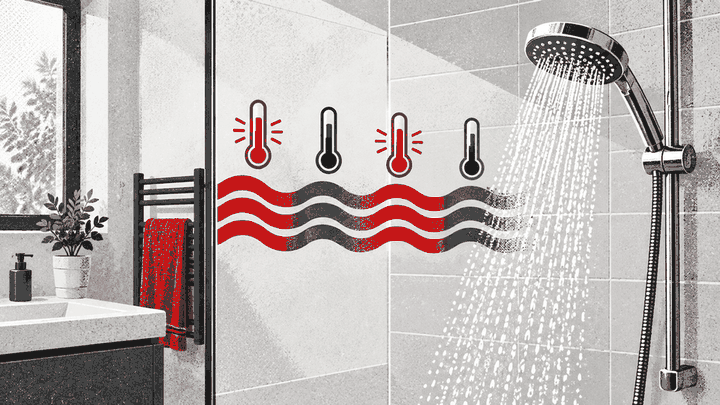
Why does my hot water run hot, cold, hot, cold?
Hot water that repeatedly turns hot, cold, hot and cold is usually losing a stable balance between water flow and heat. On a combi boiler, a very low or changing flow can make the burner reduce its output or stop and restart. A tap restrictor, blocked outlet, changing mains supply or a restricted domestic plate heat exchanger may contribute, but the pattern must be matched to the exact system before anyone names the fault.
First establish whether it happens at one tap, one shower or every hot outlet. Compare one ordinary useful flow with a slightly higher flow, note the boiler display and stop if the water becomes dangerously hot. Do not remove restrictors permanently, alter a thermostatic mixer or open the boiler. If every outlet cycles, the temperature swings are severe or a fault code appears, arrange a competent diagnosis.
“Hot then cold” can describe several different patterns
The timing is the first useful clue. Water that begins cold, warms once and then stays hot may simply be clearing cooled water from the pipe. Water that changes every few seconds or minutes during one uninterrupted draw is a cycling problem. A shower that changes only when a toilet, washing machine or second tap is used points towards changing supply conditions.
Write down roughly how long each hot and cold phase lasts. Note whether the boiler flame or hot-water symbol disappears at the same moment, whether flow weakens, and whether the problem begins immediately or only after several minutes. These observations are more useful than guessing at a component.
Do not test with your hand under water that may suddenly become very hot. HSE warns that hot water can cause serious scalding, and fluctuating flow or pressure can make shower temperatures unsafe. Keep children and vulnerable people away from the outlet until the pattern is understood.
First identify the hot-water system
A combi boiler heats mains water as a tap runs. It has to match its heat output to the flow passing through the appliance. A system or regular boiler normally heats water stored in a cylinder, so an alternating shower temperature may be caused by the outlet, mixing valve, supply or stored-water controls rather than rapid burner cycling.
An electric shower is different again: it heats cold mains water inside the shower unit and does not use the boiler for the shower temperature. If taps stay steady while an electric shower changes temperature, a boiler article cannot diagnose that appliance.
Confirm the arrangement from the user manual, visible cylinder and existing paperwork. Our guide to how a combi boiler works explains on-demand hot water and why usable flow matters.
Why low flow can make a combi cycle
Modern combis modulate: they can reduce burner output when less heat is needed. They still have a model-specific minimum output and need a stable detected hot-water flow. If the outlet passes too little water for the appliance to transfer its lowest available heat continuously, the water can heat quickly, the burner can reduce or stop, and the cycle can repeat as conditions change.
This is sometimes described as an “oversized boiler”, but that conclusion needs care. A boiler may be large for the space-heating load yet have been chosen for domestic-hot-water demand. Minimum modulation, inlet temperature, outlet flow, control design and installation all matter. One symptom cannot prove that the whole boiler is wrongly sized.
Manufacturer data shows that output range and hot-water flow are model-specific. Do not compare a display or cycling interval with a different boiler and assume the meaning transfers.
Tap restrictors and aerators can matter
An aerator, water-saving insert or flow restrictor reduces the outlet flow. That can be intentional and useful. If it is unusually restrictive, partly blocked with debris or combined with a very small tap opening, it can bring a combi close to its minimum stable hot-water condition. Some shower heads and thermostatic mixers also control flow in their own way.
Compare the affected outlet with another hot tap at an ordinary useful flow. If the second outlet is steady, the first outlet, its aerator, shower head or local mixer becomes more relevant. If all hot outlets alternate together, investigate the common supply and boiler side.
Do not permanently remove a manufacturer-specified restrictor, drill an insert, dismantle a thermostatic shower valve or defeat a water-saving or anti-scald feature. A removable tap aerator may be cleaned only when its own instructions describe that as normal user maintenance and the tap can be isolated safely. Otherwise use a plumber.
A restricted plate heat exchanger is one possible engineer finding
Many combi boilers transfer heat into tap water through a domestic plate heat exchanger. Scale, sludge or debris can reduce heat transfer or water passage in some installations. Manufacturer service literature for particular models lists a partially blocked plate heat exchanger among possible causes of poor domestic-hot-water flow or temperature performance.
That does not mean every temperature swing is a blocked plate. The same symptom can arise from low mains flow, a flow sensor, controls, a mixing valve, an outlet restriction or another model-specific condition. An engineer should measure and compare flow, temperature and appliance operation before recommending a part or cleaning procedure.
The plate heat exchanger is inside the boiler. Do not remove the case, isolate internal waterways, add descaler or attempt to flush it yourself. Gas-appliance diagnosis and internal work belong with a suitably qualified Gas Safe registered engineer.
Simultaneous demand can change the result
A combi does not have an unlimited store of ready-made hot water. If two hot outlets run together, the available flow is shared. Baxi’s homeowner guidance, for example, explains that running a bath tap and shower together reduces flow to each. Cold-mains changes elsewhere in the home can also affect a thermostatic shower’s mix.
For a useful comparison, make sure dishwashers, washing machines and other taps are not starting at the same time. Then repeat normal use with one outlet only. Do not create an artificial maximum-demand test or restrict a running tap to force the symptom.
If the pattern occurs only during another appliance’s fill cycle, record that timing. A plumber or engineer can then assess incoming dynamic pressure and flow rather than treating the boiler in isolation.
What the boiler display can tell you safely
Watch the user-facing display without removing any cover. Record the hot-water or flame symbol, flow temperature if shown, and any complete fault code. Note whether the symbol disappears when the water goes cold and returns when it reheats.
A changing flame symbol can support the description “the burner appears to stop and restart”; it does not identify why. Some controls deliberately modulate or pause, and display sequences vary. Use the exact model’s user manual for symbols.
If the appliance locks out, follow only the user reset procedure and reset limit in its manual. Repeated resets conceal evidence and do not correct the cause.
A safe five-minute comparison
- Confirm whether the source is a combi, cylinder or electric shower.
- Choose one hot tap, keep other water-using appliances off and open it to a normal useful flow.
- From a safe distance, note the time to first warmth and whether the temperature then alternates.
- Watch the boiler display and record any symbols or codes.
- On a separate normal use, compare another hot tap.
- Record whether a modestly higher useful flow makes the temperature steadier; do not create splash or scald risk.
- Stop if water becomes unexpectedly hot, the flow becomes unsafe or a warning sign appears.
This comparison separates outlet-specific and whole-system patterns. It is not a repair and should not involve tools, covers, valves inside the boiler or changes to a shower’s safety calibration.
When the shower is the only problem
If basin and kitchen hot taps remain steady but one shower alternates, the shower head, hose, thermostatic cartridge, cold supply and local flow become important. A thermostatic shower reacts to both hot and cold conditions, so a change on either side can move the mixed temperature.
Clean only the shower head or filter parts that the manufacturer’s user instructions identify as removable. Do not alter maximum-temperature stops or dismantle a concealed mixer. A competent plumber can compare the hot supply at the valve with the mixed outlet.
If several outlets change together, give the engineer that evidence; it helps avoid replacing a shower component that is reacting to a common hot-water problem.
When to stop using the outlet
Stop if the water becomes scalding, the temperature cannot be controlled, the boiler shows a recurring fault, water leaks near electrical equipment, or there is a burning smell. Use another safe source of water while arranging help.
If you smell gas or suspect carbon monoxide, do not continue testing. Leave the area, follow emergency guidance and call the National Gas Emergency Service on 0800 111 999 for a suspected gas escape. Carbon-monoxide symptoms or an alarm require fresh air and urgent action.
What to give the engineer
- the boiler make and exact model;
- whether there is a cylinder or electric shower;
- which outlets are affected;
- the approximate hot/cold interval;
- whether a normal increase in flow changes the pattern;
- whether another tap or appliance was operating;
- display symbols and full fault codes;
- recent tap, shower, water-main or boiler work; and
- any history of hard-water scale or reduced hot-water flow.
Ask for measured findings rather than a part named from the symptom alone. A sound diagnosis may include dynamic flow, temperature rise, minimum firing behaviour and inspection of the domestic-water path according to the manufacturer’s service instructions.
The practical conclusion
Repeated hot-cold-hot-cold water is a pattern, not a single fault code. Low or unstable flow can make some combis cycle near their minimum operating condition; restrictive outlets and a restricted plate heat exchanger are genuine possibilities, but neither should be assumed without comparison and measurement.
Establish the system type, compare outlets safely and record flow, timing and display behaviour. Leave permanent restrictor changes, shower calibration and all internal boiler work to the appropriate competent professional.
Hot water will not hold a steady temperature?
Share the outlet, flow and display pattern with the repair team.