
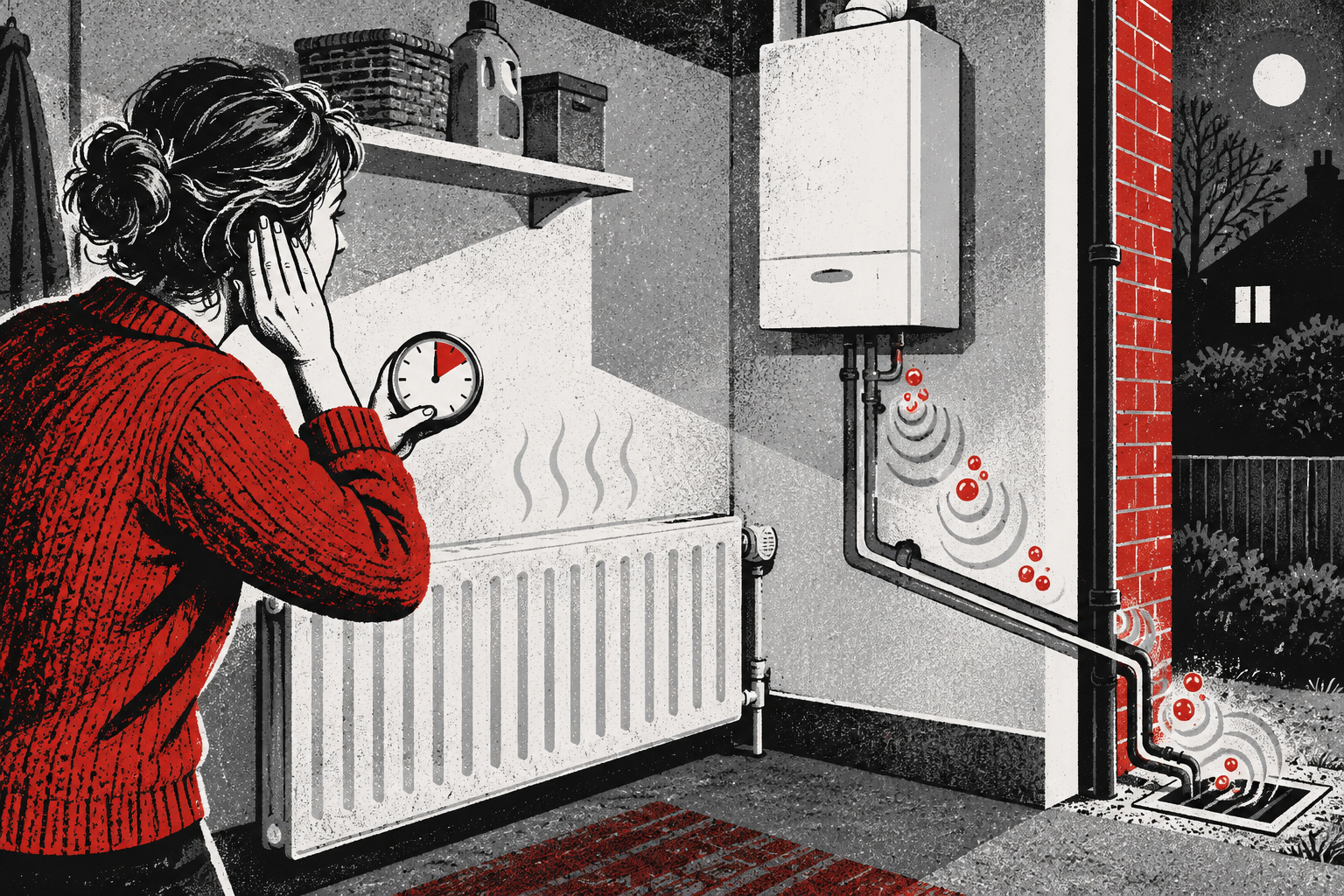
Why does my Worcester Bosch boiler gurgle when the heating turns off?
A brief water-moving sound after heating demand ends can happen while the boiler pump carries residual heat away and condensate continues to drain. A new, loud or prolonged gurgle can instead point to air, restricted circulation or a condensate route that is not draining freely.
The timing matters. Record how long the sound lasts, where it is loudest and what the display and pressure show. Keep the casing closed and do not restart the heating repeatedly to reproduce it.
Why the boiler may keep doing things after “off”
Turning the room thermostat down ends the demand, but the boiler may not become silent immediately. Professional Worcester documentation for some Greenstar ranges shows a pump-overrun period after the burner stops so residual heat can move into the system.
That overrun is model-specific, and its exact duration should not be guessed from another boiler. A steady pump or water-flow sound that fades after a short period is different from bubbling that grows louder, continues for a long time or ends in a fault.
Locate the sound without touching the appliance
Listen from a safe distance near the boiler, an adjacent radiator and any accessible plastic condensate pipe. Note whether the sound seems to come from inside the case, the heating pipes, a radiator, a condensate pump or nearby waste pipework.
Sound travels through walls and cupboards, so use a short recording from two locations. Do not put your ear against the casing or touch pipework that may remain hot after shutdown.
Record the shutdown sequence
Note the time the thermostat stops calling for heat, when the flame symbol disappears, whether a pump or fan sound continues and when the gurgling begins and ends. Include any change on the display.
If the sound begins only after the burner stops but the pump is still running, heat distribution and air movement are more relevant. If it comes from the plastic drain route and is worse in freezing weather, condensate becomes a stronger clue.
Condensate can continue to move after firing
A condensing boiler produces water during operation and drains it through a plastic pipe to a suitable waste point or soakaway. Evidence of water moving through that route can be normal.
A blocked or frozen external section can cause water to back up and create a pronounced gurgling noise. Worcester says a frozen condensate pipe may be accompanied by an EA code on some digital models. Codes and displays vary, so use the exact manual.
Cold-weather check of the external condensate pipe
From ground level, identify the usually plastic pipe leading towards a drain. Look for an exposed frozen section or obvious displacement without disconnecting anything.
Worcester’s homeowner guidance permits warm—not boiling—water along an accessible frozen external pipe when safe. Never climb, dismantle the internal trap or apply a naked flame. If the route is inaccessible or the boiler does not recover as its manual describes, call an engineer.
Air in the heating system can gurgle during overrun
When the pump continues briefly after the burner stops, air moving with the water can become more noticeable. Check whether radiators also gurgle, are cold at the top or warm unevenly.
Worcester’s Greenstar 4000 user guide includes system-gassing troubleshooting, showing that recurring air is a system condition worth investigating. Bleeding one cold-top radiator may release air, but repeated air needs its cause found.
Check the pressure when the system is cool
Let the boiler and radiators cool, then photograph the pressure reading. Worcester’s general guidance for many sealed systems is around 1 to 1.5 bar when cool, while the exact model’s marked range takes priority.
Low pressure after repeated bleeding, a large hot-to-cold change or recurring pressure loss can help an engineer assess the system. Do not top up simply to silence a sound.
Radiator patterns add useful context
Note whether all radiators warm normally before shutdown. A cold top often suggests trapped air; a cold bottom can be linked with sludge or restricted flow; one cold radiator may have a local valve or balancing issue.
If the boiler temperature rises quickly, heating stops in short bursts or several radiators stay cool, the gurgle may be part of a wider circulation problem rather than harmless overrun noise.
Compare heating shutdown with hot-water shutdown
On a combi, listen after one ordinary hot-water draw on a different occasion. If the same sound follows both heating and hot water, the condensate route or a shared boiler process may be more relevant. If it happens only after central heating, system circulation and radiator air deserve closer attention.
Do not run water or heating repeatedly for comparison. One normal event in each mode is enough. Note whether the flame ends cleanly, whether the displayed temperature continues to change and whether any code appears.
Thermal movement can sound different from gurgling
Hot metal pipes and radiators contract as they cool, producing ticks, clicks or creaks. That is different from a liquid bubbling or trickling sound, although both may occur after the thermostat switches off.
Record the character of the noise as well as its location. Regular spaced clicks from a pipe touching floorboards may be expansion movement; irregular liquid sounds within the boiler, radiator or drain route point the investigation elsewhere. Do not lift flooring or loosen pipe clips during a boiler check.
A condensate pump may run after the boiler
Some installations use a separate electric pump because condensate cannot drain by gravity. It can start after enough water collects, which may occur after the burner has stopped.
A brief normal cycle is different from repeated running, alarms, overflow or a changed gurgling sound. Do not open a powered pump or bypass an alarm connection. Record its make and indicator pattern.
Nearby waste pipework can amplify the noise
A condensate connection may discharge into household waste plumbing. Traps, partial restrictions or shared appliance drainage can make noise appear to come from the boiler.
Note whether a sink, washing machine or dishwasher changes the sound. Do not pour drain chemicals into boiler condensate pipework or disconnect a shared connection to test it.
When short overrun sounds may be normal
If the heating works properly, no code appears, pressure is stable and the sound is brief and unchanged, it may be ordinary pump overrun, thermal movement or condensate drainage. Compare it with the normal description in the exact Worcester manual.
Even a familiar sound deserves checking if it suddenly becomes louder, lasts much longer or is paired with performance changes. Record the difference rather than trying to provoke it repeatedly.
Possible professional diagnostic areas
A Gas Safe registered engineer may inspect the condensate route and trap, review fault history, check system pressure and air removal, test pump operation and overrun, compare flow and return temperatures, and assess valves, bypass arrangements and water condition.
A plumber or drainage specialist may be needed if the source is a separate pump or household waste connection. The sound alone cannot confirm a pump, heat exchanger, air vent or blockage fault.
What not to do
- Do not remove the boiler casing or internal condensate trap.
- Do not pour boiling water over frozen pipework.
- Do not climb to reach an external condensate pipe.
- Do not force pump shafts, air vents or valves.
- Do not add chemicals from a guessed diagnosis.
- Do not repeatedly switch the heating on and off to recreate the noise.
When to arrange a repair
Book professional diagnosis when the gurgle is new or worsening, continues well beyond normal overrun, appears with an EA or other code, accompanies pressure loss, causes a leak, or occurs with poor heating or repeated lockout.
Stop using the appliance and seek urgent help if you smell gas, a carbon-monoxide alarm sounds, there is smoke or scorching, or you suspect it is unsafe. HSE says a suspected unsafe gas appliance must not be used until checked by a Gas Safe registered engineer.
What to tell the engineer
- the full Worcester Bosch model;
- where the gurgling is loudest;
- how long after demand ends it starts and stops;
- the exact display symbols or code;
- the cool pressure reading;
- whether radiators contain air or cold areas;
- whether a condensate pump is fitted; and
- whether freezing weather or drainage use changes the sound.
Frequently asked questions
Is it normal for a Worcester boiler to make water noises after heating?
Brief, unchanged pump-overrun or condensate sounds can be normal. Loud, prolonged or fault-linked gurgling needs assessment.
Does an EA code always mean frozen condensate?
No. Worcester says freezing can produce gurgling and EA on some models, but the code has model-specific diagnostic causes. Use the exact manual.
Should I bleed all the radiators?
No. Bleeding is most relevant to a radiator cold at the top or audible air. It is not a universal fix for boiler or condensate noise.
Why does a separate condensate pump run after shutdown?
It may be emptying water collected during the firing cycle. Repeated running, alarm or overflow is not normal and needs checking.
Related boiler help
Has the shutdown gurgle become louder or longer?
Arrange a professional check of the condensate route, pressure and circulation.