
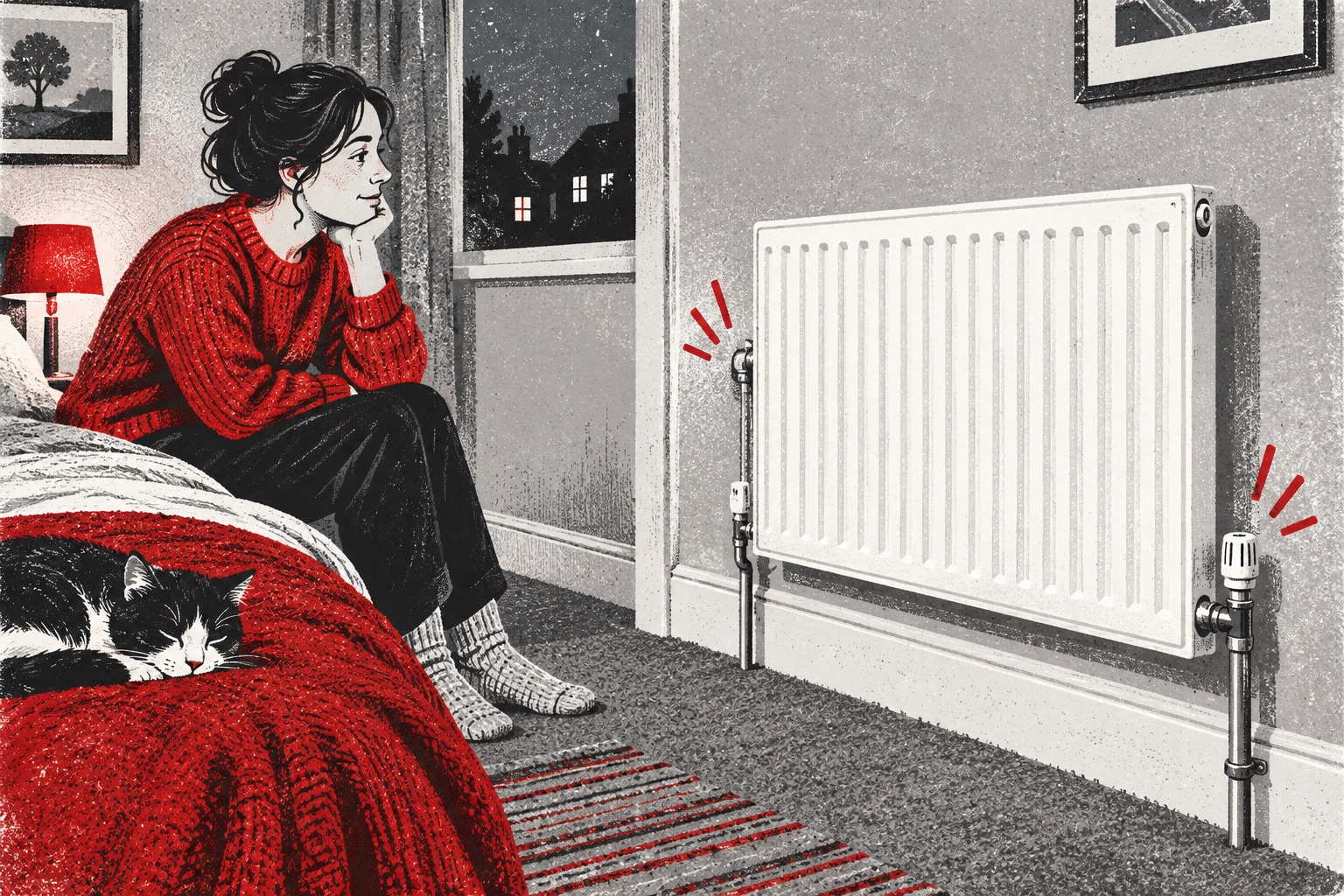
Why does one radiator tick only as it cools down?
A light ticking sound for a few minutes after the heating stops is commonly caused by metal contracting as the radiator and nearby pipes cool. Small movements against brackets, clips, floorboards or wall openings can release in tiny steps and produce a regular tick.
If the radiator heats normally, does not leak and the sound fades as it cools, it is often an ordinary expansion-and-contraction noise rather than a boiler fault.
Why cooling creates a ticking sound
Metal expands slightly when it warms and contracts as its temperature falls. A radiator panel, its connected pipes and the brackets holding it all cool at different rates.
Where one part rests against another, friction can hold the movement briefly and then release it with a click. The sound can travel through a hollow wall, floor or long pipe run, so the loudest point is not always the true source.
Why only one radiator may do it
Each radiator has a different pipe route, bracket position and relationship with its wall and floor. One pipe may pass tightly through a floorboard while the others have more clearance. One bracket may also transmit sound into plasterboard more clearly.
A recently replaced radiator, redecorated wall, new floor covering or moved pipe clip can change where parts touch. Record any recent work, but do not assume it was done incorrectly from a tick alone.
Timing is the best clue
Note when the sound begins. Cooling contraction usually starts after the boiler or heating zone stops and becomes less frequent as the radiator approaches room temperature.
A tick that continues while everything is cold, a bang at the moment a valve closes, a whistle during water flow or gurgling with a cold radiator top suggests a different pattern. A short recording can help a heating professional distinguish them.
Check only what you can see safely
Wait until the radiator is cool. Look for a pipe visibly pressed against flooring, a loose decorative cover, a radiator leaning away from the wall, a missing bracket insert or a fresh rub mark. Do not lift the radiator, loosen its brackets or force a pipe sideways.
A water-filled radiator is heavy, and moving it can strain the valves or pipe joints. Hidden pipes may also sit beside electrical cables or other services, so lifting floorboards is not a simple noise check.
Is trapped air likely?
Trapped air more often causes gurgling or leaves the top of a radiator cooler than the bottom. A radiator that is evenly warm, then gives a light tick only as it cools, points more strongly towards contraction.
Do not repeatedly bleed a radiator that heats evenly. Bleeding releases water or air from the system and can lower boiler pressure. If the radiator is cold at the top, follow the appliance and radiator guidance or ask a competent heating professional.
Could the thermostatic valve be involved?
A thermostatic radiator valve, or TRV, changes water flow as the room warms. Flow noise tends to occur while water is moving or as a valve opens and closes, rather than only during the quiet cooling period.
Note whether changing room temperature and valve movement coincide with the sound, but do not remove the valve head, adjust the lockshield or change pump settings as a test. Those changes can affect the balance of the whole system.
When ticking is usually harmless
Occasional light ticks that start after heating stops, gradually spread out and finish when the radiator is cool are a common characteristic of metal heating systems. British Gas describes ticking during warm-up or cool-down as normal and notes that under-floor sounds can come from pipes moving against joists or flooring.
You may decide no action is needed if the sound is mild and unchanged. If it is disturbing sleep or becoming louder, a plumber or heating engineer can inspect the supports and visible pipe route without treating it as an emergency.
Warning signs that need attention
Arrange a prompt check if ticking becomes loud banging, the radiator moves on its brackets, a pipe or valve leaks, boiler pressure falls, a fault code appears, or the radiator develops a marked cold area. Stop the heating and keep people away if the radiator seems insecure or hot water is escaping.
If the sound comes from inside the boiler rather than the radiator or pipe route, do not remove the casing. Work affecting a gas appliance must be carried out by a suitably qualified Gas Safe registered engineer.
What to tell the professional
- Which radiator and where the tick sounds loudest.
- How long after switch-off it begins and how long it lasts.
- Whether it also occurs during warm-up.
- Whether the radiator heats evenly.
- Any recent radiator, flooring or decorating work.
- Any leak, movement, pressure change or boiler fault.
Related Incredaboil guidance
If the movement seems to travel through the building, read why a radiator can vibrate a wall or floor. If the noise follows the burner stopping, see our guide to boiler and pipe cooling sounds.
Cooling tick becoming louder or disruptive?
Record the timing and have the supports and pipe route checked safely.