
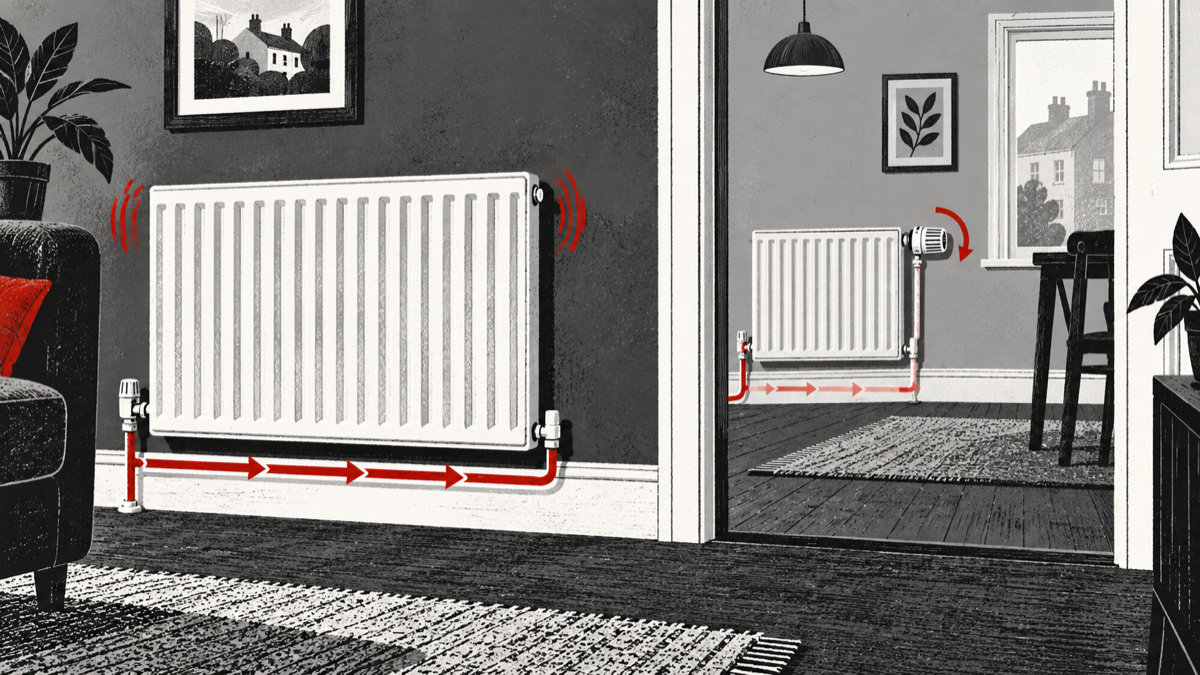
Why does one radiator vibrate when another valve closes?
Closing one radiator valve changes the route available to heating water. If the pump is still circulating, flow and pressure can rise across the remaining open valves. A loose pipe, radiator support or valve can then buzz, chatter or vibrate even though somebody touched a different radiator.
The timing is a valuable clue, but it does not identify the faulty part by itself. Record which valve closes, which radiator vibrates and whether the noise stops when demand changes. Leave pump, bypass, lockshield and pipe adjustments to a heating engineer.
The short answer
Water in a central-heating system follows every open path. When a thermostatic radiator valve, manual valve or motorised zone valve closes, less flow may be available through that path. The pump and other open radiators then see a different hydraulic condition.
If one valve or pipe is sensitive to that change, it can start to vibrate. Common areas for an engineer to assess include a thermostatic radiator valve, excessive differential pressure, pump settings, the automatic bypass, system balancing, pipe restraint and radiator brackets.
Why closing one valve affects another radiator
A thermostatic radiator valve, often called a TRV, limits water flowing through its radiator as the room approaches the selected temperature. Several TRVs can open and close at different times through the day.
Resideo explains that automatic bypass valves are used to control pressure and maintain flow as radiator or zone valves close. Its technical material also links increased differential pressure with system noise. Danfoss similarly describes differential pressure across radiator valves as important to stable, quiet operation.
This does not mean every system needs the same valve or setting. Some boilers have an internal bypass, some systems have an external one, and pump control varies widely. Diagnosis must be based on the installed equipment rather than a generic adjustment.
Could the vibrating radiator valve be chattering?
Yes. A valve can oscillate quickly when water forces and its internal control are unstable. This may sound like a buzz, machine-like rattle or rapid knocking and can be transmitted through the radiator and wall.
A non-bidirectional thermostatic valve installed against its intended flow direction can be more prone to noise when nearly closed. Some modern valves are designed for flow in either direction, so the arrow and exact product matter. Do not remove the valve head or loosen the body to investigate; water can be hot and pressurised.
Tell the engineer whether the vibrating radiator has a numbered thermostatic head, an ordinary manual knob or no user-operated valve at that end. A photo taken from a safe position is more useful than trying to identify the model from memory.
Could pump pressure be too high?
It is one possibility. When fewer routes remain open, a pump can create a larger pressure difference across the active part of the system. Excessive water velocity may produce whistle, hiss, valve chatter or vibration.
Many modern pumps vary their output, and boilers may control an internal pump automatically. The right setting depends on the boiler, system resistance, number of zones, design flow and whether an automatic bypass is present. Changing pump speed without assessing those factors can reduce circulation or hide the underlying issue.
What does system balancing have to do with it?
Balancing sets the intended flow through each radiator so heat is distributed sensibly. Resideo notes that an imbalanced system can cause uneven radiator performance and that calculated flow settings are used to correct it.
If one radiator receives more flow than it needs, a change elsewhere can make noise more obvious. But vibration alone does not prove poor balancing. A sticking valve, loose bracket, pipe touching timber or an unsuitable pump or bypass condition can produce a similar symptom.
Do not copy another radiator’s lockshield position or count turns as an online fix. Those settings interact across the whole system and should be assessed together.
Could it simply be a loose pipe or bracket?
Yes. A small hydraulic vibration can become much louder when a pipe touches a floorboard, wall opening or clip. A radiator that is not seated firmly on its brackets can also transmit movement into the building.
Look from a safe distance for visible movement, a loose cover or a pipe touching a hard surface. Do not push, lift or tighten a hot, water-filled radiator. Our guide to a radiator vibrating against the wall or floor explains how sound can travel through supports and pipework.
A safe observation check
- Identify the radiator that vibrates and the separate valve that closes just before it starts.
- Note whether the closing device is a TRV, manual radiator valve or motorised zone valve.
- Record the thermostatic settings without changing several valves.
- Note whether the boiler is firing and whether its display or pressure reading is normal.
- Describe the sound: buzz, whistle, chatter, rattle, knock or vibration through the wall or floor.
- Record how long it lasts and what ordinary event stops it.
- Note whether rooms still warm normally and whether any radiator stays cold.
One clear example is enough. Do not repeatedly close valves to provoke severe vibration, particularly if pipes move or the radiator feels insecure.
Does bleeding the radiator help?
Not usually when the defining symptom is vibration caused by another valve closing. Trapped air more commonly causes gurgling and a radiator that stays cooler at the top.
If the radiator heats evenly, repeated bleeding is unlikely to solve a pressure- or flow-related vibration and can lower sealed-system pressure. Do not release water from a hot radiator simply as a noise test.
When does it need an engineer?
Arrange a heating-system assessment if the vibration is repeatable, becoming louder, affects several radiators or begins after a pump, boiler, valve or zoning change. Also book help if a radiator no longer heats properly, valves whistle or chatter, or the boiler starts cycling or showing a fault.
An engineer can check the valve type and flow direction, differential pressure, pump control, automatic bypass operation, balancing, radiator supports and pipe contact. These checks work together; changing one component in isolation may move the noise elsewhere.
Work on a gas boiler must be carried out by a suitably qualified Gas Safe registered engineer. A competent heating professional can assess the water side and controls according to the installation.
When should you stop using the heating?
Turn the heating off with its normal user control and seek prompt help if the radiator moves on its brackets, a pipe is visibly shaking, water leaks, system pressure falls, the vibration becomes severe or there are loud bangs followed by a fault.
Keep people away from a radiator that may be insecure. Water near electrical fittings, a burning smell, smoke or repeated electrical tripping requires urgent attention. If you smell gas or a carbon-monoxide alarm sounds, follow emergency gas advice instead of continuing the test.
What not to adjust
Do not change the boiler pump speed, automatic bypass setting or installer parameters. Do not remove a thermostatic head, reverse a valve, alter lockshields throughout the house or loosen pipe clips while the system is hot.
These changes can affect boiler flow, minimum circulation and every radiator. Good notes about timing and valve positions give an engineer a safer starting point than a system whose settings have all been changed.
The practical conclusion
A radiator that vibrates when another valve closes is responding to a change in system flow or pressure. The sound may come from the radiator valve, but the pump, bypass, balancing, pipework and supports all influence what happens. Record the paired event, leave hydraulic adjustments alone and arrange a whole-system check if it keeps happening.
Radiators reacting to valve changes?
Record the sequence and have the system flow checked.